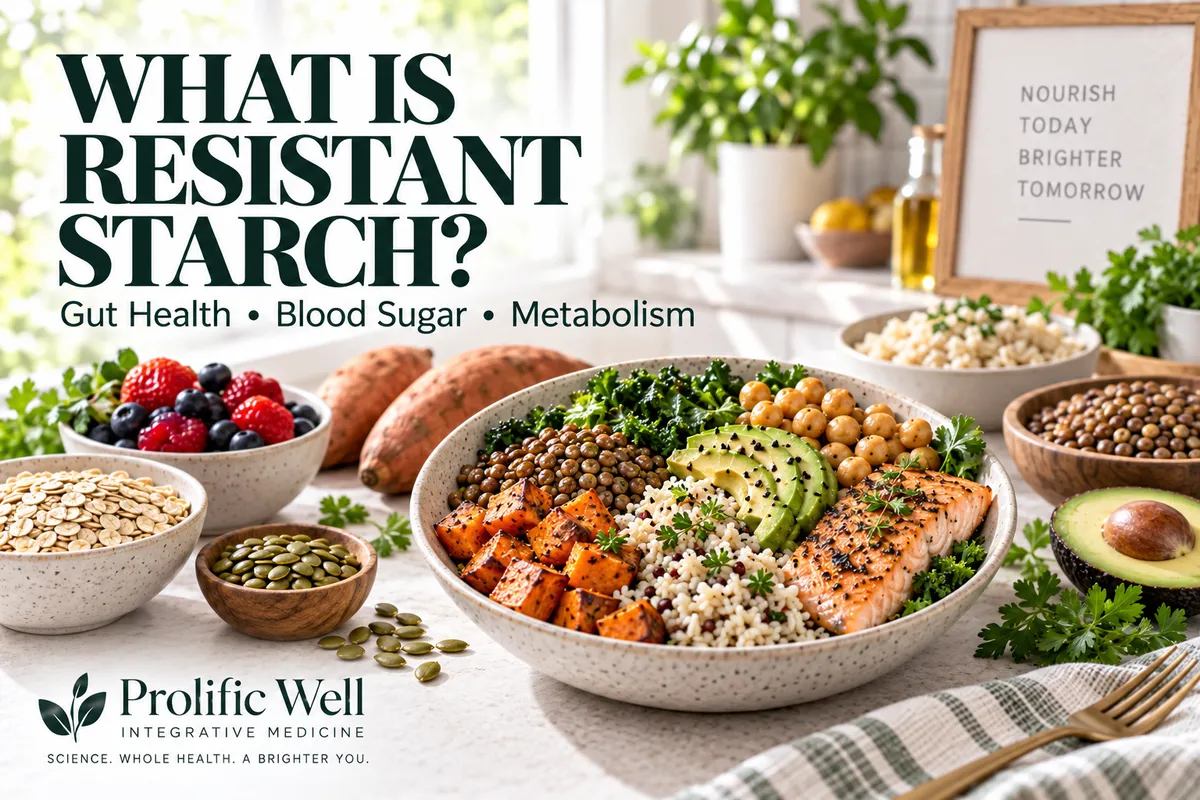
What Is Resistant Starch? Benefits for Gut Health, Blood Sugar & Metabolism
What Is Resistant Starch?
Most people think starch is starch.
You eat rice, potatoes, oats, or beans.
Your digestive system breaks the starch down into glucose.
Your blood sugar rises.
End of story.
Except digestion is more interesting than that.
Some starch does not get fully digested in your small intestine.
Instead, it travels farther through the digestive tract and reaches your colon, where your gut bacteria can ferment it.
That starch is called resistant starch.
And it creates an interesting connection between:
carbohydrates + blood sugar + gut bacteria + metabolism.
This is one reason I do not like labeling foods simply as:
“carbs.”
Two carbohydrate foods can behave very differently depending on their fiber content, starch structure, preparation, portion, and what you eat with them.
If you have not read the earlier articles in this series, start with Are Carbs Bad for You? and How to Eat Carbs Without Spiking Your Blood Sugar. They provide the foundation for understanding why carbohydrate quality matters.
Quick Answer: What Is Resistant Starch?
Resistant starch is a type of starch that resists digestion in the small intestine and reaches the large intestine, where gut bacteria can ferment it.
In that sense, it behaves more like fermentable fiber than rapidly digestible starch.
Foods that may contain resistant starch include:
beans
lentils
peas
oats
certain whole grains
green or underripe bananas
cooked and cooled potatoes
cooked and cooled rice
cooked and cooled pasta
The amount of resistant starch varies substantially depending on the food variety, processing, cooking method, temperature, and storage.
That last point is important.
The same food may not contain exactly the same starch structure depending on how you prepare it.
Why Is It Called “Resistant” Starch?
Most starch is broken down by digestive enzymes in your small intestine.
Those starch molecules eventually contribute glucose that can enter your bloodstream.
Resistant starch is different.
Part of the starch structure is less accessible to your digestive enzymes.
So rather than being completely absorbed in the small intestine, some continues into the colon.
There, bacteria can ferment it.
This distinction is why resistant starch has attracted interest in:
gut microbiome research
blood sugar regulation
insulin sensitivity
satiety
metabolic health
But resistant starch is not a magic carbohydrate.
It is one piece of a larger nutritional pattern.
Is Resistant Starch a Fiber?
Not exactly, but physiologically it shares some properties with dietary fiber.
Because resistant starch escapes digestion in the small intestine and can be fermented by bacteria in the colon, it is often discussed alongside fermentable fibers.
This matters because your colon is not simply the end of your digestive system.
It is home to a complex microbial ecosystem.
For a broader introduction to that ecosystem, read:
Unlocking the Secrets of the Microbiome: How Gut Health Transforms Your Well-being
And for practical ways to increase food diversity, read:
Heal Your Gut, Boost Your Hormones, and Regain Energy Through Food Diversity
Resistant Starch and Your Gut Microbiome
This is where resistant starch becomes especially interesting.
When resistant starch reaches your colon, certain gut bacteria can ferment it.
That fermentation can produce short-chain fatty acids, including:
butyrate
acetate
propionate
A 2024 review described resistant starch as an important substrate for gut microbial fermentation and highlighted the production of these short-chain fatty acids, particularly butyrate, as one of the major proposed mechanisms connecting resistant starch with gut and metabolic health.
Butyrate is particularly interesting because cells lining the colon can use it as an energy source.
This is one reason I often tell patients that gut health is not only about taking probiotics.
You also have to consider:
What are you feeding the organisms already living there?
Is Resistant Starch a Prebiotic?
It can have prebiotic-like effects because certain gut bacteria can use it as a substrate.
But different people have different microbiomes.
That means two people may not respond to the same resistant starch food identically.
The microbiome is influenced by:
diet
medications
antibiotics
age
geography
lifestyle
gastrointestinal disease
long-term eating patterns
This is why increasing fermentable food dramatically overnight can sometimes backfire.
More is not automatically better.
What Foods Are High in Resistant Starch?
Several categories of foods can provide resistant starch.
Beans and Lentils
Legumes are particularly interesting because they provide:
carbohydrate
protein
fiber
resistant starch
minerals
plant compounds
Examples include:
lentils
black beans
chickpeas
kidney beans
peas
This is one reason beans should not simply be labeled as “high-carb foods.”
Their nutrient profile is much more complex.
Oats and Whole Grains
Oats and certain minimally processed grains can contribute resistant starch along with other fibers.
Oats also contain beta-glucan, another type of soluble fiber.
Try building oatmeal as a complete meal rather than making it primarily sugar.
For example:
oats + Greek yogurt + berries + chia seeds + walnuts
instead of:
oats + syrup + brown sugar
If you are working on better meal composition overall, read The Prolific Well Guide to Eating for Energy, Metabolism, Hormones, and Longevity.
Green Bananas
Less-ripe bananas contain more resistant starch than very ripe bananas.
As bananas ripen, some starch is converted into simpler sugars.
That does not mean ripe bananas are “bad.”
It simply illustrates that food chemistry changes as food matures.
Nutrition is rarely as static as a nutrition label makes it appear.
Potatoes
Potatoes contain starch.
When they are cooked and then cooled, some of that starch can reorganize into a structure that is more resistant to digestion.
This process is called retrogradation.
That brings us to one of the most interesting practical nutrition questions.
Does Cooling Starch Really Change It?
Yes.
When some starch-rich foods are cooked and then cooled, portions of the starch molecules reorganize.
This can increase a type of resistant starch known as retrograded starch.
Examples may include:
rice
potatoes
pasta
This does not mean refrigeration suddenly transforms these foods into low-carbohydrate foods.
The majority of the carbohydrate may still be digestible.
But the starch structure can change.
And sometimes that change is enough to alter the glucose response.
Does Cooling Rice Increase Resistant Starch?
Yes, research suggests it can.
One randomized crossover study examined freshly cooked white rice versus rice cooled for 24 hours at 4°C and then reheated.
The cooled-and-reheated rice contained more resistant starch:
Fresh rice: 0.64 g resistant starch per 100 g
versus
Cooled and reheated rice: 1.65 g per 100 g
The cooled rice also produced a lower glycemic response in the small group of healthy adults studied.
That is interesting.
But notice what it does not mean.
It does not mean:
“Refrigerate rice and eat unlimited amounts.”
The rice still contains carbohydrate.
Portion still matters.
Meal composition still matters.
Your individual metabolic health still matters.
Does Reheating Rice Destroy the Resistant Starch?
Not necessarily.
The study above specifically tested rice that had been refrigerated and reheated, and the resistant starch remained higher than in freshly cooked rice.
That makes this particularly practical.
You do not necessarily have to eat cold leftover rice.
A reasonable strategy can be:
cook → cool safely → refrigerate → reheat thoroughly
But food safety matters enormously with rice.
Cooked rice should not be left sitting at room temperature for extended periods because Bacillus cereus spores can survive cooking and proliferate if rice is stored improperly.
So if you are using this strategy, refrigerate cooked rice promptly and reheat it appropriately.
Metabolic optimization should never come at the expense of food safety.
Does Cooled Rice Lower Blood Sugar?
There is some evidence that it can produce a smaller post-meal glucose response than freshly cooked rice.
A study involving people with type 1 diabetes compared freshly prepared rice with rice that had been refrigerated for 24 hours and reheated.
The cooled rice produced lower post-meal glucose measures.
However, it also increased the number of hypoglycemic episodes when participants used their standard insulin dose.
That second finding is important.
If someone uses insulin, changing the carbohydrate digestibility of a meal can potentially change insulin requirements.
This is exactly why nutrition advice needs context.
If You Take Insulin, Be Careful With This Strategy
If you use insulin and routinely dose based on carbohydrate intake, do not assume cooled rice behaves identically to freshly cooked rice.
In the type 1 diabetes study, cooled rice reduced post-meal glucose but also increased hypoglycemia when participants used their standard insulin dose.
If you have diabetes and use insulin or medications that can cause hypoglycemia, discuss significant dietary changes with your treating clinician.
Do not chase lower glucose at the expense of safety.
What About High-Resistant-Starch Rice?
Researchers have also studied rice varieties that naturally contain higher levels of resistant starch.
Randomized trials have found lower post-meal glucose responses after high-resistant-starch rice compared with conventional rice in healthy adults and people with type 2 diabetes.
Again, I would not interpret this as:
“Rice is now a metabolic treatment.”
The more useful conclusion is:
The structure and type of carbohydrate can influence how your body handles it.
That is much more scientifically accurate.
Does All Cooled Rice Have the Same Effect?
No.
Rice variety matters.
Cooking method matters.
Cooling time matters.
A study comparing multiple rice varieties and cooking methods found substantial differences in resistant starch content between preparations. Interestingly, although refrigerated rice differed in resistant starch content, the high- and lower-resistant-starch rice preparations did not significantly differ in glycemic index in that small trial.
That is a useful reminder:
Nutrition science rarely gives us a simple hack that works identically every time.
What About Cooled Potatoes?
The same general principle of starch retrogradation can occur in potatoes.
Cooking gelatinizes starch.
Cooling allows some of those starch chains to reorganize into less digestible forms.
That means foods such as:
potato salad
cooked-and-cooled potatoes
potatoes cooked ahead and reheated
may contain more resistant starch than freshly cooked hot potatoes.
But again:
resistant starch does not erase carbohydrate.
Think enhancement, not loophole.
Can You Reheat Potatoes Too?
Some retrograded resistant starch can remain after reheating.
The exact amount depends on:
potato variety
cooking method
cooling time
reheating temperature
The larger principle is more useful than chasing an exact number.
Preparation influences starch structure.
Resistant Starch and Blood Sugar
Resistant starch is less readily digested into glucose than rapidly digestible starch.
That means replacing some digestible starch with resistant starch can potentially reduce the amount or speed of glucose entering circulation after a meal.
But the glucose response to your entire meal still depends on:
total carbohydrate
portion size
protein
fiber
fat
activity
insulin sensitivity
medications
sleep
individual physiology
That is why resistant starch fits into the framework I teach in How to Eat Carbs Without Spiking Your Blood Sugar.
It is one tool.
Not the entire strategy.
Resistant Starch and Insulin Resistance
This is an active area of research.
Some studies suggest resistant starch may improve certain measures of insulin sensitivity or post-meal metabolic response in specific populations.
But results vary depending on:
resistant starch type
amount
study duration
population
baseline metabolic health
overall diet
I would therefore avoid claims such as:
“Resistant starch reverses insulin resistance.”
That is much stronger than the evidence supports.
Instead:
Resistant starch is one dietary strategy that may support metabolic health when included within an overall nutrient-dense dietary pattern.
That is a much more responsible way to think about it.
Resistant Starch Is Not the Same as “Low Carb”
This distinction is important.
A bowl of cooled rice is still primarily a carbohydrate-containing food.
A potato is still a carbohydrate-containing food.
Beans contain significant carbohydrate too.
Resistant starch changes how some of that carbohydrate is digested.
It does not turn the food into protein or fat.
If you are struggling with the broader carbohydrate conversation, read:
Are Carbs Bad for You?
That article explains why carbohydrate quality, portion, preparation, and meal composition matter more than labeling every carbohydrate as good or bad.
Resistant Starch and Your Gut
This may ultimately be one of its most interesting roles.
Once resistant starch reaches the colon, bacterial fermentation can produce short-chain fatty acids.
A 2024 review highlighted butyrate, acetate, and propionate among the important fermentation products associated with resistant starch metabolism.
These microbial metabolites participate in communication between:
gut microbes
intestinal cells
immune pathways
metabolism
This is why I think of food as more than simply:
protein + carbs + fat.
Food is also information for your microbiome.
What Is Butyrate?
Butyrate is one of the major short-chain fatty acids produced when certain gut bacteria ferment dietary substrates.
It can serve as an important energy source for colon cells.
It is also being studied for roles in:
intestinal barrier function
immune regulation
inflammation
metabolic signaling
This is another reason plant diversity matters.
Your gut microbiome needs substrates.
For a deeper discussion of building that diversity, read Heal Your Gut, Boost Your Hormones, and Regain Energy Through Food Diversity. My existing guide discusses vegetables, fruit, fermented foods, prebiotic foods, legumes, whole grains, nuts, seeds, and protein diversity as part of a broader gut-supportive eating pattern.
Can Resistant Starch Help Constipation?
Possibly for some people, but it is not a universal constipation treatment.
Resistant starch can increase fermentable substrate reaching the colon.
That can influence stool characteristics and microbial activity.
But constipation has many possible causes, including:
inadequate fluid
insufficient total fiber
medications
thyroid dysfunction
pelvic-floor dysfunction
low activity
IBS
neurological conditions
gastrointestinal disease
If constipation is persistent, worsening, or accompanied by pain, bleeding, unexplained weight loss, or other concerning symptoms, it deserves evaluation rather than simply adding more resistant starch.
Can Resistant Starch Cause Gas and Bloating?
Yes.
And this is important for your gut-health audience.
Because resistant starch is fermented by gut bacteria, increasing it quickly can sometimes cause:
gas
bloating
abdominal pressure
changes in bowel movements
That does not necessarily mean resistant starch is “bad” for you.
It may simply mean:
too much, too fast.
For people with significant IBS, SIBO-like symptoms, or other digestive disorders, tolerance can vary considerably.
Start slowly.
Listen to your body.
And do not assume every supposedly gut-healthy food is appropriate for every gut.
More Prebiotic Food Is Not Always Better
This is a principle I wish more people understood.
A person with a relatively stable digestive system may tolerate:
beans
lentils
onions
garlic
resistant starch
fermented foods
very well.
Another person with severe bloating and altered motility may feel terrible after suddenly doubling all of them.
Integrative nutrition should not become another rigid ideology.
We want the right strategy for the right person at the right time.
If persistent digestive symptoms are part of your picture, start with Unlocking the Secrets of the Microbiome: How Gut Health Transforms Your Well-being.
Resistant Starch and Hormone Health
I would be careful with claims that resistant starch directly “balances hormones.”
That oversimplifies physiology.
The more plausible relationship is indirect.
Nutrition can influence:
metabolic health
insulin signaling
gut microbial activity
bowel function
body composition
All of those systems can interact with hormonal physiology.
For people dealing with fatigue, weight changes, blood-sugar issues, thyroid concerns, or hormone symptoms, read How Integrative & Functional Medicine Uncover the Root Cause of Hormone Imbalance and Chronic Fatigue.
That article explains why hormones, metabolism, gut function, nutrient status, and stress physiology should not be treated as completely separate systems.
Resistant Starch and Midlife Metabolism
This conversation becomes particularly relevant in midlife.
Many adults over 40 begin experiencing some combination of:
declining muscle mass
increased visceral fat
worsening insulin sensitivity
less activity
poorer sleep
hormone changes
Resistant starch is not going to solve those problems by itself.
The larger foundation remains:
protein + strength training + fiber-rich foods + appropriate carbohydrates + healthy fats + sleep + movement.
If you are over 40, read:
Why Protein Matters More After 40
and
How Much Protein Do You Really Need?
Preserving muscle is one of the strongest metabolic investments you can make as you age.
Does Resistant Starch Help With Weight Loss?
I would not market resistant starch as a weight-loss intervention.
Some studies suggest resistant starch may affect satiety, glucose response, or metabolic signaling.
But body-weight regulation remains much more complicated.
Weight is influenced by:
total energy intake
food quality
physical activity
muscle
sleep
medications
hormones
appetite signaling
genetics
environment
Use resistant starch because it can contribute to a diverse, fiber-rich nutritional pattern.
Not because someone promised it would melt abdominal fat.
Do You Need a Resistant Starch Supplement?
Usually, no.
Resistant starch supplements exist, including products derived from:
raw potato starch
green banana starch
high-amylose maize starch
They are commonly used in research because investigators can control dosage.
But for most people starting with nutrition, I prefer food first.
Foods provide resistant starch alongside:
vitamins
minerals
other fibers
protein
phytochemicals
Depending on the food.
Supplements may have a role in selected circumstances, but they are not required to benefit from resistant-starch-containing foods.
A Practical Way to Add Resistant Starch
You do not have to overhaul your diet.
Try one change.
Breakfast
Oats + Greek yogurt + berries + chia seeds
Lunch
Lentil salad + greens + salmon or tofu + olive oil
Dinner
Chicken or fish + vegetables + cooked-and-cooled/reheated rice
Another Dinner
Beans + vegetables + cooled/reheated potato + avocado
Notice something important.
The resistant starch food is not the entire meal.
It lives inside a balanced meal.
That is the point.
What Does a Resistant-Starch-Friendly Meal Look Like?
Use this framework:
1. Protein
Examples:
fish
chicken
eggs
tofu
tempeh
Greek yogurt
beans or lentils
2. Vegetables
Aim for color and variety.
3. Resistant-starch-containing carbohydrate
Examples:
lentils
beans
oats
cooled rice
cooled potatoes
4. Healthy fat
Examples:
avocado
olive oil
nuts
seeds
5. Movement
Consider a short walk afterward.
That brings together the principles from:
The Prolific Well Guide to Eating for Energy, Metabolism, Hormones, and Longevity
How to Eat Carbs Without Spiking Your Blood Sugar
and
Why Protein Matters More After 40
My Take on the “Leftover Rice Hack”
You will probably see social-media posts saying:
“Refrigerate your rice and it won't spike your blood sugar.”
That goes too far.
There is legitimate physiology behind cooking and cooling starch.
And human studies do show that cooled-and-reheated rice can contain more resistant starch and, in some settings, produce a smaller glucose response.
But:
cooling rice does not eliminate its carbohydrate.
It does not give you permission to ignore portion size.
It does not replace protein, vegetables, activity, sleep, or metabolic treatment.
Use the science.
Skip the exaggeration.
Five Ways to Get More Resistant Starch From Food
1. Eat beans and lentils regularly
Add them to:
soups
salads
bowls
chili
side dishes
2. Try oats
Build them with protein and healthy fats.
3. Cook potatoes ahead
Cool them appropriately and use them later in meals.
4. Cook rice ahead
Refrigerate promptly and reheat safely.
5. Increase gradually
If your gut is sensitive, do not suddenly triple your fermentable fiber intake.
Your microbiome may need time to adapt.
Frequently Asked Questions
What is resistant starch?
Resistant starch is starch that is not completely digested in the small intestine. Some reaches the colon, where gut bacteria can ferment it.
What foods contain resistant starch?
Sources can include beans, lentils, peas, oats, some whole grains, underripe bananas, and certain cooked-and-cooled starches such as rice and potatoes.
Is resistant starch good for gut health?
It can provide fermentable substrate for gut bacteria and contribute to short-chain fatty acid production, including butyrate.
Is resistant starch a prebiotic?
It can have prebiotic-like effects because certain gut microbes ferment it.
Does resistant starch lower blood sugar?
Some resistant-starch-containing foods and preparations can produce smaller post-meal glucose responses than more rapidly digestible versions, but effects vary by food and individual.
Does cooling rice increase resistant starch?
Yes. Human studies have shown that cooking, refrigerating, and reheating rice can increase resistant starch content compared with freshly cooked rice.
Can you reheat resistant starch?
Some resistant starch created during cooling can remain after reheating. The amount varies with food and preparation.
Does cooled rice have fewer carbs?
Not meaningfully in the way people usually mean “low carb.” Some starch becomes more resistant to digestion, but rice remains a carbohydrate-rich food.
Are cold potatoes healthier than hot potatoes?
Cooling potatoes may increase resistant starch, but “healthier” depends on your entire dietary pattern, portion, preparation, and individual needs.
Can resistant starch cause gas?
Yes. Because gut bacteria ferment it, resistant starch may cause gas or bloating, especially when intake increases rapidly.
Should people with diabetes eat resistant starch?
Potentially, but diabetes nutrition should be individualized. People using insulin or medications that cause hypoglycemia should be especially careful because changes in carbohydrate digestibility can affect glucose patterns and medication requirements.
The Bottom Line
Resistant starch is one of the best examples of why nutrition cannot be reduced to:
carbs = good
or
carbs = bad.
Food structure matters.
Preparation matters.
Your gut microbiome matters.
Your blood sugar response matters.
And your entire meal matters.
Cooking and cooling certain starch-rich foods can increase the amount of starch that escapes digestion in the small intestine.
That resistant starch can then become fuel for certain gut bacteria.
It may also produce a smaller post-meal glucose response in some circumstances.
Interesting?
Absolutely.
Magic?
No.
I want you to use resistant starch as one more tool in a bigger strategy:
Eat diverse whole foods.
Prioritize protein.
Feed your gut.
Choose carbohydrates thoughtfully.
Build muscle.
Move after meals.
And understand how your own body responds.
That is much more powerful than another nutrition hack.
Read Next
Continue the Prolific Well Nutrition Series:
The Prolific Well Guide to Eating for Energy, Metabolism, Hormones, and Longevity
How Much Protein Do You Really Need?
Why Protein Matters More After 40
Are Carbs Bad for You?
How to Eat Carbs Without Spiking Your Blood Sugar
Coming next: Does Cooling Rice Really Lower Its Blood Sugar Impact?
You may also find these existing Prolific Well articles helpful:
Heal Your Gut, Boost Your Hormones, and Regain Energy Through Food Diversity
Unlocking the Secrets of the Microbiome: How Gut Health Transforms Your Well-being
Explore Prolific Well Metabolic Health Services for information on insulin resistance, high blood sugar, diabetes, weight changes, muscle loss, fatigue, and related metabolic concerns.
A More Personalized Approach
If you are dealing with:
insulin resistance
prediabetes
diabetes
post-meal glucose spikes
bloating
constipation
IBS-like symptoms
weight resistance
midlife metabolic changes
simply adding resistant starch may not address the entire problem.
At Prolific Well Integrative Medicine, I look at nutrition within the larger physiology of:
blood sugar regulation
insulin sensitivity
muscle mass
hormones
thyroid function
gut microbiome
bowel function
sleep
stress
nutrient status
medications
physical activity
The goal is not to chase one perfect food.
The goal is to understand how your food, gut, metabolism, and lifestyle work together.
That is how nutrition becomes useful.
References
Chen Z, Liang N, Zhang H, et al. Resistant starch and the gut microbiome: Exploring beneficial interactions and dietary impacts. Food Chemistry: X. 2024;21:101118. This review explains how resistant starch reaches the colon, is fermented by gut bacteria, and contributes to production of short-chain fatty acids such as butyrate, acetate, and propionate.
View study on PubMedFeng H, Cheng B, Lim J, et al. Advancements in enhancing resistant starch type 3 content in starchy food and its impact on gut microbiota: A review. Comprehensive Reviews in Food Science and Food Safety. 2024;23(3):e13355. This review focuses on resistant starch type 3, including retrograded starch formed when cooked starches cool, and its interaction with the gut microbiota.
View study on PubMedSonia S, Witjaksono F, Ridwan R. Effect of cooling of cooked white rice on resistant starch content and glycemic response. Asia Pacific Journal of Clinical Nutrition. 2015;24(4):620-625. Refrigerated and reheated white rice contained more resistant starch than freshly cooked rice and produced a lower glycemic response in the small group of healthy adults studied.
View study on PubMedXiong K, Wang J, Kang T, Xu F, Ma A. Effects of resistant starch on glycaemic control: a systematic review and meta-analysis. British Journal of Nutrition. 2021;125(11):1260-1269. This meta-analysis of 19 randomized controlled trials found modest improvements in fasting glucose and HOMA-IR with resistant starch interventions, with effects varying by dose and intervention duration.
View study on PubMedSnelson M, Jong J, Manolas D, et al. A comparison of the effects of resistant starch types on glycemic response in individuals with type 2 diabetes or prediabetes: A systematic review and meta-analysis. 2023. This review found that different resistant starch types can affect fasting and post-meal glucose differently and concluded that more research is needed, particularly for resistant starch type 3.
View study on PubMedSanders LM, Dicklin MR, Palacios OM, et al. Effects of potato resistant starch intake on insulin sensitivity, related metabolic markers and appetite ratings in men and women at risk for type 2 diabetes: a pilot cross-over randomised controlled trial. Journal of Human Nutrition and Dietetics. 2021;34(2). This trial evaluated potato-derived resistant starch in adults at increased risk for type 2 diabetes and highlights that metabolic responses may vary between individuals.
View study on PubMedMaki KC, Pelkman CL, Finocchiaro ET, et al. Effect of 12 weeks of resistant starch supplementation on cardiometabolic risk factors in adults with prediabetes: a randomized controlled trial. American Journal of Clinical Nutrition. 2018. This study found no significant improvement in insulin sensitivity or most glycemic outcomes despite modest changes in several secondary measures, illustrating why resistant starch should not be presented as a universal treatment for insulin resistance.
View study on PubMed


