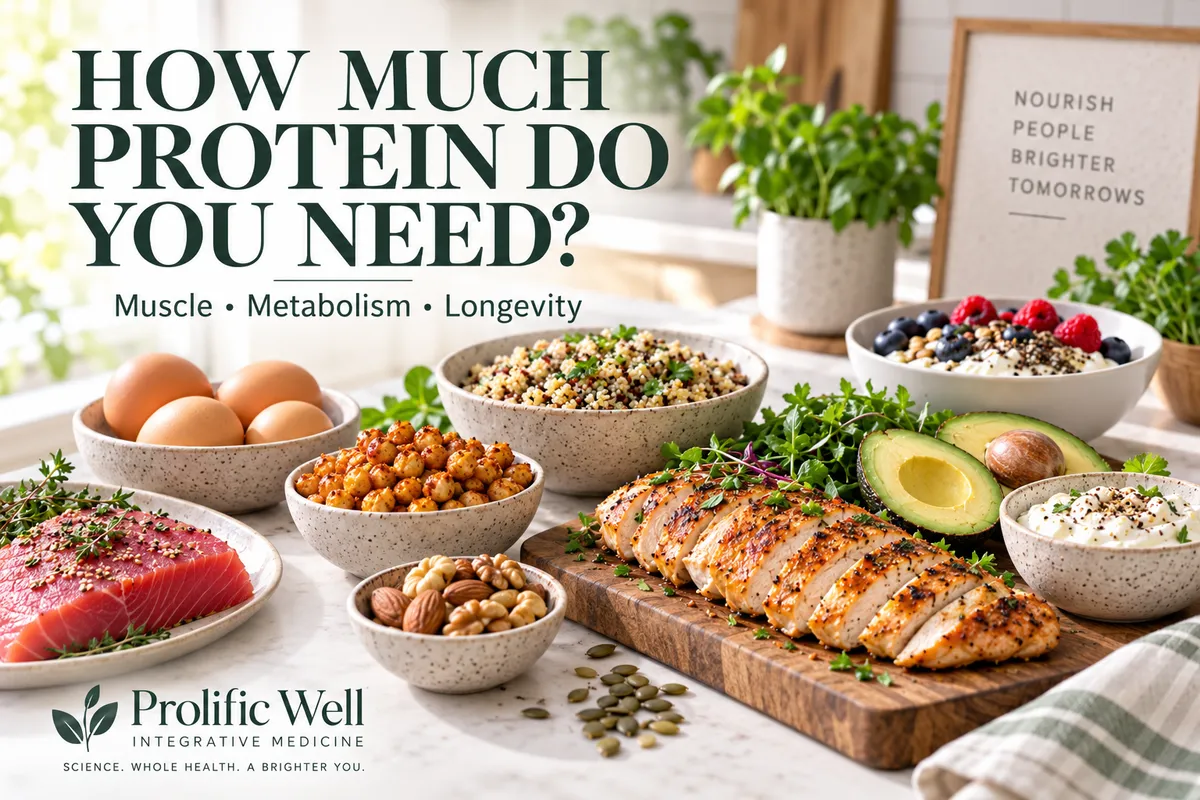
How Much Protein Do You Really Need? A Doctor’s Guide to Protein, Muscle, Metabolism & Healthy Aging
How Much Protein Do You Really Need?
Protein has become one of the most talked-about nutrients in health and fitness.
Some people are adding protein powder to everything.
Others are still eating a piece of toast for breakfast, a small salad for lunch, and trying to make up their entire protein intake at dinner.
Then there is the most common question I hear:
“How much protein do I actually need?”
The answer is not one universal number.
Your protein needs depend on your age, body size, activity level, muscle mass, health conditions, and goals.
A 30-year-old sedentary adult does not necessarily have the same nutritional needs as a 55-year-old woman entering menopause, a 70-year-old trying to preserve independence, or someone actively strength training.
This is why I prefer to teach people how protein works rather than simply hand them another number to memorize.
Protein is not only for bodybuilders.
It is one of the fundamental building materials of your body.
Quick Answer: How Much Protein Do You Need?
For generally healthy adults, the current U.S. Recommended Dietary Allowance is 0.8 grams of protein per kilogram of body weight per day.
But that number is best understood as a baseline requirement, not necessarily the ideal intake for every person trying to preserve muscle and physical function as they age.
Research and expert groups focused on healthy aging frequently suggest approximately 1.0 to 1.2 grams per kilogram per day for healthy older adults, with higher intake sometimes recommended for people who are physically active, recovering from illness, or at risk of muscle loss.
That means protein should be individualized rather than reduced to:
“Everyone needs exactly X grams.”
Why Does Your Body Need Protein?
Protein is made from amino acids.
Your body uses amino acids to build and maintain tissues throughout your body.
Think beyond muscle.
Protein contributes to:
skeletal muscle
enzymes
antibodies
connective tissue
transport proteins
many signaling molecules
repair and maintenance of body tissues
Your body is constantly breaking proteins down and rebuilding them.
That means protein intake is not a one-time project.
You need an ongoing supply.
This concept fits directly with one of the nutritional principles emphasized in the Yates Protocol: food provides the raw materials your body uses to build and maintain itself.
Why Protein Becomes More Important as You Age
This is where the conversation becomes particularly important for my patients in midlife and beyond.
As we age, maintaining muscle becomes harder.
Older adults often experience a reduced muscle-building response to protein intake, sometimes described as anabolic resistance.
At the same time, many people become less active and gradually lose muscle without realizing it.
That matters because muscle is not merely about appearance.
Muscle supports:
strength
balance
mobility
glucose metabolism
physical resilience
recovery
independence later in life
Recent reviews continue to support higher protein intakes in many older adults than the minimum RDA, often around 1.0 to 1.2 g/kg/day, particularly when maintaining muscle and function is the goal.
This is one reason my nutrition conversations increasingly shift with age.
At 25, someone may be thinking mostly about weight.
At 55, I want us thinking about what your body will need at 75.
That is longevity nutrition.
Protein After 40: Why I Start Paying More Attention
Forty is not a magical physiological cutoff.
But it is often the stage when several things begin happening at the same time:
people become less active
work and family responsibilities increase
sleep may decline
resistance training becomes less consistent
body composition begins changing
women may enter perimenopause
muscle loss can become easier to overlook
This is why protein becomes part of a larger conversation about preserving lean mass.
For women navigating perimenopause and menopause, I do not look at protein in isolation.
I look at:
protein + strength training + hormones + sleep + metabolic health + overall nutrition.
That combination matters more than chasing one nutrient.
How Much Protein Should You Eat Per Meal?
This is where many people struggle.
Someone may technically eat enough protein over the entire day but consume:
7 grams at breakfast
10 grams at lunch
55 grams at dinner
That is very different from distributing protein more evenly.
Research in older adults commonly suggests that roughly 25 to 30 grams of high-quality protein per meal may help support muscle protein synthesis, although individual needs vary with body size and total daily intake.
So rather than focusing only on your daily total, ask:
Am I getting a meaningful amount of protein at breakfast, lunch, and dinner?
That question often changes someone's diet immediately.
Breakfast Is Often the Weakest Protein Meal
Breakfast is where I see the biggest gap.
A common breakfast might be:
coffee
toast
cereal
oatmeal by itself
a muffin
fruit
a sweetened yogurt
None of those foods is automatically “bad.”
But many of them provide very little protein by themselves.
Then the person tells me:
“I'm hungry again at 10:30.”
That makes sense.
One of the practical recommendations in the Yates Protocol is to start the day with a savory, protein-rich breakfast rather than relying primarily on refined carbohydrates.
You do not need steak and eggs every morning.
Try:
eggs with vegetables
Greek yogurt with berries, nuts, and seeds
cottage cheese with fruit
tofu scramble with vegetables
leftover salmon with vegetables and rice
beans with eggs or vegetables
a protein smoothie when convenience matters
Breakfast does not have to taste like dessert.
What Does 25–30 Grams of Protein Look Like?
This is often more useful than numbers alone.
Depending on the food and preparation, approximately 25–30 grams of protein might come from:
a moderate serving of chicken or turkey
a serving of fish
several eggs combined with another protein-rich food
Greek yogurt plus nuts or seeds
tofu or tempeh
lentils or beans combined with other protein-rich foods
cottage cheese
a thoughtfully formulated protein shake
Exact protein amounts vary, so checking labels or using a nutrition tracker temporarily can be helpful if you are trying to understand your current intake.
You do not need to track forever.
Sometimes tracking for several days simply teaches you what your meals actually contain.
What Are the Best Sources of Protein?
The Yates Protocol emphasizes choosing protein thoughtfully rather than simply eating more meat. It discusses fish, poultry, eggs, beef, pork, plant proteins, and limiting heavily processed meats.
I like that framework because the question should not be:
“How do I eat as much protein as possible?”
It should be:
“How do I get enough protein from foods that support the rest of my health too?”
Good options can include:
Fish and seafood
Fish can provide high-quality protein, and some varieties also supply omega-3 fatty acids.
Examples include:
salmon
sardines
trout
herring
cod
tuna
shellfish
The exact choice matters because mercury exposure, sustainability, preparation, and frequency can vary.
Eggs
Eggs are nutrient-dense and versatile.
They can make breakfast much easier, especially when combined with vegetables and another protein source if needed.
Poultry
Chicken and turkey provide concentrated protein and can work well in:
salads
soups
stir-fries
bowls
wraps
leftovers
Preparation matters.
Grilled, baked, roasted, or sautéed poultry is nutritionally different from heavily breaded and deep-fried versions.
Red meat
Red meat can provide protein along with iron, zinc, vitamin B12, and other nutrients.
But I would not recommend treating all red meat as nutritionally identical.
Frequency, processing, portion size, cooking method, and the rest of the dietary pattern matter.
Fresh meat and highly processed meats should not automatically be placed in the same category.
Beans and lentils
Beans and lentils are valuable because they provide:
protein
fiber
resistant starch
minerals
plant compounds
They may not be as protein-dense per calorie or serving as many animal proteins, but they bring other nutritional benefits.
This is why I like food combinations instead of arguing endlessly about whether plant or animal protein is “better.”
Soy foods
Tofu, tempeh, edamame, and other minimally processed soy foods can be excellent protein sources.
They are particularly useful for people who want to reduce meat intake or eat predominantly plant-based.
Dairy
If tolerated, foods such as:
Greek yogurt
cottage cheese
milk
some cheeses
can contribute substantially to protein intake.
Animal Protein vs. Plant Protein: Which Is Better?
This question creates much more conflict online than it needs to.
Animal proteins often provide all essential amino acids in highly digestible concentrations.
Plant foods provide protein too, along with fiber and a wide range of beneficial plant compounds.
You do not need to turn nutrition into a team sport.
A diet can include both.
For someone eating entirely plant-based, protein planning becomes more important because:
individual plant foods vary in amino acid composition
serving sizes may need to be larger
total protein density may be lower in some foods
But yes, it is entirely possible to consume adequate protein on a well-planned plant-based diet.
Do You Need to Combine Plant Proteins at Every Meal?
No.
You may have heard that vegetarians must carefully combine foods such as rice and beans at every single meal to create a “complete protein.”
Your body maintains an amino acid pool throughout the day.
The more important goal is eating enough total protein and consuming a diverse range of protein-containing foods across the day.
Variety helps.
Perfection is unnecessary.
Is Protein Good for Metabolism?
Protein gets marketed as if it “boosts metabolism” dramatically.
That language can be misleading.
Protein does have a higher thermic effect than carbohydrate or fat, meaning your body expends more energy digesting and processing it.
But the more important metabolic reason I care about adequate protein is muscle preservation.
Skeletal muscle is metabolically active tissue and plays an important role in glucose disposal and metabolic health.
So I think about protein as one component of a bigger metabolic strategy:
adequate protein + resistance training + movement + sleep + appropriate carbohydrates + healthy fats.
Protein by itself does not fix metabolic dysfunction.
Can Protein Help With Weight Loss?
Protein can be useful during weight loss because it may help with:
satiety
maintaining lean mass
meal structure
reducing the tendency to eat mostly refined carbohydrates
But I want to be very careful with the goal.
Losing weight while losing significant muscle is not necessarily a metabolic victory.
This becomes particularly important for people using GLP-1 medications or following aggressive calorie-restriction plans.
If appetite drops dramatically but protein and resistance training disappear too, lean mass can become part of the weight being lost.
The number on the scale is not the whole story.
Protein, Menopause, and Midlife Health
For women in perimenopause and menopause, protein is increasingly relevant because body composition often changes during this stage of life.
Hormonal changes can overlap with:
reductions in muscle mass
increased central adiposity
changes in insulin sensitivity
reduced physical activity
sleep disruption
Protein is not a treatment for menopause.
But adequate protein intake can be part of a broader strategy to preserve muscle, strength, and metabolic resilience during midlife.
For women, I often think less about:
“How little can I eat to stay thin?”
and more about:
“How do we preserve the muscle, bone, cognition, metabolism, and independence you will need later?”
That is a much more useful longevity question.
Protein and Bone Health
People often think only of calcium and vitamin D when discussing bone health.
Those nutrients matter.
But bone is also a living tissue matrix that contains protein.
Adequate protein, resistance exercise, vitamin D, calcium, hormonal health, and overall nutritional status all interact.
For women concerned about osteopenia or osteoporosis, I do not want nutrition focused on one mineral while ignoring muscle and protein.
Strong muscle and strong bone belong in the same conversation.
Can You Eat Too Much Protein?
Yes, more is not automatically better.
Once protein intake is adequate for your needs, simply pushing protein higher and higher does not guarantee additional benefit.
Extremely high protein intake can also crowd out:
vegetables
fruit
fiber
legumes
healthy fats
other nutrient-rich foods
And certain medical conditions require individualized recommendations.
That is especially important for people with significant kidney disease.
The PROT-AGE recommendations specifically identify severe kidney disease as a situation in which higher protein recommendations may not apply.
If you have kidney disease, significant liver disease, a metabolic disorder, or another condition affecting protein metabolism, work with your healthcare professional rather than following generic social-media protein targets.
Is High Protein Bad for Your Kidneys?
For healthy people, higher protein intake is not the same thing as causing kidney disease.
But this question becomes different once chronic kidney disease already exists.
Someone with reduced kidney function may need a carefully individualized protein target.
This is why I do not recommend copying a fitness influencer's protein intake simply because you share the same age or weight.
Your physiology matters.
Do You Need Protein Powder?
No.
Protein powder is a convenience product, not a nutritional requirement.
You can meet your protein needs entirely through food.
But protein powder can be useful for people who:
struggle to eat enough protein
have very busy mornings
exercise frequently
have reduced appetite
follow a plant-based diet
need portable food options
If you use one, look at the whole product.
Consider:
protein source
amount per serving
added sugar
sweeteners
additives
tolerance
third-party testing when relevant
Do not assume “protein” automatically makes a packaged product healthy.
What About Collagen? Does It Count as Protein?
Collagen contains protein, but it is not equivalent to a complete dietary protein for muscle-building purposes.
It is relatively low in some essential amino acids and lacks tryptophan.
So if you are taking collagen for skin, joints, or connective tissue, I would not automatically count it as your primary protein source at breakfast.
You still need complete, high-quality protein from food or an appropriate protein supplement.
Should You Eat Protein Before or After Exercise?
For most people, total daily protein intake matters more than obsessing over a tiny “anabolic window.”
Having protein around the time of resistance training can be useful, but you do not need to panic if you cannot drink a shake within 17 minutes of finishing your workout.
Focus first on:
adequate total daily protein
spreading protein across meals
consistent resistance training
adequate overall nutrition
Then fine-tune timing if your goals require it.
Protein and Strength Training Belong Together
This is one of the most important points in the entire article.
Protein provides the building blocks.
Resistance training gives your muscles the reason to use them.
If healthy aging is your goal, I would not recommend thinking about protein without also thinking about strength.
Nutrition and movement are partners.
Eating high protein while remaining completely sedentary does not create the same physiological stimulus as eating adequate protein while regularly challenging your muscles.
How to Calculate a Starting Protein Target
If you want a simple educational calculation, convert your body weight from pounds to kilograms:
Body weight in pounds ÷ 2.2 = kilograms
Then multiply by a protein target.
For example, a person weighing 150 pounds weighs approximately 68 kilograms.
At:
0.8 g/kg: about 54 grams/day
1.0 g/kg: about 68 grams/day
1.2 g/kg: about 82 grams/day
These examples illustrate how dramatically recommendations can differ depending on the goal.
For healthy older adults, expert groups commonly discuss 1.0–1.2 g/kg/day, while people with illness, malnutrition risk, or higher physical demands may require individualized higher intakes.
This is an educational starting point, not a prescription for every person.
A Simple Protein Day
Instead of eating nearly all your protein at dinner, think about distribution.
For example:
Breakfast
Eggs + Greek yogurt + vegetables
Lunch
Chicken, salmon, tofu, or lentils over greens with vegetables
Snack if needed
Greek yogurt, cottage cheese, edamame, nuts plus another protein source, or a protein shake
Dinner
Fish, poultry, lean meat, tofu, tempeh, beans, or lentils with vegetables and a quality carbohydrate
The exact foods can change.
The principle is consistency.
My Favorite Protein Question
Instead of immediately asking:
“How many grams should I eat?”
Start with:
“Where is my protein?”
Ask that at breakfast.
Ask it at lunch.
Ask it at dinner.
If you cannot identify a meaningful protein source, that meal may be a good place to start.
This is one reason I like the Yates Protocol's practical approach. It does not treat nutrition as a collection of obscure rules. It brings the conversation back to actual food and actual meals.
Five Simple Ways to Increase Protein Without Overhauling Your Diet
Add eggs, Greek yogurt, tofu, or another protein source to breakfast.
Add a real protein source to salads rather than eating vegetables alone.
Keep convenient proteins available, such as boiled eggs, yogurt, edamame, canned fish, tofu, or leftovers.
Use beans or lentils more often, especially alongside other protein foods.
Think about tomorrow's protein before you get hungry.
That last one is underrated.
Healthy eating is much easier when you make decisions before you are exhausted and starving.
Frequently Asked Questions
How much protein does the average adult need?
The U.S. RDA is 0.8 grams of protein per kilogram of body weight per day for generally healthy adults. Individual needs may be higher based on age, exercise, health status, and goals.
How much protein do adults over 50 need?
There is no single universal number, but expert groups focused on aging commonly suggest around 1.0–1.2 g/kg/day for healthy older adults, particularly when preserving muscle and physical function is the goal.
How much protein should I eat at each meal?
Research in older adults commonly discusses roughly 25–30 grams per meal as a useful amount for stimulating muscle protein synthesis, although requirements vary by body size and total daily intake.
Do women need more protein during menopause?
There is no separate official protein RDA specifically for menopause. However, maintaining adequate protein becomes increasingly important during midlife because preserving muscle, strength, bone health, and metabolic function becomes a larger priority.
Is 100 grams of protein a day too much?
It depends on your body size, health status, activity level, and goals. For one person, 100 grams may be appropriate. For another, it may be unnecessary or medically inappropriate.
Is plant protein enough?
Yes. A well-planned plant-based diet can provide adequate protein. Variety and total intake become particularly important.
Is chicken better than beef for protein?
Both provide protein. The more useful comparison includes overall nutrient profile, fat content, processing, portion size, preparation method, and how frequently each food is eaten.
Are eggs a good source of protein?
Yes. Eggs provide high-quality protein along with several other nutrients, although most people will need more than one egg to create a meal containing 25–30 grams of protein.
Does collagen count toward my protein goal?
Collagen contributes protein, but it is not a complete protein and should not generally replace complete protein sources when muscle maintenance is the goal.
Do I need a protein shake?
No. Protein shakes are optional and can be convenient, but whole-food protein sources can meet protein requirements.
The Bottom Line
Protein is not a trend.
It is a fundamental nutrient your body uses throughout life.
But the goal is not to eat the highest-protein diet possible.
The goal is to eat enough protein for your body, your stage of life, and your goals, while still leaving room for vegetables, fruit, fiber-rich carbohydrates, healthy fats, and the many other foods that contribute to health.
As you move through midlife and into older age, protein deserves more attention because protecting muscle becomes increasingly important.
And muscle represents much more than appearance.
It represents your ability to climb stairs.
Carry groceries.
Travel.
Recover from illness.
Get up from the floor.
Remain independent.
And continue participating fully in your own life.
That is why I care about protein.
Not because I want you to chase another nutrition number.
Because I want you to build the body that will carry you through the decades ahead.
Read Next
If you are building your nutrition foundation, start with:
The Prolific Well Guide to Eating for Energy, Metabolism, Hormones, and Longevity
Then continue with upcoming guides:
For more on how nutrition diversity affects your gut, hormones, and energy, read:
Heal Your Gut, Boost Your Hormones, and Regain Energy Through Food Diversity
And for the bigger metabolic picture:
Why You're Still Tired After Winter: Understanding Energy, Stress, Hormones, and Metabolism
A More Personalized Approach
If you are dealing with fatigue, muscle loss, menopause-related body composition changes, metabolic concerns, digestive issues, or difficulty figuring out what your body actually needs, generic protein advice may not be enough.
At Prolific Well Integrative Medicine, I look at nutrition within the larger picture of hormone health, metabolic health, gut function, body composition, lifestyle, and longevity.
The goal is not simply to live longer.
It is to stay strong enough, clear enough, and healthy enough to keep living your life.
References
Bauer J, Biolo G, Cederholm T, et al. Evidence-based recommendations for optimal dietary protein intake in older people: a position paper from the PROT-AGE Study Group. Journal of the American Medical Directors Association. 2013;14(8):542-559. This expert group recommends approximately 1.0 to 1.2 g/kg/day for healthy older adults, with higher intakes often considered for active adults or those with acute or chronic illness.
View study on PubMedDeutz NEP, Bauer JM, Barazzoni R, et al. Protein intake and exercise for optimal muscle function with aging: recommendations from the ESPEN Expert Group. Clinical Nutrition. 2014;33(6):929-936. ESPEN similarly recommends 1.0 to 1.2 g/kg/day for healthy older adults and 1.2 to 1.5 g/kg/day for many older adults with illness or malnutrition risk, alongside regular resistance and aerobic exercise.
View study on PubMedPaddon-Jones D, Rasmussen BB. Dietary protein recommendations and the prevention of sarcopenia. Current Opinion in Clinical Nutrition and Metabolic Care. 2009;12(1):86-90. This review proposed that roughly 25 to 30 grams of high-quality protein per meal may help maximize muscle protein synthesis and highlighted the importance of distributing protein across the day rather than consuming most of it at dinner.
View study on PubMedPaddon-Jones D, Leidy H. Dietary protein and muscle in older persons. Current Opinion in Clinical Nutrition and Metabolic Care. 2014;17(1):5-11. This review supports a meal-based approach to protein intake and discusses approximately 30 grams per meal as a practical strategy for middle-aged and older adults concerned with preserving muscle mass.
View study on PubMedLayman DK, Anthony TG, Rasmussen BB, et al. Defining meal requirements for protein to optimize metabolic roles of amino acids. American Journal of Clinical Nutrition. 2015. This review discusses how the anabolic response to protein changes with age and supports consuming approximately 20 to 30 grams of protein per meal, along with resistance exercise, to support muscle protein synthesis.
View study on PubMedKim JE, O'Connor LE, Sands LP, Slebodnik MB, Campbell WW. Effects of dietary protein intake on body composition changes after weight loss in older adults: a systematic review and meta-analysis. Nutrition Reviews. 2016. In adults over 50 undergoing intentional weight loss, higher-protein diets were associated with greater preservation of lean mass and greater loss of fat mass compared with lower-protein diets.
View study on PubMedLoenneke JP, Loprinzi PD, Murphy CH, Phillips SM. Per meal dose and frequency of protein consumption is associated with lean mass and muscle performance. Clinical Nutrition. 2016;35(6):1506-1511. This study examined the relationship between consuming adequate protein at multiple meals and measures of lean mass and muscle performance.
View study on PubMedProtein and Aging: Practicalities and Practice. 2025. This recent review summarizes contemporary protein recommendations for aging adults and notes that approximately 25 to 30 grams per meal, or about 0.4 g/kg per meal, may be sufficient to maximize muscle protein synthesis in many older adults.
View review on PubMed


