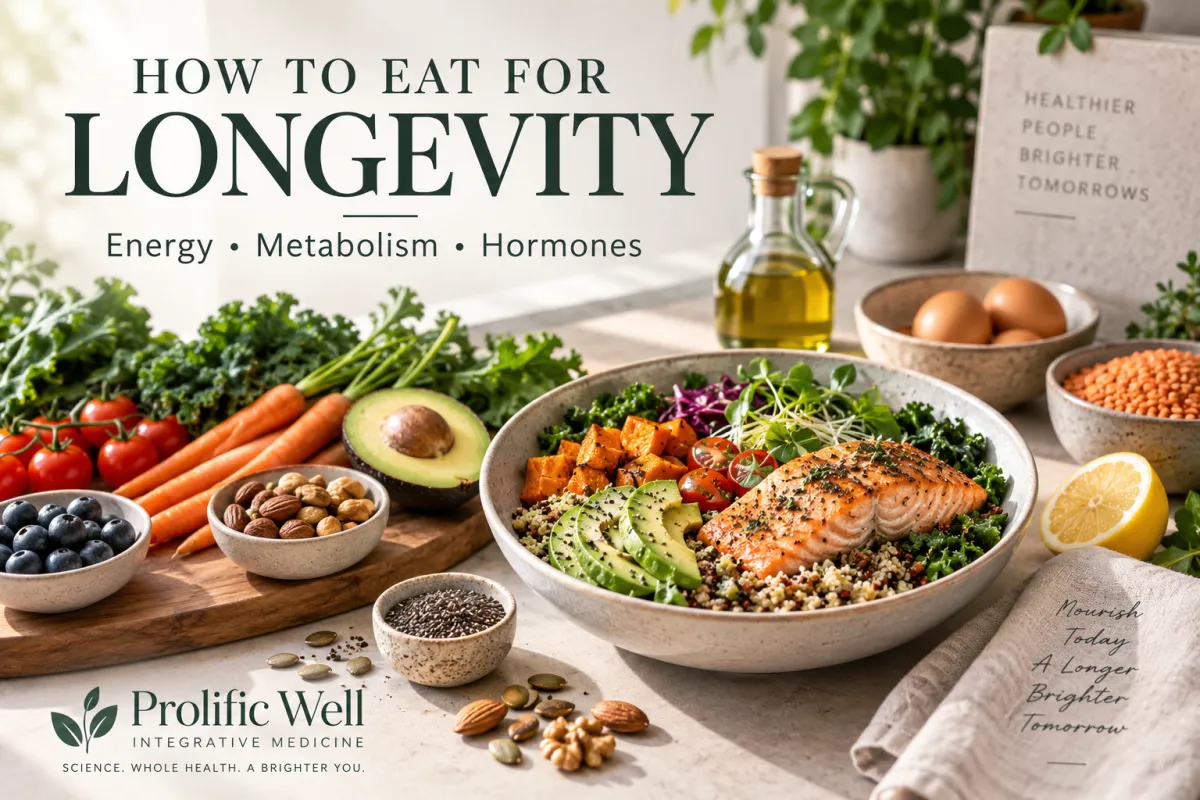
The Prolific Well Guide to Eating for Energy, Metabolism, Hormones, and Longevity
Nutrition has become unnecessarily complicated.
One person tells you to stop eating carbohydrates. Someone else tells you to eat plant-based. Another says you need more protein. Social media warns you about fruit, seed oils, grains, dairy, lectins, gluten, fasting, eating too frequently, and sometimes eating at all.
No wonder people feel confused.
In my clinical work, I see people who are genuinely trying to take care of themselves but no longer know what “healthy eating” is supposed to look like.
My approach is much simpler.
Food should give your body the raw materials it needs to function well today while helping protect the body you want to live in 10, 20, and 30 years from now.
That means thinking beyond calories and weight.
What you eat helps provide the building blocks your body uses for muscle, bone, brain function, energy production, cellular repair, digestion, and hormone physiology.
You do not need a perfect diet.
You need a nutritional foundation that you can actually live with.
This guide will show you how I think about that foundation.
What Does Healthy Eating Actually Mean?
A healthy diet is not one specific diet.
There is no single plate that works perfectly for every body, every culture, every age, and every medical condition.
There are, however, principles that show up repeatedly.
Most of your nutrition should come from foods that are relatively close to their original form:
vegetables
fruits
beans and legumes
nuts and seeds
eggs
fish and seafood
poultry or meat if you eat them
minimally processed grains and starches
healthy sources of dietary fat
These foods provide combinations of protein, carbohydrates, fats, vitamins, minerals, fiber, and other compounds the body needs.
Highly refined foods can certainly fit into life occasionally. The problem occurs when they become the foundation of the diet and crowd out the foods supplying the nutrients your body actually needs.
I do not want my patients becoming afraid of food.
I want them to become more skilled at choosing food.
That is a very different relationship with nutrition.
Start With the Three Macronutrients
Most foods contain some combination of three major macronutrients:
Protein
Carbohydrates
Fat
All three have legitimate physiological roles.
The goal is not to declare one “good” and another “bad.”
The more useful question is:
What type am I eating, how much am I eating, and what else am I eating with it?
1. Build Your Meals Around Protein
Protein is one of the first things I look at when someone tells me:
“I'm hungry all the time.”
“I don't feel satisfied after breakfast.”
“I'm trying to maintain muscle.”
“My energy crashes during the day.”
“I'm losing weight but I'm worried about losing muscle.”
“I'm getting older and don't feel as strong as I used to.”
Protein supplies amino acids that your body uses to build and maintain tissues throughout the body.
Good protein sources can include:
eggs
fish
seafood
chicken
turkey
lean meats
Greek yogurt or cottage cheese if tolerated
tofu
tempeh
edamame
beans
lentils
peas
nuts and seeds
You do not have to eat meat to eat adequate protein, but plant-based eating does require some intentionality.
A simple question to ask at every meal:
Where is my protein?
If breakfast consists only of coffee and toast, lunch is a salad with very little protein, and dinner is the first substantial protein of the day, there may be room to improve the distribution.
Rather than trying to “catch up” at dinner, consider including a meaningful protein source throughout the day.
We will explore protein requirements much more deeply in a future Prolific Well guide because protein needs vary according to age, body size, physical activity, health status, and goals.
2. Stop Treating All Carbohydrates as the Same Food
One of the most common statements I hear is:
“I'm trying not to eat carbs.”
But “carbohydrate” describes an enormous category of foods.
Broccoli contains carbohydrates.
Blueberries contain carbohydrates.
Lentils contain carbohydrates.
Potatoes contain carbohydrates.
Rice contains carbohydrates.
A soda contains carbohydrates too.
Those foods are clearly not nutritionally identical.
So rather than simply asking, “Are carbs bad?” I encourage people to look at the quality, quantity, preparation, and context of the carbohydrate.
Higher-quality carbohydrate choices can include:
vegetables
fruits
beans
lentils
peas
potatoes and other root vegetables
minimally processed whole grains
other fiber-rich plant foods
Highly refined carbohydrates and foods containing large amounts of added sugar can behave very differently in the diet.
What About Rice?
This conversation is personal to me because I grew up in Vietnam.
Rice was not a “bad food.” It was food.
This is one reason I dislike nutritional messaging that turns traditional cultural foods into moral categories.
You do not necessarily have to remove rice, potatoes, noodles, or every other starch from your life.
Instead, look at the whole meal.
For example, consider the difference between:
Rice by itself
versus
Rice + vegetables + protein + healthy fat
The amount and composition of the entire meal matter.
Food should fit your physiology, but it should also fit your culture and your actual life.
3. Choose Healthy Fats Instead of Fearing Fat
For decades, many people were taught that eating fat automatically made them unhealthy or caused weight gain.
Nutrition is more nuanced than that.
Dietary fat is part of a healthy diet.
Foods that can provide beneficial fats include:
extra virgin olive oil
avocado
nuts
seeds
fatty fish
olives
Different fats have different properties, and food source matters.
The useful question is not:
“How do I eliminate fat?”
It is:
“Where is most of my fat coming from?”
There is a major difference between dietary fat coming primarily from minimally processed foods and fat that arrives predominantly through highly processed foods, fried foods, and packaged snacks.
We will explore saturated fats, unsaturated fats, omega-3s, cooking oils, butter, coconut oil, and the seed-oil debate separately because each deserves more nuance than a paragraph.
Build the Whole Meal, Not Just One Nutrient
People often become fixated on individual nutrients.
They ask:
“Is this food high in protein?”
“Is this low carb?”
“Does this have fat?”
“Is fruit too high in sugar?”
But we eat meals, not isolated nutrients.
That is why I prefer teaching people how to construct a meal.
A practical starting framework is:
Protein
Choose a meaningful source of protein.
Plants
Add vegetables, fruit, legumes, or another fiber-rich plant food.
Carbohydrate
Add an appropriate amount of a minimally processed carbohydrate according to your needs and activity.
Healthy fat
Include a quality source of dietary fat.
You can adapt this framework to your appetite, culture, dietary preferences, health conditions, and goals.
What Does a Balanced Plate Look Like?
You do not need to weigh every bite of food to begin improving your diet.
Start visually.
Imagine your plate containing:
A substantial source of protein
Chicken, fish, eggs, tofu, tempeh, beans, lentils, Greek yogurt, or another protein-rich food.
Plenty of plant foods
Vegetables, greens, colorful produce, beans, herbs, or fruit.
A thoughtful carbohydrate
Rice, potatoes, lentils, beans, oats, quinoa, whole grains, or another starch appropriate for you.
A healthy fat
Olive oil, avocado, nuts, seeds, olives, or naturally occurring fat from the meal.
It does not have to look identical every day.
Your dinner might be Vietnamese.
Tomorrow's lunch might be Mediterranean.
Breakfast might be eggs and vegetables one day and yogurt, berries, nuts, and seeds another.
Nutrition becomes much easier when you understand the principles instead of trying to memorize somebody else's meal plan.
Food Diversity Matters Too
Even a diet made entirely of “healthy foods” can become repetitive.
Many people eat the same:
two vegetables
two proteins
one breakfast
one fruit
one starch
week after week.
Your diet should have some variety.
Different foods provide different combinations of fibers, vitamins, minerals, polyphenols, amino acids, and other nutrients.
This also connects nutrition to one of my favorite areas of medicine: the gut microbiome.
If you want to go deeper into why dietary diversity matters for digestion and the microbiome, read my guide:
Heal Your Gut, Boost Your Hormones, and Regain Energy Through Food Diversity
I discuss practical ways to diversify your vegetables, fruit, proteins, fermented foods, and prebiotic foods rather than immediately reaching for another restrictive diet.
Nutrition and Blood Sugar: Think About the Entire Meal
Blood sugar has become another area filled with fear.
People see a glucose increase and assume a food must be harmful.
But blood glucose is designed to change after eating.
The bigger picture includes:
what you ate
how much you ate
what foods were eaten together
your activity
your individual metabolic health
your overall glucose pattern
A meal primarily made of rapidly digested carbohydrates may affect you differently from one containing protein, fiber, fat, and carbohydrates together.
This is another reason I like building meals rather than obsessing over individual foods.
If cravings, mood fluctuations, energy changes, and weight changes seem to occur together, metabolism and blood sugar are worth considering as part of the larger picture.
Your hormones, stress physiology, sleep, nutrition, and metabolism do not operate in separate rooms.
They communicate.
For more on this systems-based approach, see my article on integrative and functional medicine, hormone imbalance, and chronic fatigue.
What About Resistant Starch?
One particularly interesting area of carbohydrate nutrition is resistant starch.
Some starch escapes digestion in the small intestine and reaches the large intestine, where it behaves differently from rapidly digested starch.
Certain cooking and cooling processes can also change the starch structure of foods.
This is why foods such as:
rice
potatoes
oats
legumes
certain cooked and cooled starches
deserve a more interesting conversation than simply labeling them “carbs.”
I will cover resistant starch separately because this subject connects gut health, carbohydrate metabolism, food preparation, and practical meal planning.
It is a perfect example of why nutrition cannot always be reduced to:
carbs = bad
or
carbs = good.
Physiology is more interesting than that.
Your Gut Is Part of Your Nutrition Story
You can eat the most nutrient-dense diet in the world, but digestion still matters.
Food needs to be:
chewed
digested
broken down
absorbed
utilized
Persistent bloating, reflux, constipation, diarrhea, abdominal discomfort, or food intolerance may deserve investigation rather than increasingly aggressive food restriction.
Nutrition and gastrointestinal function need to be considered together.
For a deeper introduction, read:
Unlocking the Secrets of the Microbiome: How Gut Health Transforms Your Well-being.
There are also situations in which nutrient status cannot be understood simply by asking what someone eats.
For example, my recent article on low ferritin and the gut-health connection explores why intake is only part of the story when absorption, inflammation, blood loss, or gastrointestinal conditions are involved.
How Nutrition Connects With Hormones
People often search for the “best foods to balance hormones.”
I wish physiology were that simple.
There is no single food that universally fixes hormones.
Instead, nutritional status provides part of the environment in which hormonal systems operate.
Your body needs adequate energy and nutrients to perform the countless biochemical processes involved in human physiology.
At the same time, hormone changes can affect:
appetite
body composition
sleep
energy
food preferences
activity
how someone feels in their body
This relationship becomes particularly important during transitions such as perimenopause and menopause.
The answer is usually not a magical “hormone-balancing food.”
The more useful goal is to create a nutritional foundation that supports the whole person while evaluating hormonal concerns individually when necessary.
That distinction is important.
Nutrition can support physiology.
Nutrition does not replace appropriate medical evaluation.
Nutrition for Longevity Is Really Nutrition for Function
When people hear “longevity,” they sometimes imagine living to an extreme age.
That is not what interests me most.
I want more life in your years.
I want you to be able to:
think clearly
travel
carry groceries
get off the floor
maintain muscle
remain independent
enjoy meals with family
participate in your community
remember the people and experiences you love
That changes the nutrition conversation.
Instead of asking only:
“Will this make me lose weight?”
we begin asking:
“Will the way I am eating help me build and maintain the body I want to live in?”
That is a much better long-term question.
Hydration Is Part of Nutrition
Food gets most of the attention, but hydration matters too.
Water participates throughout normal physiology.
Yet hydration does not need to become another obsessive rule.
Your needs can vary depending on:
activity
climate
body size
diet
pregnancy
illness
medications
fluid losses
A simple starting point is to make water and unsweetened beverages your primary drinks rather than obtaining large amounts of sugar through beverages.
Pay attention to thirst and how you feel.
Some medical conditions also require specific fluid recommendations, so more water is not automatically better for everyone.
Breakfast: Start by Asking What the Meal Does for You
Breakfast becomes an easy place to improve nutrition because many common breakfasts are predominantly refined carbohydrates.
Think:
pastry and coffee
sweet cereal
muffin
sweetened coffee drink
toast by itself
Then people wonder why they are hungry again shortly afterward.
Try building breakfast using the same principles you would use at dinner.
Start with protein.
Then add fiber-rich plants, an appropriate carbohydrate if desired, and healthy fat.
Examples might include:
Eggs + sautéed vegetables + avocado
Greek yogurt + berries + nuts and seeds
Tofu scramble + vegetables
Leftover salmon + rice + vegetables
And yes, breakfast can be savory.
There is no rule stating breakfast must taste like dessert.
Lunch: Build for the Afternoon You Want to Have
A good lunch should help carry you through your afternoon.
Think beyond a tiny salad or something grabbed between meetings.
Ask:
Where is my protein?
Where are my vegetables or fiber?
What carbohydrate makes sense for me?
Will this meal actually satisfy me?
If you routinely feel exhausted after lunch, food is only one possible contributor.
Sleep, stress, metabolic health, circadian rhythm, thyroid function, nutrient status, and other factors may also matter.
I discuss those connections more deeply in:
Why You're Still Tired After Winter: Understanding Energy, Stress, Hormones, and Metabolism.
Dinner: Keep It Simple Enough to Repeat
Dinner does not have to involve 14 ingredients.
Try:
Protein + vegetables + quality starch + healthy fat
For example:
salmon + roasted vegetables + potatoes
chicken + vegetable stir-fry + rice
tofu + vegetables + noodles
lentils + greens + roasted root vegetables
beef + broccoli + rice
Healthy eating becomes sustainable when you stop requiring every meal to be impressive.
Some nights, dinner simply needs to nourish you.
Should You Snack?
There is no universal rule requiring everyone to snack.
There is also no universal rule forbidding it.
Consider:
hunger
meal size
activity
schedule
blood glucose needs
medical conditions
If you are genuinely hungry, choose something that contributes nutritionally rather than turning snacks into an endless stream of refined carbohydrates.
Examples might include:
fruit with nuts
yogurt
vegetables with hummus
eggs
edamame
cheese with fruit if tolerated
nuts and seeds
The goal is not perfection.
It is intentionality.
How to Eat Well at Restaurants
Eating well should not require withdrawing from your life.
Restaurants, celebrations, vacations, holidays, and family dinners are part of being human.
When eating out, use the same basic framework.
Look for:
A protein source
Vegetables or another plant food
A carbohydrate appropriate for your needs
A cooking method you feel good about
A portion that leaves you comfortably satisfied
Grilled, roasted, baked, steamed, or sautéed foods can be useful options when you want something less heavily fried.
Then enjoy your meal.
One restaurant dinner does not define your health.
Your repeated patterns matter much more.
Healthy Eating While Traveling
Travel is another place where perfectionism collapses quickly.
I would rather you have a flexible strategy than a rigid food plan that lasts two days.
Think in anchors.
Find protein.
Eggs, yogurt, fish, chicken, tofu, beans, nuts, or whatever works within your dietary pattern.
Find plants.
Fruit at breakfast. A salad at lunch. Vegetables at dinner.
Hydrate.
Especially during flights and long travel days.
Eat local food.
Food is also culture.
You can care about your metabolic health and still experience the food of another country.
Those ideas are not mutually exclusive.
Six Nutrition Changes to Start With This Week
If everything in this guide feels like a lot, do not overhaul your kitchen tomorrow.
Start here.
1. Add a protein-rich food to breakfast.
Do this before buying another supplement.
2. Add vegetables or leafy greens to dinner.
Addition is often easier than restriction.
3. Make water and unsweetened beverages your default drinks.
You do not need your hydration to become dessert.
4. Replace some deep-fried meals with grilled, roasted, baked, or sautéed meals.
You do not need to do this perfectly.
5. Upgrade one refined carbohydrate.
Experiment with beans, lentils, potatoes, whole grains, vegetables, or another minimally processed starch that works for you.
6. Identify your biggest obstacle.
Is it:
time?
travel?
eating at work?
not shopping?
not knowing what to cook?
family preferences?
fatigue at the end of the day?
Do not just tell yourself to “have more discipline.”
Solve the actual obstacle.
That is how nutrition becomes sustainable. These practical priorities closely reflect the chapter's closing “quick wins” framework.
You Do Not Need the Perfect Diet
One of the most important things I want you to take from this guide is this:
Health is not created by one perfect meal, and it is not destroyed by one imperfect meal.
Your body responds to patterns.
That should feel freeing.
You can improve your nutrition without becoming afraid of restaurants.
You can eat rice.
You can eat carbohydrates.
You can eat fat.
You can enjoy your culture.
You can travel.
You can celebrate birthdays.
And you can still make decisions that support your metabolic health and longevity.
The objective is not food perfection.
The objective is understanding your body well enough to make thoughtful choices most of the time.
Frequently Asked Questions
What is the healthiest way to eat?
There is no single diet that is healthiest for everyone. A strong general foundation includes nutrient-dense whole foods, adequate protein, plenty of plant foods, quality carbohydrate sources, healthy fats, appropriate hydration, and eating patterns that are sustainable for your individual needs.
Should I eat protein at every meal?
Including a meaningful protein source throughout the day can make it easier to meet your overall protein needs. Individual requirements vary based on age, activity, body size, health status, and goals.
Are carbohydrates bad for you?
No. Carbohydrates are a broad category that includes vegetables, fruit, beans, lentils, whole grains, potatoes, rice, sweets, and sugar-sweetened beverages. Food quality, amount, preparation, and the overall meal matter more than simply labeling all carbohydrates as good or bad.
What should a balanced meal contain?
A practical balanced meal often includes a protein source, plant foods, an appropriate carbohydrate, and a healthy source of fat. The proportions can be individualized.
What should I eat for better energy?
Start with regular, balanced meals that include protein, nutrient-dense plant foods, quality carbohydrates, healthy fats, and adequate hydration. Persistent fatigue deserves a broader evaluation because sleep, hormones, thyroid function, anemia, metabolic health, medications, stress, and other medical conditions may also contribute.
What foods are best for hormone balance?
There is no single hormone-balancing food. Adequate nutrition helps support normal physiology, while specific hormone symptoms may require individualized evaluation.
What should I eat for longevity?
Focus less on finding a single “longevity food” and more on your overall dietary pattern. Prioritize nutrient-dense whole foods, protein, plant diversity, quality fats and carbohydrates, adequate hydration, and habits that help preserve physical function as you age.
Do I have to give up my favorite foods?
Usually not. Unless a food needs to be avoided for a medical reason, healthy eating can include flexibility. What you do repeatedly matters more than an occasional meal.
Where to Go Next
This guide is the beginning, not the end.
Over the coming Prolific Well Nutrition Series, I will go deeper into questions I hear repeatedly from patients:
How much protein do I really need?
Why does protein matter more as we get older?
Are carbohydrates actually bad for you?
How can I eat carbohydrates without creating large blood sugar swings?
Does cooling rice change how it is digested?
What fats should I actually eat?
How much water do I really need?
What should I eat for breakfast?
Why am I hungry again two hours after eating?
Each deserves its own conversation.
For now, start with one meal.
Look at your plate and ask:
Where is my protein?
Where are my plants?
What kind of carbohydrate am I eating?
Where is my healthy fat?
Then improve one thing.
That is enough to begin.
A More Personalized Approach to Nutrition
If you are dealing with persistent fatigue, digestive symptoms, blood sugar concerns, hormone changes, weight changes, or simply feel confused by conflicting nutrition advice, your needs may go beyond a generic meal plan.
At Prolific Well Integrative Medicine, I look at nutrition as one part of a larger physiological picture that can include hormones, metabolic health, gut function, nutrient status, sleep, stress, and your personal health history.
The goal is not to make your life revolve around food.
The goal is to understand your body well enough that food becomes one of the tools helping you live healthy, strong, and long.
Learn more about the Prolific Well approach to hormones, gut health, metabolic health, and longevity here:
Explore Prolific Well Integrative Medicine
References
American Diabetes Association Professional Practice Committee. Facilitating Positive Health Behaviors and Well-being to Improve Health Outcomes: Standards of Care in Diabetes—2026. Diabetes Care. 2026;49(Suppl 1). Current guidance emphasizes minimally processed, nutrient-dense, high-fiber carbohydrate sources, adequate protein, water in place of sugar-sweetened beverages, and individualized nutrition based on metabolic goals and preferences.
View the 2026 ADA Standards of CareAmerican Diabetes Association Professional Practice Committee. Prevention or Delay of Diabetes and Associated Comorbidities: Standards of Care in Diabetes—2026. Diabetes Care. 2026;49(Suppl 1). The ADA notes that there is no single ideal percentage of calories from carbohydrate, protein, and fat. Mediterranean-style, plant-forward, DASH, and lower-carbohydrate patterns can all be appropriate depending on individual needs, while overall food quality remains central.
View the ADA diabetes-prevention guidanceBauer J, Biolo G, Cederholm T, et al. Evidence-based recommendations for optimal dietary protein intake in older people: a position paper from the PROT-AGE Study Group. Journal of the American Medical Directors Association. 2013;14(8):542-559. The expert group recommends approximately 1.0 to 1.2 g/kg/day of protein for healthy older adults to help preserve lean mass and physical function, with higher needs in some active or ill individuals.
View study on PubMedDeutz NEP, Bauer JM, Barazzoni R, et al. Protein intake and exercise for optimal muscle function with aging: recommendations from the ESPEN Expert Group. Clinical Nutrition. 2014;33(6):929-936. This expert consensus emphasizes adequate protein together with resistance and aerobic exercise as part of preserving muscle strength and function with aging.
View study on PubMedMartínez-González MA, et al. Benefits of the Mediterranean Diet: Insights From the PREDIMED Study. Progress in Cardiovascular Diseases. 2015;58(1):50-60. The PREDIMED randomized trial found lower major cardiovascular event rates among high-risk adults assigned to Mediterranean dietary patterns supplemented with extra-virgin olive oil or nuts compared with the control diet.
View review on PubMedMartínez-González MA, et al. Empirically-derived food patterns and the risk of total mortality and cardiovascular events in the PREDIMED study. Clinical Nutrition. 2015. Greater adherence to a Mediterranean-type eating pattern was associated with lower cardiovascular and all-cause mortality risk in this analysis of the PREDIMED cohort.
View study on PubMedAmerican Diabetes Association Professional Practice Committee. Facilitating Positive Health Behaviors and Well-being to Improve Health Outcomes: Standards of Care in Diabetes—2025. Diabetes Care. 2025;48(Suppl 1). This guidance recommends at least 14 grams of fiber per 1,000 calories and emphasizes foods such as non-starchy vegetables, whole fruits, legumes, whole grains, nuts, and seeds while minimizing refined grains, sugar-sweetened beverages, and ultraprocessed foods.
View the ADA nutrition guidanceWang L, Martínez Steele E, et al. Ultra-processed foods and risk of all-cause mortality: an updated systematic review and dose-response meta-analysis of prospective cohort studies. 2025. This meta-analysis of more than one million participants found higher consumption of ultra-processed foods was associated with higher all-cause mortality risk, supporting an overall emphasis on minimally processed foods rather than focusing only on individual macronutrients.
View study on PubMed


