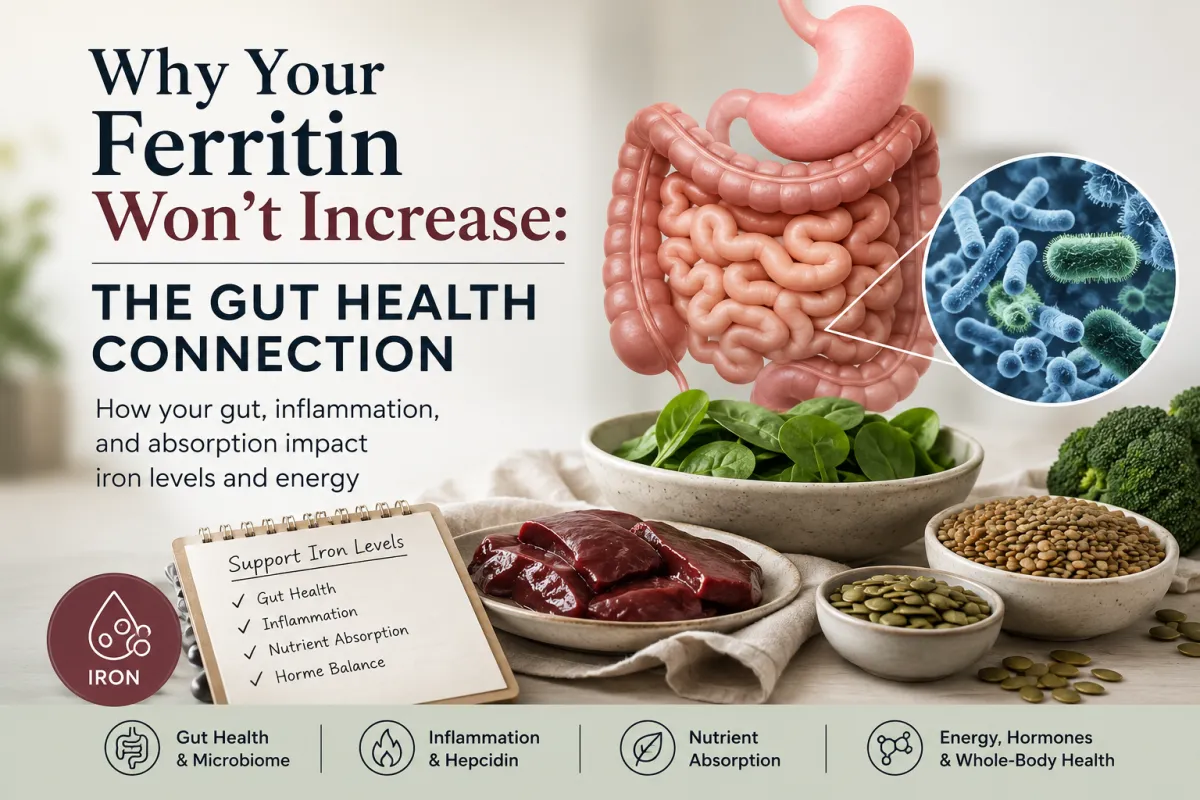
Why Your Iron Levels Won't Improve: The Missing Gut Health Connection
Are You Taking Iron but Still Have Low Ferritin?
If you've been taking iron supplements for months and your ferritin barely changes, you're not alone.
Many people assume low ferritin simply means they need more iron. In reality, persistent iron deficiency is often a sign that something else is interfering with absorption or regulation.
As an integrative medicine physician, I frequently look beyond the iron supplement itself and evaluate the digestive system, inflammation, hormones, thyroid function, and gut microbiome to identify the root cause.
Related reading: Why You're Still Tired Even After Sleeping → (Internal link to your fatigue blog)
What Is Ferritin?
Ferritin is your body's iron storage protein.
Think of it as your savings account for iron.
While serum iron tells us how much iron is circulating in your bloodstream today, ferritin tells us how much iron your body has stored for future use.
Low ferritin may contribute to:
Fatigue
Hair thinning
Brain fog
Restless legs
Poor exercise recovery
Cold intolerance
Reduced concentration
If you've also noticed increased hair shedding, read:
👉 Can Low Iron Cause Hair Loss? Here's What You Need to Know (Internal link to your hair loss article.)
Why Won't My Ferritin Increase?
There isn't one answer.
In my clinic, persistent low ferritin usually falls into one (or more) of these categories:
1. Poor Iron Absorption
Your digestive tract absorbs iron—not your supplement bottle.
Iron absorption may decrease because of:
Low stomach acid
Celiac disease
Inflammatory bowel disease
Chronic gastritis
H. pylori
Gut dysbiosis
If digestion isn't working properly, increasing iron intake alone may not solve the problem.
Learn more:
👉 Signs Your Gut Microbiome Is Out of Balance (Internal link to your gut health blog.)
2. Chronic Inflammation
Inflammation changes how your body handles iron.
One important hormone involved is hepcidin.
When inflammation rises, hepcidin increases.
That tells your body to:
absorb less iron
lock iron inside storage cells
reduce iron availability
This is why someone can have "normal" iron intake yet continue feeling exhausted.
3. Gut Microbiome Imbalance
This is one of the most overlooked causes.
Healthy gut bacteria produce compounds called short-chain fatty acids, especially butyrate, which help:
maintain the intestinal lining
regulate inflammation
support nutrient absorption
strengthen immune function
When the microbiome becomes imbalanced, iron absorption may decline.
If you frequently experience bloating, constipation, or food sensitivities, your microbiome may deserve closer evaluation.
Related article:
👉 Everything You Need to Know About Gut Health (Internal link.)
Could GLP-1 Medications Affect Iron Levels?
Patients taking medications like:
Zepbound®
Mounjaro®
Ozempic®
Wegovy®
sometimes develop declining ferritin over time.
This doesn't necessarily mean the medication causes iron deficiency directly.
Instead, several factors may contribute:
eating less food
lower protein intake
decreased iron intake
constipation
altered gut motility
microbiome changes
If you're taking a GLP-1 medication, it's important to monitor nutritional status—not just weight.
Related reading:
👉 What Every Woman Should Know Before Starting GLP-1 Medications (Internal link.)
Can Thyroid Problems Cause Low Ferritin?
Yes.
This is one reason I rarely evaluate ferritin in isolation.
Low ferritin and thyroid dysfunction frequently occur together.
Iron plays a role in thyroid hormone production, while thyroid disorders may contribute to fatigue, hair loss, and menstrual changes that further affect iron stores.
Related article:
👉 Why Thyroid Symptoms Persist Even When Your Labs Are "Normal" (Internal link.)
What Tests May Help Identify the Root Cause?
Depending on your symptoms, your healthcare provider may recommend evaluating:
Blood Tests
CBC
Ferritin
Iron panel
TIBC
Transferrin saturation
Vitamin B12
Folate
Vitamin D
hs-CRP
Thyroid panel
Functional Testing
Some patients may also benefit from comprehensive stool testing to evaluate:
microbiome diversity
digestive function
inflammation
intestinal permeability
infections
Testing should always be individualized based on symptoms and clinical history.
Functional Medicine Looks Beyond the Iron Bottle
One of the biggest differences between conventional and functional medicine is the question we ask.
Instead of asking:
"How much iron should we prescribe?"
we ask:
Why isn't iron being absorbed?
Is inflammation blocking absorption?
Is gut health impaired?
Could hormones be contributing?
Is there ongoing blood loss?
Are medications interfering?
Answering these questions often leads to more sustainable improvements.
Frequently Asked Questions
Can low ferritin cause hair loss?
Yes. Low ferritin is commonly associated with increased hair shedding, especially in women. Other causes such as thyroid disorders, hormonal changes, nutritional deficiencies, and stress should also be considered.
Related article: Top Causes of Hair Loss in Women (Internal link.)
Can gut health affect iron absorption?
Yes. Inflammation, dysbiosis, and digestive disorders may reduce iron absorption even when you're taking supplements.
Can GLP-1 medications lower ferritin?
They may contribute indirectly by reducing appetite, changing dietary intake, and altering gastrointestinal function. Monitoring nutritional status during treatment is important.
Should I keep taking more iron if my ferritin stays low?
Not necessarily. Increasing the dose without identifying the underlying cause may not solve the problem. A comprehensive evaluation can help determine why ferritin remains low.
The Bottom Line
If your ferritin won't increase despite supplementation, don't assume you simply need more iron.
Persistent low ferritin may be related to:
gut health
inflammation
microbiome imbalance
thyroid dysfunction
menstrual blood loss
nutritional deficiencies
medication effects
digestive disorders
Finding and treating the underlying cause often leads to better long-term results than simply increasing iron intake.
Ready to Find the Root Cause?
At Prolific Well Integrative Medicine, we evaluate the whole picture—not just a single lab value. If you're experiencing fatigue, hair loss, low ferritin, digestive concerns, or hormone changes, we can help uncover the factors contributing to your symptoms and develop a personalized plan.
Schedule your consultation today to take the next step toward restoring your energy and overall health.
Internal Linking Strategy (SEO & AEO)
To strengthen your site's topical authority, link this article to related content you've already created or plan to create:
Hormones
Perimenopause Symptoms
Menopause and Fatigue
Hormone Testing
Thyroid Disease
Hashimoto's Disease
Hair
Why Am I Losing My Hair?
Iron Deficiency and Hair Loss
Biotin for Hair Growth
Zinc for Hair Health
Gut
Gut Microbiome 101
SIBO
Constipation
Leaky Gut
Digestive Health
Nutrition
Vitamin B12
Folate
MTHFR Gene Mutation
Vitamin D
Magnesium
Metabolism
GLP-1 Medications
Weight Loss
Insulin Resistance
Blood Sugar Balance
This interconnected structure helps search engines and AI systems recognize your website as an authoritative resource on women's health, functional medicine, hormones, gut health, and longevity. It also encourages readers to stay on your site longer by naturally guiding them to related educational content.
can you get the link from my blog and embedded for me: https://prolificwell.com/blogs
Yes. I reviewed the blog page and found several relevant articles already published on your website that can be embedded naturally into the ferritin article. The strongest existing internal links are your posts on chronic fatigue, gut dysfunction, metabolism, hormones, thyroid, and hydration.
Below is the revised blog with real internal links embedded.
Why Your Ferritin Won’t Increase: The Hidden Gut Health Connection
By Dr. Evelyn Le Ellis, ND, MPH, FAIHM
Are you taking iron supplements but still struggling with low ferritin, fatigue, hair loss, brain fog, restless legs, or poor exercise tolerance?
Persistent low ferritin is not always caused by inadequate iron intake. In some cases, the problem is how well the body absorbs, regulates, transports, and stores iron.
The gastrointestinal tract, gut microbiome, inflammatory signaling, hormones, thyroid function, medications, and ongoing blood loss can all influence iron status. This is why a more complete evaluation may be necessary when iron supplementation alone is not working.
For a broader explanation of why persistent symptoms may continue even when routine testing appears normal, read How Integrative and Functional Medicine Uncover the Root Cause of Hormone Imbalance and Chronic Fatigue. That article explains how nutrient status, gut function, inflammation, thyroid signaling, and metabolic health can contribute to chronic fatigue and brain fog.
What Is Ferritin?
Ferritin is a protein that stores iron inside the body.
Serum iron measures the iron circulating in the bloodstream at the time of testing, while ferritin is commonly used to estimate stored iron. However, ferritin is also an acute-phase reactant, meaning it can increase during inflammation.
Because of this, ferritin should not always be interpreted by itself. Depending on the clinical picture, a provider may also evaluate:
Complete blood count
Serum iron
Total iron-binding capacity
Transferrin saturation
High-sensitivity C-reactive protein
Erythrocyte sedimentation rate
Vitamin B12 and folate
Thyroid markers
The pattern matters more than one isolated number.
What Are Common Symptoms of Low Ferritin?
Low iron stores may be associated with:
Fatigue
Hair shedding or thinning
Brain fog
Restless legs
Reduced exercise tolerance
Shortness of breath with exertion
Feeling cold
Difficulty concentrating
Headaches
Weakness
These symptoms are not specific to iron deficiency. Thyroid dysfunction, hormone changes, inadequate calories or protein, sleep disruption, inflammation, and other nutrient deficiencies may create similar symptoms.
Your existing article, Prepare Your Body for the Rest of the Year: How to Build Sustainable Energy, Metabolism, and Hormone Balance, provides additional context on how nutrient status, digestion, microbiome health, stress physiology, and hormone communication affect energy and resilience.
Why Won’t My Ferritin Increase?
When ferritin remains low despite supplementation, several possibilities should be considered.
1. Ongoing Blood Loss
Iron cannot be fully restored when the body continues to lose more than it absorbs.
Potential contributors include:
Heavy or prolonged menstrual bleeding
Uterine fibroids
Gastrointestinal bleeding
Frequent blood donation
Recent surgery
Pregnancy or postpartum blood loss
For women in perimenopause, irregular or unexpectedly heavy periods may gradually deplete iron stores.
Hormonal transitions can affect bleeding patterns, sleep, energy, mood, and cognition. Your article Why Women Feel Exhausted, Anxious, and “Not Like Themselves” explains why hormone symptoms should be interpreted in the context of sleep, stress, gut health, inflammation, and life stage.
2. Poor Iron Absorption
Iron is primarily absorbed in the upper small intestine. Absorption may be impaired by:
Celiac disease
Inflammatory bowel disease
Chronic gastritis
Helicobacter pylori
Bariatric surgery
Low stomach acid
Certain medications
Intestinal inflammation
Other malabsorption disorders
The dose of an iron supplement may be adequate, but the gastrointestinal environment may not support effective absorption.
3. Inflammation and Hepcidin
Hepcidin is a peptide hormone produced primarily by the liver. It helps regulate how much iron is absorbed from the intestine and how much is released from storage cells.
During inflammation, cytokines such as interleukin-6 can increase hepcidin production. Higher hepcidin activity reduces intestinal iron absorption and limits the release of stored iron into circulation.
This may create functional iron deficiency, a state in which iron exists in the body but is not sufficiently available to tissues.
In these cases, simply increasing iron intake may not fully address the problem. The source of inflammation also deserves attention.
How Does the Gut Microbiome Affect Iron?
The gut microbiome and iron have a bidirectional relationship.
Iron availability can influence which organisms thrive in the intestinal environment. At the same time, microbial balance, mucosal inflammation, intestinal barrier integrity, and microbial metabolites may influence nutrient absorption and immune signaling.
A healthy microbiome supports the production of short-chain fatty acids, including butyrate. Butyrate helps nourish colon cells, supports the intestinal barrier, and participates in anti-inflammatory signaling.
When microbial diversity declines or dysbiosis develops, the intestinal environment may become less supportive of nutrient absorption.
Your article on sustainable energy and hormone balance also explains how digestive imbalance and microbiome function may affect mood, cravings, inflammation, and energy regulation. Read Prepare Your Body for the Rest of the Year for a broader systems-based perspective.
Can Thyroid Dysfunction and Low Ferritin Occur Together?
Yes. Iron status and thyroid function are physiologically connected.
Iron is involved in thyroid hormone production, while thyroid dysfunction may contribute to symptoms such as:
Fatigue
Hair loss
Cold intolerance
Constipation
Brain fog
Reduced exercise tolerance
Heavy or irregular menstrual bleeding
Because of this overlap, evaluating ferritin without considering thyroid function may miss an important contributor.
Your article How Integrative and Functional Medicine Uncover the Root Cause of Hormone Imbalance and Chronic Fatigue discusses thyroid conversion, gut permeability, inflammation, micronutrients, and metabolic health as interconnected contributors to persistent symptoms.
Can GLP-1 Medications Affect Iron Status?
GLP-1 receptor agonists and dual GIP/GLP-1 therapies may indirectly affect iron status in some patients.
These medications can:
Reduce appetite
Decrease total calorie intake
Reduce dietary iron intake
Slow gastric emptying
Contribute to nausea or food aversion
Change bowel habits
Increase constipation
Affect the intestinal microbial environment
The medication itself should not automatically be assumed to be the cause of low ferritin. However, declining food intake and reduced nutrient density can become clinically relevant, particularly when someone is losing weight rapidly or avoiding iron-rich foods.
Patients using these therapies may benefit from periodically reviewing:
Protein intake
Total calorie intake
Iron-rich foods
Ferritin
Complete blood count
Vitamin B12
Folate
Vitamin D
Other nutrients based on symptoms
Can Dehydration Make Fatigue Feel Worse?
Dehydration does not usually explain low ferritin by itself, but it can intensify fatigue, headaches, constipation, dizziness, poor concentration, and reduced exercise performance.
This can make it difficult to distinguish symptoms related to iron deficiency from symptoms related to inadequate fluid intake.
For practical hydration guidance, read Hydration: The Daily Habit That Transforms Hormones, Energy and Longevity.
What Testing May Help When Ferritin Stays Low?
Testing should be individualized, but evaluation may include:
Blood testing
Complete blood count
Ferritin
Serum iron
Total iron-binding capacity
Transferrin saturation
Reticulocyte count
Vitamin B12
Folate
Thyroid panel
High-sensitivity C-reactive protein
Erythrocyte sedimentation rate
Comprehensive metabolic panel
Gastrointestinal evaluation
Depending on symptoms and medical history, evaluation may also include:
Celiac screening
Stool testing for occult blood
Testing for H. pylori
Gastroenterology referral
Endoscopy or colonoscopy when clinically indicated
Fecal calprotectin when intestinal inflammation is suspected
Functional gastrointestinal testing
In selected cases, comprehensive stool testing may provide additional information about:
Microbial diversity
Dysbiosis patterns
Digestive function
Short-chain fatty acid production
Intestinal inflammation
Mucosal immune activity
Functional stool testing should complement—not replace—appropriate conventional evaluation for bleeding, inflammatory bowel disease, celiac disease, malignancy, or other medical causes.
Should You Simply Take More Iron?
Not necessarily.
Taking more iron without understanding why ferritin remains low may lead to:
Constipation
Nausea
Abdominal pain
Poor adherence
Unnecessary supplementation
Delayed identification of ongoing blood loss or malabsorption
The more useful question is not only:
“How much iron should I take?”
It is also:
“Why is my body not absorbing, retaining, or using iron effectively?”
Frequently Asked Questions
Can gut problems cause low ferritin?
Yes. Conditions that impair digestion or intestinal absorption can contribute to low ferritin. Examples include celiac disease, inflammatory bowel disease, gastritis, H. pylori, bariatric surgery, and other malabsorption conditions.
Can inflammation cause iron deficiency?
Inflammation can increase hepcidin, reducing intestinal iron absorption and limiting iron release from storage. This can contribute to functional iron deficiency.
Can low ferritin cause hair loss?
Low iron stores may contribute to increased hair shedding in some individuals. However, thyroid disease, hormone changes, stress, inadequate protein, medications, and other nutrient deficiencies should also be evaluated.
Can GLP-1 medications lower ferritin?
They may contribute indirectly if appetite suppression significantly reduces dietary iron, protein, or total nutrient intake. The relationship should be evaluated individually rather than assumed.
Why is ferritin normal even though I have symptoms?
Ferritin can rise during inflammation. A result within the laboratory reference range does not always rule out iron-related concerns, particularly when inflammatory markers are elevated. Ferritin should be interpreted alongside the complete blood count, iron studies, symptoms, and inflammatory status.
The Bottom Line
Persistent low ferritin is often more complicated than inadequate iron intake.
Possible contributors include:
Ongoing blood loss
Heavy menstrual bleeding
Poor intestinal absorption
Celiac disease
Gastrointestinal inflammation
Gut dysbiosis
Elevated hepcidin
Thyroid dysfunction
Reduced food intake
Medication effects
A comprehensive evaluation helps determine whether the priority is iron replacement, improving dietary intake, addressing blood loss, treating gastrointestinal disease, reducing inflammation, or supporting another underlying system.
At Prolific Well Integrative Medicine, we evaluate fatigue, hair loss, digestive symptoms, hormone changes, thyroid function, nutrient status, and lifestyle patterns together rather than treating one laboratory number in isolation.
Related articles from Prolific Well:


