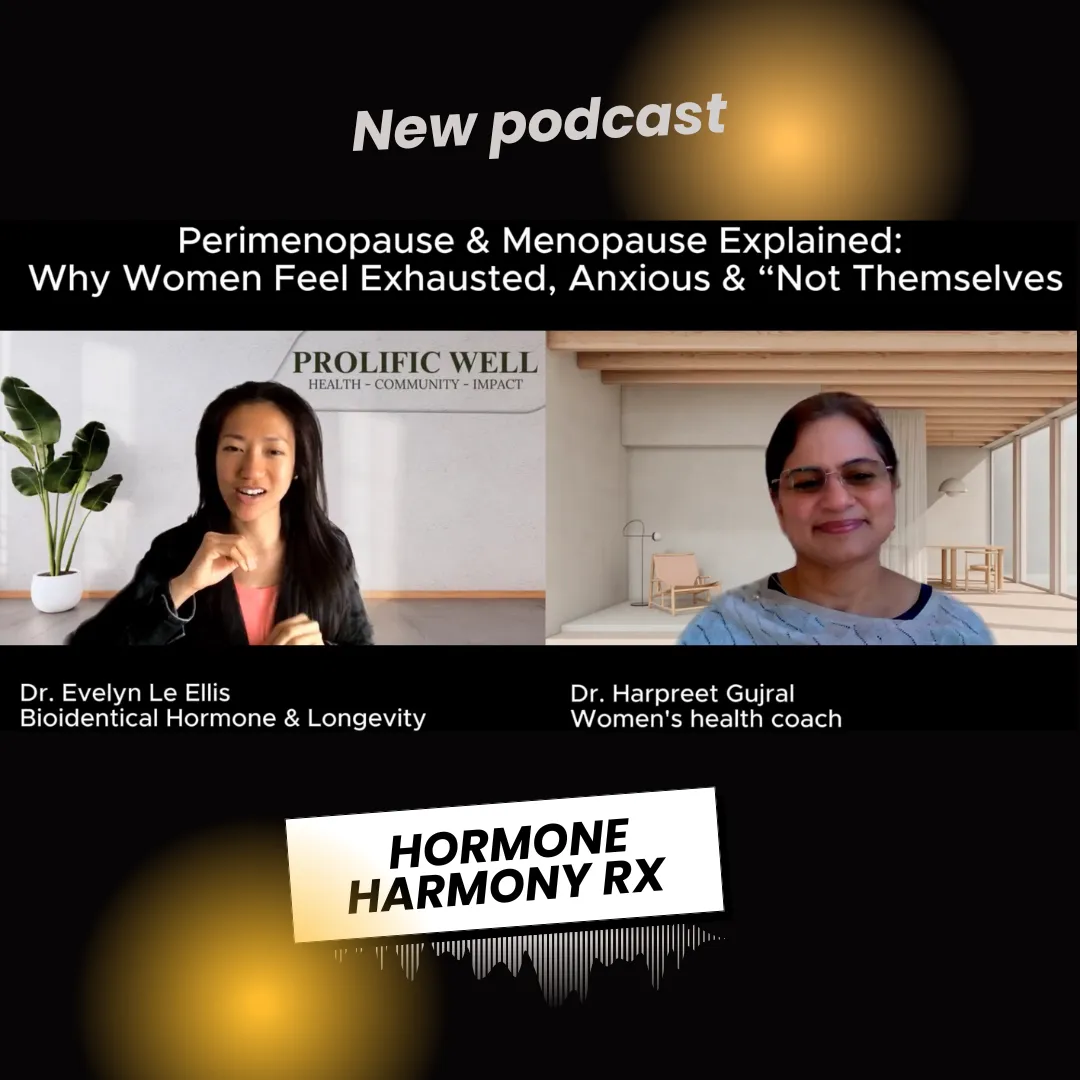
Perimenopause & Menopause Explained: Why Women Feel Exhausted, Anxious, and “Not Like Themselves”
Perimenopause & Menopause Explained: Why Women Feel Exhausted, Anxious, and “Not Like Themselves”
By Dr. Evelyn Le Ellis, ND, MPH, FAIHM
Podcast conversation with Dr. Harpreet Gujral, DNP
Take this Quiz to get a personalized self-care plan
Am I Thriving… or Just Getting Through the Day?
Many women reach a point—often quietly—where they stop and ask themselves:
Why am I waking up at 3 AM?
Why do I feel exhausted, foggy, irritable, or anxious when nothing “looks wrong”?
Why don’t I feel like myself anymore?
This moment is not weakness.
It’s a crossroads.
In a recent podcast episode, I sat down with Dr. Harpreet Gujral, Board-Certified Nurse Practitioner and Women’s Health Coach, to talk openly about perimenopause, menopause, hormone imbalance, and why so many women feel dismissed, confused, or gaslit during this phase of life.
What emerged was a powerful truth:
👉 Women aren’t broken. They’re under-supported.
The Hidden Reality of Perimenopause & Menopause
Perimenopause can begin as early as the mid-30s to early-40s, often years before periods stop completely. Yet many women are told:
“Your labs are normal.”
“This is just stress.”
“It’s part of aging.”
But here’s what women are actually experiencing:
Insomnia and waking at 3 AM
Anxiety or mood changes that feel unfamiliar
Brain fog and memory lapses
Weight gain despite eating “right”
Hot flashes, night sweats, heart palpitations
Loss of motivation, confidence, or joy
As Dr. Harpreet shared in our conversation, she lived this herself—while working full-time in high-pressure medical systems, caring for others, and ignoring her own symptoms.
That lived experience changed everything.
Why Conventional Medicine Often Falls Short
For decades, women’s hormone health has been shaped by outdated fear and misinformation, particularly following the early reporting of the Women’s Health Initiative (WHI) study in the early 2000s.
The result?
Hormones labeled as “dangerous”
Conversations shut down before they begin
Women left to suffer in silence
Dr. Harpreet described how those early messages shaped her own clinical decisions—until deeper research, updated evidence, and personal experience revealed the truth:
👉 When used appropriately, hormone therapy can be life-changing and protective for many women.
Today’s hormone care is not yesterday’s hormone care.
The science has evolved—but awareness hasn’t caught up.
Hormones Are Only Part of the Story
One of the most important insights from our conversation is this:
Hormones don’t exist in isolation.
A woman’s hormone experience is shaped by:
Stress and cortisol levels
Sleep quality and circadian rhythm
Gut health and inflammation
Trauma, culture, and ancestry
Life stage, workload, and relationships
This is why a 15-minute visit and a single prescription rarely lead to lasting change.
True healing requires context, coaching, and continuity.
Why Coaching Changes Outcomes
Information is everywhere.
Support is not.
As both Dr. Harpreet and I discussed, women don’t fail because they lack discipline or intelligence. They struggle because they’re trying to navigate complex physiology alone.
Health coaching bridges the gap between:
Knowing what to do
And actually living it
Through coaching, women:
Identify blind spots
Learn to read their body’s signals
Build sustainable routines
Replace self-criticism with self-compassion
Just like working with a personal trainer at the gym, support turns intention into results.
Cycle Awareness: A Missing Key for Women
For women who still menstruate, cycle awareness is a powerful and underutilized tool.
Tracking your cycle can reveal patterns in:
Energy
Mood
Focus
Sleep
Digestion
When women understand when to:
Push
Rest
Reflect
Create
Life stops feeling like a constant uphill battle.
And for women who are post-menopausal, hormone testing and symptom tracking still provide critical insight into rhythm, stress response, and nervous system health.
The Role of Community in Women’s Health
Isolation is one of the most overlooked drivers of burnout and hormonal imbalance.
Women are biologically wired for connection.
Yet many suffer quietly—believing they’re alone.
Dr. Harpreet emphasized something powerful:
👉 Healing accelerates in community.
Kitchen-table conversations.
Walks with a friend.
Supportive clinical relationships.
These are not “extras.”
They are medicine.
The Golden Truth: Your Body Is Not Broken
If there’s one message to take from this conversation, it’s this:
Your body is intelligent.
Your symptoms are signals.
And your hormones are asking you to listen—not fight.
Perimenopause and menopause are not endings.
They are transitions.
With the right support, this chapter can become one of the most grounded, confident, and powerful phases of a woman’s life.
About Dr. Harpreet Gujral
Dr. Harpreet Gujral is a Board-Certified Nurse Practitioner and Women’s Health Coach with over 25 years of experience. She blends science, functional medicine, mindfulness, and coaching to help women navigate perimenopause and menopause with clarity and confidence.
Connect with Dr. Harpreet:
Linktree: https://linktr.ee/limitlesshealth12
About Dr. Evelyn Le Ellis
Dr. Evelyn Le Ellis is an Integrative Naturopathic Doctor and founder of Prolific Well Integrative Medicine, specializing in women’s hormone health, longevity, and root-cause healing.
She helps women:
Understand their hormones
Restore energy and mental clarity
Build sustainable vitality through personalized care
👉 Ready to feel like yourself again?
Take this Quiz to get a personalized self-care plan
Final Thought
You don’t need to push harder.
You don’t need to suffer silently.
You need understanding, support, and permission to listen to your body.
This is your time to rise—not just survive.


