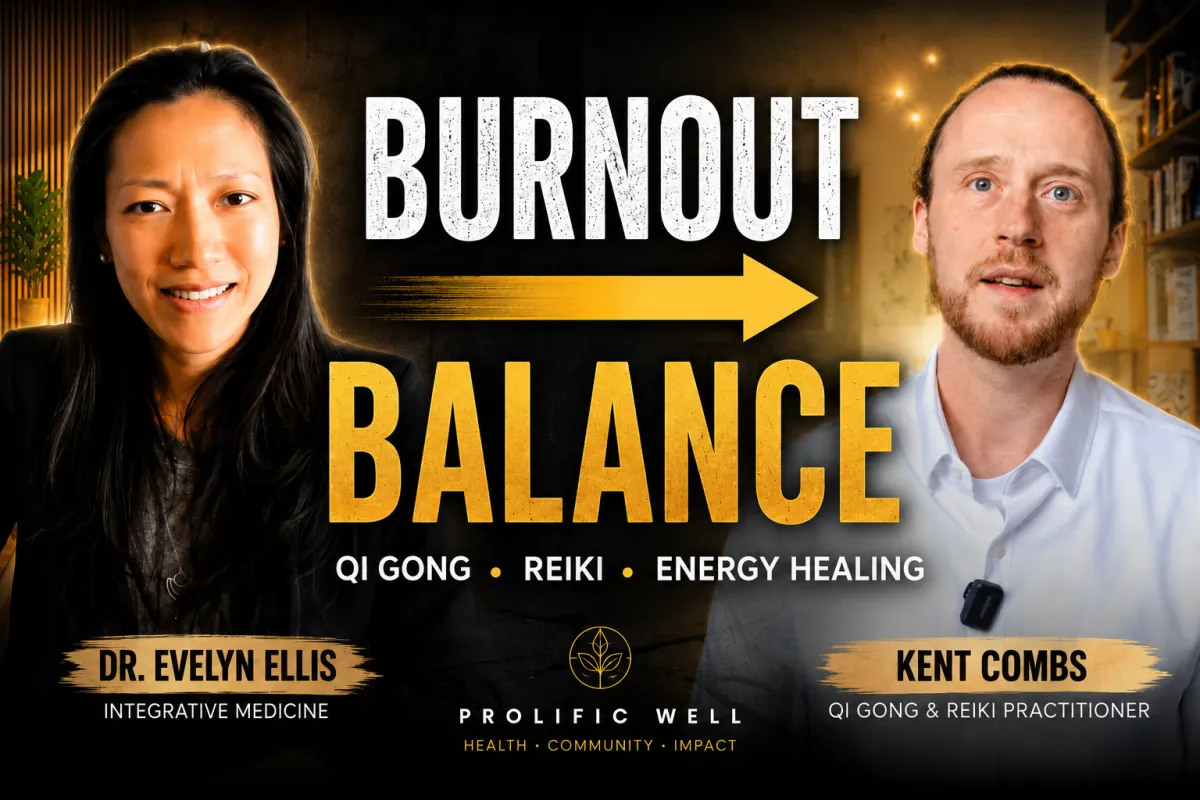
Qi Gong, Reiki, and the Nervous System: A Conversation with Kent Combs on Coming Back to Your Body
Qi Gong, Reiki, and the Nervous System: A Conversation with Kent Combs on Coming Back to Your Body
When Your Body Is Asking You to Slow Down
Many people do not realize they are living in chronic stress until the body starts speaking louder.
It may show up as fatigue, poor sleep, anxiety, low motivation, muscle tension, blood pressure changes, digestive symptoms, mood swings, brain fog, or the feeling of being disconnected from yourself.
In medicine, we often talk about hormones, inflammation, metabolism, gut health, cardiovascular risk, and lab markers. Those are important. But there is another layer that cannot be ignored:
The nervous system.
Before the body can repair, it needs to feel safe. Before energy can return, the body needs rhythm. Before clarity comes back, the mind and body often need space to slow down.
In this podcast episode, I sat down with Kent Combs, a Qi Gong teacher, Reiki practitioner, and integration guide based in Olympia, Washington. Kent’s work helps people reconnect with the body through gentle movement, breath, awareness, energy work, meditation, and integration.
This conversation was not about forcing healing or chasing quick fixes. It was about coming back to yourself.
Meet Kent Combs: Qi Gong, Reiki, and Integration
Kent Combs offers Qi Gong, Reiki, meditation, Tai Chi, space clearing, and integration support both online and in the Olympia/Tumwater area.
What I appreciate about Kent’s work is that he does not present healing as something aggressive or complicated. His approach is gentle, grounded, and practical.
He helps people reconnect the threads of body, energy, and awareness — especially when life, stress, grief, burnout, or transition has pulled those threads apart.
Kent’s own path into this work was not immediate. He has shared that he was once skeptical of Qi Gong and Reiki. Like many people, he initially thought these practices sounded too “woo-woo.” But his own experience changed his perspective. Through practice, he noticed shifts in his body, mind, and emotional state. Over time, Qi Gong became a pathway back to himself.
That matters because many people are curious about mind-body healing but hesitant. They wonder:
“Do I have to believe in this for it to help?”
“Do I need to be spiritual?”
“What if I cannot meditate?”
“What if I am too stiff, too tired, or too overwhelmed?”
Kent’s answer is refreshingly simple: begin where you are.
What Is Qi Gong?
Qi Gong is an ancient Chinese mind-body practice that combines gentle movement, breath, posture, attention, and awareness.
It is often compared to Tai Chi, meditation, or yoga, but it has its own rhythm and philosophy. Qi Gong can be practiced standing, seated, or adapted for different bodies and ability levels.
For people who feel burned out, overstimulated, or disconnected from their body, Qi Gong offers a different relationship with movement. It is not about pushing harder. It is not about performance. It is not about burning calories or achieving a perfect shape.
It is about listening.
That distinction is powerful.
Many people treat their body like a machine. They override fatigue. They ignore tension. They keep going until symptoms become too loud to dismiss. Qi Gong invites the opposite approach: slow down, breathe, notice, soften, and reconnect.
If you have been feeling exhausted, foggy, or hormonally off, you may also enjoy this related article: Why You’re Still Tired After Winter.
Why Mind-Body Practices Matter for Stress
The modern body is under constant demand.
Work stress, caregiving, financial pressure, emotional strain, poor sleep, inflammation, digital overload, hormone shifts, and constant stimulation can all keep the nervous system in a protective state.
When the nervous system is in protection mode, the body may prioritize survival over repair. Digestion, sleep, hormone signaling, immune function, mood regulation, and metabolic resilience may all be affected.
This is why stress is not “just in your head.”
Stress is physiological.
It affects the body’s chemistry, rhythm, energy, and recovery capacity. Over time, chronic stress can contribute to symptoms such as:
Fatigue
Anxiety
Poor sleep
Blood sugar swings
Muscle tension
Digestive issues
Brain fog
Mood changes
Cravings
Blood pressure changes
Hormone imbalance
At Prolific Well, I often remind patients that the body does not heal well in a constant state of urgency. Nutrition, supplements, hormone support, functional labs, and advanced testing all matter — but the nervous system environment matters too.
You cannot build long-term health on a foundation of constant survival.
For a deeper medical perspective on root-cause care, read: How Integrative & Functional Medicine Uncover the Root Cause of Hormone Imbalance and Chronic Fatigue.
What the Research Suggests About Qi Gong and Tai Chi
Qi Gong and Tai Chi are not new practices, but modern research is increasingly studying how these gentle mind-body approaches may support health.
The evidence is still developing, and it is important not to overstate it. Qi Gong, Tai Chi, Reiki, and meditation should not be framed as replacements for medical care, therapy, medication, lab evaluation, or emergency treatment when those are needed.
However, research suggests that slow movement and mind-body practices may support stress regulation, mood, sleep, balance, and cardiometabolic health in certain populations.
A 2024 randomized clinical trial published in JAMA Network Open found that Tai Chi reduced systolic blood pressure more than aerobic exercise over 12 months in adults with prehypertension.
The National Center for Complementary and Integrative Health also notes that practices such as Tai Chi and Qi Gong are being studied for stress, anxiety, balance, and general wellness support.
From an integrative medicine perspective, this makes sense. Slow rhythmic movement, breath regulation, attention, and body awareness may help shift the body away from constant fight-or-flight signaling and toward a more regulated state.
This does not mean Qi Gong is a cure-all. It means it may be a useful supportive practice for people who need a gentler way to reconnect with their body.
For related reading on cardiovascular and metabolic prevention, visit: Cholesterol Explained: Why Advanced Lipid Testing Provides Deeper Insight Into Heart Risk.
Reiki: Stillness, Support, and Receiving
Kent also practices Reiki, a form of energy work that is usually still and receptive rather than movement-based.
Qi Gong is more active. Reiki is more passive.
Qi Gong asks the person to participate through movement, breath, and attention. Reiki often allows the person to rest, receive, and settle.
For some people, that stillness can be uncomfortable at first. We live in a culture that praises productivity, busyness, and constant output. Rest can feel foreign. Receiving can feel vulnerable. Slowing down can bring awareness to emotions or tension that have been buried for a long time.
That is why safety and consent matter in body-based and energy-based work.
Kent’s approach emphasizes respect for the person’s pace. That is important. The goal is not to force a release or create a dramatic experience. The goal is to support the person in feeling more connected, grounded, and present.
This is also why complementary therapies should be held with maturity. Reiki may be supportive for relaxation, emotional comfort, and quality of life for some people, but it should not replace appropriate medical care.
In integrative medicine, the question is not “science or holistic care?”
The better question is: what belongs where?
Medical evaluation belongs where medical evaluation is needed. Therapy belongs where therapy is needed. Nutrition, lab testing, hormone care, movement, breathwork, community, spiritual care, and emotional support each have their place.
Whole-person healing requires discernment.
Integration: When Insight Becomes Embodied
One of the most meaningful parts of this conversation was the idea of integration.
Many people have insight. They know what they should do. They know they need to rest, eat better, move their body, set boundaries, ask for help, process grief, or stop overriding themselves.
But knowing is not the same as integrating.
Integration is what happens when awareness becomes lived experience.
It is the difference between saying, “I know I need to slow down,” and actually creating a life where your body is allowed to slow down.
It is the difference between reading about nervous system regulation and practicing one small breath when your body starts to tighten.
It is the difference between understanding your stress pattern intellectually and learning how to respond differently in the moment.
This is where Qi Gong, Reiki, meditation, breathwork, and other mind-body practices can become helpful. They give the body a way to participate in change.
For many women in midlife, this is especially relevant. Perimenopause and menopause can bring shifts in mood, sleep, cognition, stress resilience, energy, and identity. But this stage of life does not have to be a breakdown. It can be a recalibration.
For more on this, read: Midlife Isn’t a Crisis: How Women 45+ Can Reclaim Purpose, Confidence, and Their Heart’s Calling.
The Body Is Not Your Enemy
One of the biggest messages I want listeners to take from this conversation is this:
Your body is not your enemy.
When your body gives you symptoms, it is not trying to sabotage you. It is trying to communicate.
Fatigue may be asking for recovery.
Anxiety may be signaling overwhelm.
Digestive issues may reflect stress, inflammation, food patterns, microbiome imbalance, or nervous system dysregulation.
Pain may have physical, emotional, hormonal, and neurological layers.
Poor sleep may be connected to stress hormones, blood sugar, menopause, thyroid function, pain, or unresolved tension.
This is why I believe in a layered approach to healing.
At Prolific Well, we look at labs, hormones, metabolic markers, gut health, cardiovascular risk, nutrient status, toxins, and lifestyle patterns. But we also look at the human being sitting in front of us.
What have you been carrying?
What pace have you been living at?
What has your body been trying to say?
Where do you need more support?
Where do you need more structure?
Where do you need more softness?
Healing is not always about doing more. Sometimes it is about creating the conditions where the body can finally stop defending itself.
For related reading, visit: Why Your Chronic Pain Isn’t Just Physical.
Gut Health, Hormones, and the Nervous System Connection
The nervous system does not work in isolation.
Stress can affect digestion. Digestion can affect mood. The microbiome can influence inflammation, immune signaling, neurotransmitter activity, hormone metabolism, and energy regulation.
This is why people can sometimes feel like “everything is connected” — because it often is.
A person may come in with fatigue, bloating, anxiety, cravings, brain fog, hot flashes, poor sleep, and low motivation. Those symptoms may involve hormones, blood sugar, cortisol rhythm, gut health, thyroid function, nutrient status, and nervous system signaling.
That is why one-size-fits-all advice often fails.
Some people do not need another extreme diet. They need a more regulated body.
Some people do not need harsher exercise. They need restorative movement.
Some people do not need to push harder. They need to rebuild capacity.
Food diversity, microbiome support, gentle movement, stress regulation, sleep repair, and targeted lab testing can all be part of the bigger picture.
For more on the gut-hormone connection, read: Heal Your Gut, Boost Your Hormones, and Regain Energy Through Food Diversity.
A Simple Practice to Begin
If you are new to Qi Gong, Reiki, meditation, or body-based healing, you do not need to start with an hour-long practice.
Start small.
Try this:
Place both feet on the floor.
Let your shoulders soften.
Place one hand on your belly or heart.
Inhale slowly.
Exhale slowly.
Notice where your body feels tight.
Notice where your body feels supported.
Do not force anything.
Just give yourself one honest minute.
One minute will not fix everything.
But it may interrupt the pattern of rushing, bracing, and overriding. Over time, small practices can teach the body a different rhythm.
That is where change begins.
When to Seek Medical Support
Mind-body practices can be deeply supportive, but they are not a substitute for medical care.
If you are experiencing persistent fatigue, chest pain, shortness of breath, fainting, severe depression, suicidal thoughts, unexplained weight loss, heavy bleeding, severe pain, neurological symptoms, uncontrolled blood pressure, or symptoms that are worsening, please seek appropriate medical evaluation.
If you are navigating hormone changes, chronic fatigue, gut symptoms, metabolic concerns, sleep problems, anxiety, brain fog, or burnout, a root-cause evaluation can help identify what your body needs.
At Prolific Well, we often use advanced lab testing, hormone evaluation, gut testing, nutrient assessment, cardiovascular risk markers, and lifestyle medicine to build a personalized plan.
Supportive practices like Qi Gong, breathwork, Reiki, meditation, and restorative movement can fit beautifully alongside medical care when used appropriately.
For another related article, read: IV Nutrient Therapy Explained: Benefits, Risks, and Who Actually Needs It.
Final Takeaway: Come Back to Yourself
My conversation with Kent Combs was a reminder that healing does not always have to be forceful.
Sometimes healing begins with breath.
Sometimes it begins with gentle movement.
Sometimes it begins with stillness.
Sometimes it begins with being witnessed.
Sometimes it begins when we stop treating the body like a problem and start listening to it as a guide.
If you have been living in survival mode, disconnected from your body, or exhausted from pushing through, this episode is an invitation to pause.
You do not have to do everything at once.
Start with one breath.
One movement.
One moment of awareness.
One honest question:
“What is my body trying to tell me?”
That is often where the path back to health begins.
Listen to the Full Podcast Episode
Watch or listen to the full conversation with Kent Combs here:
[Insert YouTube or podcast episode link here]
You can learn more about Kent Combs and his Qi Gong, Reiki, meditation, and integration work at:
Work With Prolific Well
If you are ready to better understand your hormones, energy, gut health, metabolism, and nervous system patterns, Prolific Well Integrative Medicine can help you build a personalized path forward.
We support patients in Olympia, Tumwater, and surrounding communities with integrative and functional medicine care focused on hormone health, longevity, gut health, chronic fatigue, stress resilience, and whole-person wellness.
Book a consultation with Prolific Well and begin building the health foundation your future self will thank you for.


