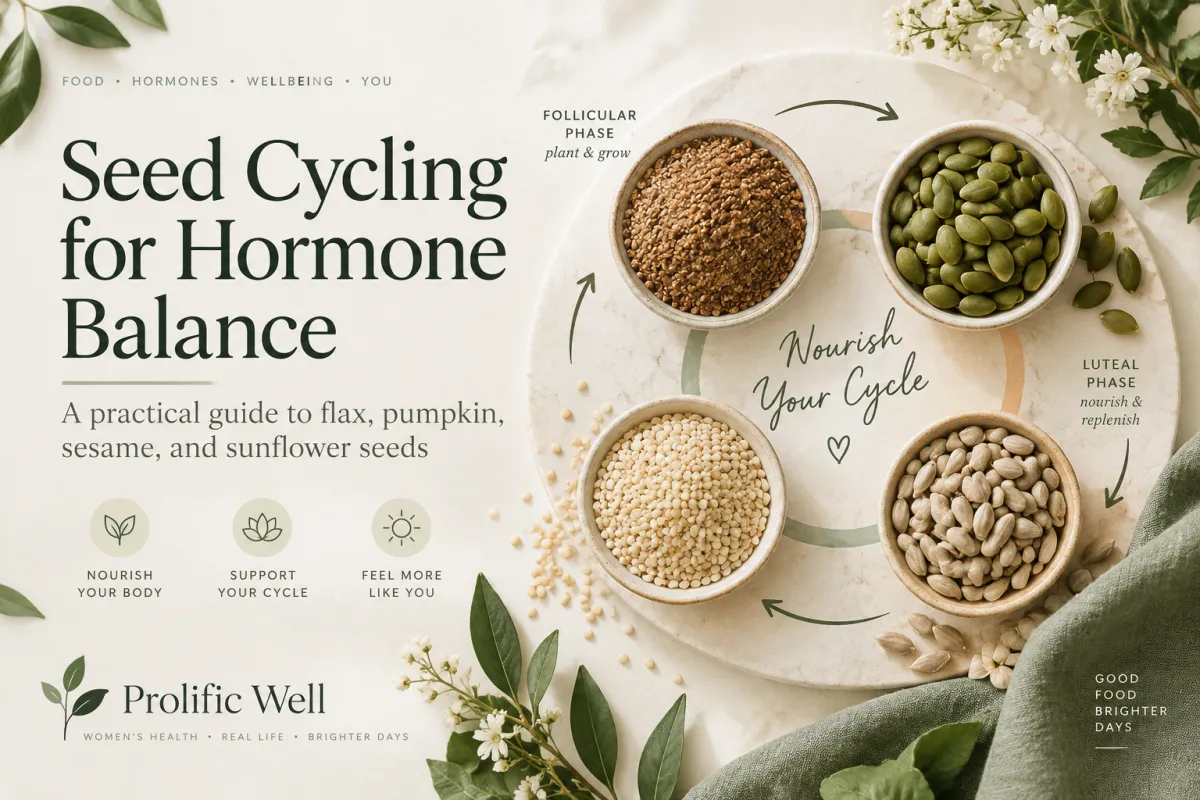
Seed Cycling for Hormone Balance: Does It Work and How Do You Do It?
Seed cycling has become popular in the hormone-health world because it offers a simple food-based routine: use certain seeds during the first half of the menstrual cycle and switch to a different pair during the second half.
I understand why people are drawn to it.
It is practical. It uses whole foods. It gives women a way to pay attention to the rhythm of their menstrual cycle instead of treating every day as physiologically identical.
But I also want to be clear about what the evidence does and does not show.
Seed cycling is not a proven treatment for hormone imbalance, PCOS, infertility, PMS, or irregular periods. It may still be a reasonable nutrition strategy because flax, pumpkin, sesame, and sunflower seeds provide fiber, healthy fats, lignans, minerals, and antioxidants that support overall metabolic and reproductive health.
The key is to use seed cycling as a supportive food strategy, not as a replacement for evaluating why your hormones or menstrual cycle may be changing.
What Is Seed Cycling?
Seed cycling is a dietary practice that rotates four seeds according to the two main halves of the menstrual cycle.
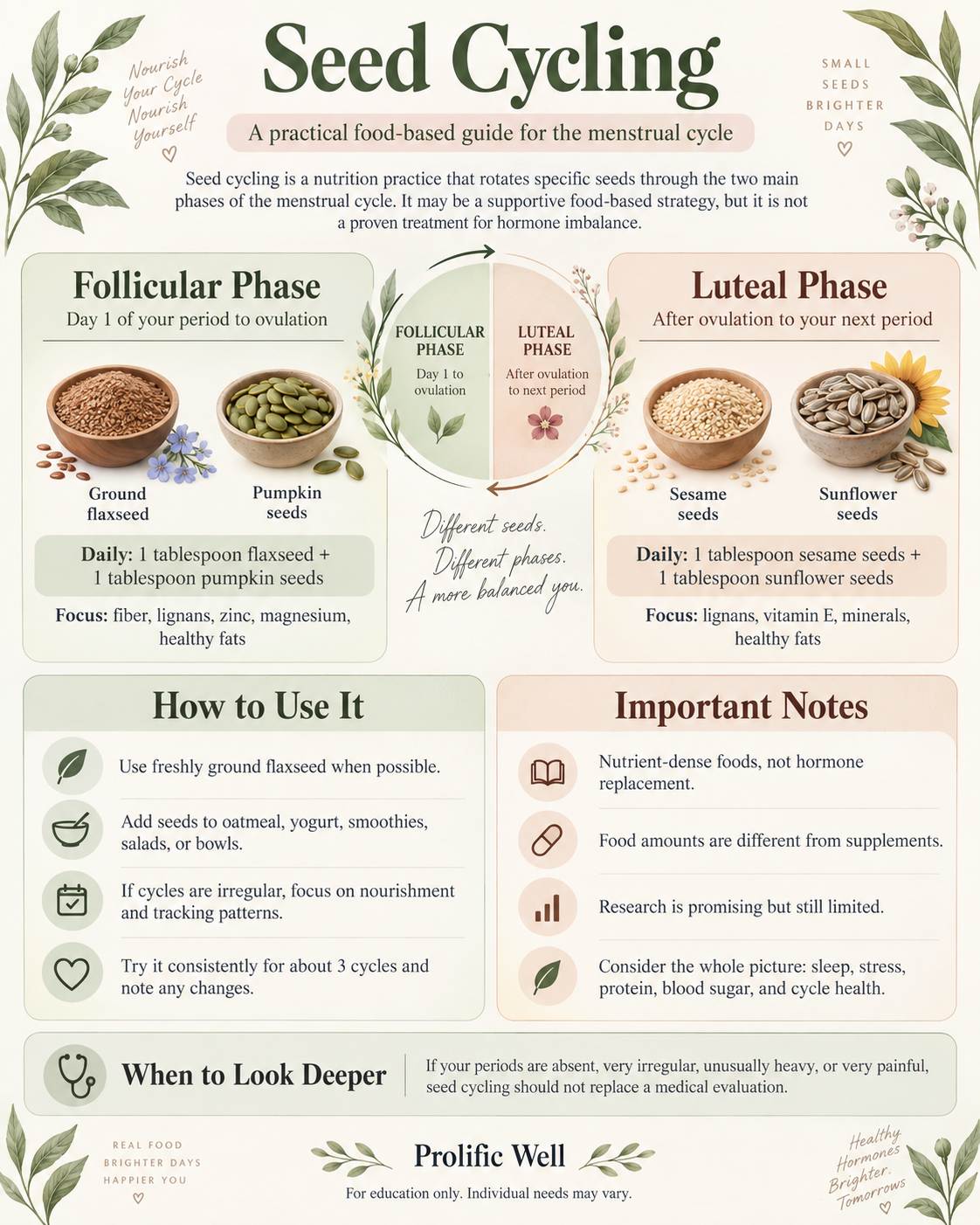
A commonly used protocol is:
Follicular Phase: Menstruation to Ovulation
Consume daily:
1 tablespoon freshly ground flaxseed
1 tablespoon pumpkin seeds
This phase begins on Day 1 of your menstrual cycle, which is the first day of full menstrual bleeding, and continues until ovulation.
For someone with a 28-day cycle, this is often described as approximately Days 1 through 14.
Luteal Phase: Ovulation to Your Next Period
Consume daily:
1 tablespoon freshly ground sesame seeds
1 tablespoon sunflower seeds
This phase begins after ovulation and continues until your next menstrual period starts.
For a typical 28-day cycle, this is often approximated as Days 15 through 28.
The seed-cycling resources you shared use this basic rotation of flax and pumpkin during the first half of the cycle, followed by sesame and sunflower during the second half.
I prefer teaching this according to actual cycle physiology rather than fixed calendar days, because not every woman ovulates on Day 14.
A 24-day cycle, a 32-day cycle, or an irregular cycle may look very different.
Quick Reference: How to Seed Cycle
Use this visual as a simple guide to the four-seed rotation. The exact timing should follow your actual cycle when possible, especially if you do not ovulate on Day 14.
Why Divide the Menstrual Cycle Into Two Phases?
To understand seed cycling, it helps to understand what your hormones are already doing.
During the follicular phase, estrogen generally rises as follicles in the ovary develop. Ovulation occurs when one dominant follicle releases an egg.
After ovulation, the luteal phase begins. The corpus luteum produces progesterone, along with estrogen, to prepare the uterine lining for a potential pregnancy.
If pregnancy does not occur, estrogen and progesterone fall and menstruation begins again.
Seed cycling is based on the idea that particular nutrients and plant compounds may complement these changing physiologic phases.
That concept is plausible from a nutritional standpoint.
What has not yet been established is that eating these four seeds in this exact sequence reliably produces clinically meaningful changes in estrogen and progesterone in most women.
That distinction is important.
Does Seed Cycling Actually Balance Hormones?
This is where I want to separate marketing claims from evidence.
A 2025 systematic review evaluated seed cycling and its components in reproductive-aged women with PMS or PCOS. Ten studies involving 635 participants reported improvements in outcomes such as menstrual regularity, PMS symptoms, some hormonal measures, and metabolic markers. However, the authors also emphasized that the studies were relatively small and that the evidence was limited by moderate study quality and a lack of standardized protocols.
So my interpretation is:
The research is promising enough to be interesting, but not strong enough to say that seed cycling has been proven to balance hormones.
That does not make seed cycling useless.
It means we should be precise about why we are using it.
For many patients, the benefit may come partly from eating more nutrient-dense seeds, more fiber, more plant lignans, and more healthy fats consistently.
Those are worthwhile changes even if the exact timing of the seeds turns out to be less important than social media suggests.
Why Flaxseed Gets So Much Attention
Of the four seeds commonly used in seed cycling, flaxseed has some of the strongest hormone-related research.
Flaxseed is rich in lignans, plant compounds that are metabolized by intestinal bacteria into enterodiol and enterolactone.
These compounds can interact with estrogen physiology, although their effects are more complicated than simply “raising” or “lowering” estrogen.
In a small randomized crossover study of 18 normally cycling women, flaxseed consumption was associated with a longer luteal phase and fewer anovulatory cycles during the flaxseed treatment periods. However, luteal-phase progesterone concentrations themselves were not significantly higher.
That is a very useful distinction.
You may see claims online that:
“Flaxseed boosts progesterone.”
That is not what this study demonstrated.
The study observed changes in menstrual-cycle characteristics and the progesterone-to-estradiol ratio, not a clear increase in progesterone itself.
Another study in premenopausal women found that adding flaxseed substantially increased lignan excretion but did not significantly change measured serum hormones.
Flaxseed has also been shown to influence estrogen metabolism in both premenopausal and postmenopausal populations.
For me, the take-home message is not that flax “detoxes estrogen.”
It is that flax is a lignan-rich, fiber-rich food that may influence estrogen metabolism and deserves a place in a hormone-supportive diet for many people.
Why Pumpkin Seeds Are Used in the Follicular Phase
Pumpkin seeds are commonly paired with flaxseed during the first half of the cycle.
Nutritionally, pumpkin seeds provide:
magnesium
zinc
plant protein
fiber
unsaturated fats
phytosterols
Zinc is involved in reproductive function and many enzymatic processes, while magnesium contributes to glucose regulation, muscle function, and nervous-system physiology.
However, there is much less direct evidence showing that pumpkin seeds specifically improve follicular-phase estrogen production when eaten during Days 1 through 14.
So I would describe pumpkin seeds as nutritionally supportive, rather than claiming that they directly “raise estrogen.”
Why Sesame Seeds Are Used in the Luteal Phase
Sesame seeds are rich in lignans including sesamin and sesamolin.
They also provide:
healthy fats
fiber
calcium
magnesium
copper
antioxidants
Sesame has demonstrated effects on sex-hormone-related markers in human research, but one often-cited randomized study involved postmenopausal women, not cycling premenopausal women.
In that study, 50 grams of sesame seed powder daily for five weeks influenced several metabolic and hormonal markers, including increases in sex hormone-binding globulin and urinary 2-hydroxyestrone.
That makes sesame interesting from a hormone-metabolism standpoint.
But it does not prove that eating sesame during the luteal phase increases progesterone.
I would not make that claim to a patient.
Why Sunflower Seeds Are Used in the Luteal Phase
Sunflower seeds provide:
vitamin E
selenium
magnesium
healthy fats
plant protein
Vitamin E has antioxidant functions and is important in cell-membrane health.
Again, the nutritional value is clear.
The evidence that sunflower seeds specifically improve luteal-phase progesterone production through seed cycling is not established.
That is why I teach seed cycling as a nutrition framework rather than a precise hormonal therapy.
What About Omega-3 and Evening Primrose Oil?
Some seed-cycling protocols add supplements such as omega-3 fatty acids during the follicular phase and evening primrose oil during the luteal phase.
I consider those separate interventions.
They are not the same thing as the four-seed food protocol.
If I recommend omega-3s, evening primrose oil, magnesium, vitamin B6, or another supplement, I want there to be a specific clinical reason rather than adding it automatically because someone is seed cycling.
Supplements should answer a question.
What are we trying to improve?
PMS?
Inflammation?
Triglycerides?
Dietary omega-3 intake?
Breast tenderness?
Cycle irregularity?
Once we know the goal, we can decide whether a supplement belongs in the plan.
How to Seed Cycle
If you would like to try seed cycling, I keep the protocol simple.
Phase 1: Menstruation Through Ovulation
Each day:
1 tablespoon freshly ground flaxseed
1 tablespoon pumpkin seeds
Continue until you ovulate.
Phase 2: After Ovulation Until Your Next Period
Each day:
1 tablespoon freshly ground sesame seeds
1 tablespoon sunflower seeds
Continue until the first day of your next menstrual period.
Then return to flax and pumpkin.
How Do I Know When I Ovulate?
You do not have to assume ovulation occurs on Day 14.
You may track ovulation with:
cervical mucus changes
urinary LH testing
basal body temperature
fertility-awareness tracking
menstrual-cycle apps, although apps estimate rather than confirm ovulation
If you know your usual ovulation pattern, switch seeds after ovulation rather than rigidly following Day 14.
For someone who simply wants an easy routine and has a relatively predictable 28-day cycle, Days 1–14 and Days 15–28 can be a practical approximation.
Why I Recommend Grinding the Seeds
I generally prefer freshly ground flaxseed, especially because whole flax can pass through the gastrointestinal tract without being fully broken down.
Grinding exposes more of the seed's nutrients and lignan precursors for digestion.
Sesame seeds can also be ground if desired.
You can grind a small amount using a:
coffee grinder
spice grinder
high-powered blender
Because seeds contain oils that can oxidize, grind smaller batches and store them in a sealed container in the refrigerator.
You do not need to turn this into another complicated wellness project.
Consistency matters more than perfection.
Easy Ways to Eat Your Seeds
The easiest strategy is to attach them to foods you already eat.
Try adding your seed mixture to:
Greek yogurt
oatmeal
chia pudding
smoothies
cottage cheese
salads
overnight oats
soups
grain bowls
nut or seed butter
homemade energy bites
I prefer incorporating the seeds into an actual meal rather than treating them like another supplement you have to remember.
That makes the habit much easier to maintain.
Can Seed Cycling Help PMS?
Possibly.
The 2025 systematic review found that seed-cycling interventions and individual seed components were associated with improvement in PMS symptom severity in some studies.
But PMS has multiple possible contributors, including:
normal sensitivity to hormone fluctuations
sleep disruption
stress
inadequate caloric intake
blood sugar instability
alcohol
nutrient deficiencies
thyroid dysfunction
medication effects
If PMS significantly interferes with your relationships, work, sleep, or daily life, I would not rely on seed cycling alone.
We need to look deeper.
Can Seed Cycling Help PCOS?
This is another area where the answer is possibly supportive, but not enough as a stand-alone treatment.
The 2025 systematic review found favorable changes in menstrual regularity, metabolic measures, and hormonal markers in studies involving women with PCOS.
Flaxseed in particular has been studied in PCOS-related metabolic and hormonal contexts.
But PCOS can involve:
insulin resistance
elevated androgens
irregular or absent ovulation
inflammation
sleep problems
weight changes
genetic susceptibility
Seed cycling does not replace evaluating these drivers.
A tablespoon of seeds will not compensate for untreated insulin resistance, significant hyperandrogenism, thyroid dysfunction, or chronic anovulation.
It can be one piece of a larger plan.
What If My Periods Are Irregular?
If your cycle is irregular, I would not obsess over finding the perfect seed-switching day.
If you can identify ovulation, use your actual ovulation date.
If your cycles are very irregular or you are not ovulating consistently, the more important question is:
Why?
Potential contributors can include:
PCOS
thyroid dysfunction
hyperprolactinemia
inadequate energy intake
excessive exercise
perimenopause
stress
medication effects
pregnancy
Seed cycling may still be a nutritious routine, but it should not distract us from determining why the menstrual cycle is irregular.
Do I Need to Follow the Moon if I Don't Have a Period?
Some seed-cycling websites suggest following the lunar cycle if you do not menstruate, often using the new moon as Day 1 and the full moon as the midpoint.
I do not consider moon-based cycling a physiologically established treatment.
You can certainly use a calendar-based rotation if it helps you maintain a routine, but I would not tell you that the moon is regulating your reproductive hormones.
If you are not menstruating when you normally should be, I would rather investigate the reason.
Can You Seed Cycle During Perimenopause?
You can still eat these seeds during perimenopause.
However, perimenopause often involves increasingly variable ovulation.
A woman may ovulate normally one month, ovulate much later the next month, and occasionally have an anovulatory cycle.
That makes a rigid Day 1–14 and Day 15–28 protocol less physiologically precise.
I am more interested in making sure a woman in perimenopause is getting enough:
protein
fiber
omega-3 fats
calcium
magnesium
micronutrients
total calories
along with resistance training, sleep support, and appropriate evaluation of symptoms.
Seed cycling can fit into that foundation.
It should not become the foundation itself.
Can You Seed Cycle After Menopause?
After menopause, there is no follicular or luteal phase because regular ovulation has stopped.
You can still eat flax, pumpkin, sesame, and sunflower seeds. They remain nutritious foods.
But rotating them according to menstrual phases no longer has the same physiologic rationale.
For postmenopausal women, I focus more on consistent dietary patterns supporting:
cardiovascular health
metabolic health
bone health
muscle preservation
bowel regularity
healthy estrogen metabolism
Interestingly, flaxseed and sesame have both been studied in postmenopausal women and shown effects on certain hormone-metabolism and cardiovascular markers.
How Long Should You Try Seed Cycling?
I generally think in terms of several menstrual cycles rather than several days.
Hormonal symptoms fluctuate naturally from month to month.
If you try seed cycling, I would give the routine roughly three cycles while tracking meaningful outcomes such as:
cycle length
ovulation
PMS
breast tenderness
headaches
cravings
bowel movements
sleep
acne
bleeding patterns
Then ask:
Did anything actually improve?
Do not continue something indefinitely simply because it has become part of your routine.
Measure whether it is helping you.
Who Should Be More Careful With Seed Cycling?
For most people, these are common foods.
But individualized considerations still matter.
Talk with your healthcare professional if you have:
a seed allergy
significant gastrointestinal disease
difficulty tolerating high-fiber foods
a history of bowel obstruction or narrowing
specific medication concerns
a medical condition requiring individualized nutrition recommendations
Also remember that seeds are calorie-dense foods.
That is not a reason to fear them. It simply means the amount should fit into the rest of your nutrition pattern.
Seed Cycling Frequently Asked Questions
Does seed cycling really balance hormones?
We do not currently have strong enough evidence to say that seed cycling reliably “balances hormones.” A 2025 systematic review found promising results for PMS, PCOS, menstrual regularity, metabolic markers, and some hormonal measures, but the available studies were relatively small and varied in quality.
What seeds do you use for seed cycling?
The traditional four-seed approach uses flax and pumpkin seeds during the follicular phase, followed by sesame and sunflower seeds during the luteal phase.
How much seed should I eat each day?
A commonly used protocol is 1 tablespoon of each seed daily, meaning two tablespoons total per day.
Should flaxseed be ground?
Yes. I generally recommend ground flaxseed because grinding improves access to the seed's nutrients and lignan precursors.
Can I grind all my seeds ahead of time?
You can grind a small batch and refrigerate it in an airtight container. I would avoid grinding very large quantities and leaving them at room temperature for prolonged periods because the oils can oxidize.
Does flaxseed increase estrogen?
That is too simplistic.
Flax contains lignans that can influence estrogen metabolism. Human studies have shown changes in estrogen metabolites and some cycle characteristics, but the effect is not simply “more estrogen” or “less estrogen.”
Does sesame increase progesterone?
We do not have good evidence that eating sesame seeds during the luteal phase directly raises progesterone in cycling women. Sesame does contain lignans and has demonstrated effects on several hormone-related markers in human research, but commonly cited research includes postmenopausal women rather than reproductive-aged women.
Can seed cycling help me get pregnant?
Seed cycling should not be presented as a fertility treatment.
Nutrition absolutely matters for reproductive health, but infertility can involve ovulation, sperm quality, fallopian tubes, endometriosis, ovarian reserve, age, thyroid function, metabolic health, and other factors.
Do not delay fertility evaluation because you are waiting for a nutritional strategy to correct an underlying medical problem.
The Bigger Picture: Your Hormones Respond to More Than Seeds
This is probably the most important message I want you to take from this article.
Your reproductive system does not respond to one food in isolation.
Your hormones receive information from:
total nutrition
protein intake
blood glucose
insulin
body composition
sleep
stress
physical activity
thyroid function
gut health
medications
age
genetics
Seeds can contribute valuable nutrients.
But they cannot compensate for everything else.
I would much rather see you consistently eating enough protein, fiber-rich plants, healthy fats, colorful vegetables, and minimally processed foods than perfectly rotating four seeds while the rest of your nutrition is chaotic.
The Bottom Line
Seed cycling is one of those wellness practices where I think the truth lives between the extremes.
I would not dismiss it as nonsense.
Flax, pumpkin, sesame, and sunflower seeds are nutritious foods, and emerging research suggests that seed-based dietary interventions may support menstrual, metabolic, and hormonal outcomes in some women.
But I also would not promise that:
flax raises estrogen, sesame raises progesterone, or rotating seeds will fix a hormone imbalance.
The science is not there yet.
What I do like about seed cycling is that it encourages women to pay attention to their menstrual cycle while consistently eating nutrient-dense whole foods.
That is a reasonable experiment.
Try it for a few cycles.
Track your symptoms.
Pay attention to your body.
And if your periods are significantly irregular, painful, absent, unusually heavy, or accompanied by symptoms that affect your quality of life, do not simply keep adding supplements and seeds.
Find out what your physiology is trying to tell you.
What to Read Next
If you are working on hormone health, nutrition is only one piece of the picture. Continue with these Prolific Well guides to build a stronger foundation:
How Much Protein Do You Really Need?
Learn how protein needs change with age, activity, metabolism, and your health goals.
Why Protein Matters More After 40
Understand why preserving muscle becomes increasingly important for metabolism, bone health, and longevity.
How to Eat Carbs Without Spiking Your Blood Sugar
Learn how protein, fiber, fat, meal order, and movement can change your glucose response.
What Fats Should I Actually Eat?
A practical guide to choosing fats that support metabolic, cardiovascular, and hormonal health.
References
Nagarajan DR, et al. Efficacy of Seed Cycling as an Integrative Therapy for Premenstrual Syndrome and Polycystic Ovary Syndrome in Reproductive-Aged Women: A Systematic Review. Cureus. 2025.
Phipps WR, et al. Effect of flax seed ingestion on the menstrual cycle. Journal of Clinical Endocrinology & Metabolism. 1993.
Frische EJ, et al. Effect of flaxseed and wheat bran on serum hormones and lignan excretion in premenopausal women. Journal of the American College of Nutrition. 2003.
Wu WH, et al. Sesame ingestion affects sex hormones, antioxidant status, and blood lipids in postmenopausal women. Journal of Nutrition. 2006.
Hutchins AM, et al. Flaxseed consumption influences endogenous hormone concentrations in postmenopausal women. Nutrition and Cancer. 2001.
Chang VC, et al. Effect of Dietary Flaxseed Intake on Circulating Sex Hormone Levels among Postmenopausal Women: A Randomized Controlled Intervention Trial. Nutrition and Cancer. 2019.
Lampe JW, et al. Urinary lignan and isoflavonoid excretion in premenopausal women consuming flaxseed powder. American Journal of Clinical Nutrition. 1994.
Haggans CJ, et al. The effect of flaxseed and wheat bran consumption on urinary estrogen metabolites in premenopausal women. Cancer Epidemiology, Biomarkers & Prevention. 2000.
Medical Disclaimer
This article is for educational purposes only and is not intended to diagnose or treat a medical condition. Menstrual irregularities, infertility, abnormal bleeding, severe PMS, or other hormone-related symptoms may require medical evaluation. Dietary strategies should be individualized based on your medical history, medications, nutritional needs, and health goals.


