
Prevent Holiday Weight Gain & Burnout: Cravings, Gut Health, Cortisol and Metabolism
The holidays can be joyful, meaningful, and full of connection. They can also bring richer foods, disrupted routines, more alcohol, less movement, shorter sleep, travel, family stress, and a calendar that feels increasingly full.
By January, many people tell me some version of the same thing:
“I gained so much weight.”
“My cravings are out of control.”
“My digestion feels completely different.”
“I am exhausted.”
“I need to detox and start over.”
But your metabolism does not suddenly stop working because you ate pie at Thanksgiving or attended several holiday parties.
What matters more is the accumulation of signals your body receives over several weeks.
Food is a signal.
Sleep is a signal.
Movement is a signal.
Stress is a signal.
Alcohol is a signal.
And your gut microbiome is responding to those signals too.
The goal during the holidays is not perfection. The goal is to maintain enough of your normal physiologic rhythm that you can enjoy the season without feeling like you need to rescue your body in January.
How Much Weight Do People Actually Gain During the Holidays?
One of the first things I want to clear up is the common belief that everyone gains five or ten pounds between Thanksgiving and New Year's.
Research paints a more nuanced picture.
In a prospective study of 195 adults published in the New England Journal of Medicine, average holiday-season weight gain was much smaller than the commonly repeated five-pound figure. The researchers also found that much of the weight gained during the broader holiday period was not subsequently lost, which means even modest annual gains can accumulate over time. New England Journal of Medicine
That distinction matters.
My bigger concern is usually not one Thanksgiving dinner.
It is when Thanksgiving dinner gradually turns into several weeks of:
Skipping normal meals
Eating more ultra-processed foods
Drinking more alcohol
Sleeping less
Exercising less
Grazing throughout the day
Feeling more stressed
Telling yourself, “I will start over in January”
That pattern can affect much more than the number on the scale.
Why Can the Scale Jump Several Pounds After a Holiday Meal?
If your weight suddenly increases after a holiday weekend, that does not necessarily mean you gained that amount of body fat.
Short-term changes on the scale may reflect:
Greater sodium intake and water retention
Increased carbohydrate intake and glycogen storage
Food still moving through the gastrointestinal tract
Alcohol intake
Changes in bowel movements
Hormonal fluctuations
Less movement than usual
This is why I do not recommend panicking over the scale the morning after Thanksgiving or a holiday party.
Return to your routine first.
Hydrate.
Eat normally.
Move your body.
Sleep.
Give your digestive system time.
One meal does not determine your metabolic health.
Cravings Are Biology, Not Weakness
Cravings are often described as a willpower problem.
That explanation is far too simple.
Your brain is constantly receiving information about:
Blood glucose
Hunger
Satiety
Sleep
Stress
Hormones
Food availability
Emotional state
Habits
Reward pathways
Your environment
During the holidays, many of those signals change at the same time.
Maybe you slept five hours because you were wrapping gifts.
You skipped breakfast because you knew a large dinner was coming.
You have been sitting more because the weather changed.
Cookies have been sitting on the counter for three days.
Your work deadlines increased.
Your family is visiting.
Then suddenly you are standing in the kitchen wondering why the cookies seem impossible to ignore.
That does not mean your body is failing you.
It means your physiology is responding to the environment you have created around it.
If cravings, weight changes, mood shifts, or fatigue are happening outside the holiday season as well, they can sometimes overlap with broader hormonal or metabolic concerns. You can read more in my guide, Hormone Imbalance Symptoms in Women and Men: 30 Warning Signs You Shouldn't Ignore. Prolific Well
Blood Sugar Can Influence Hunger and Cravings
One practical strategy for appetite regulation is to build meals around:
Protein + fiber + plants + healthy fats + minimally processed carbohydrates
For example, instead of having only coffee and a pastry for breakfast, you might choose:
Greek yogurt with berries, chia seeds, and nuts.
Eggs with vegetables and avocado.
Oatmeal with protein, berries, seeds, and nut butter.
A smoothie containing adequate protein, vegetables or berries, fiber, and healthy fats.
You do not need to eliminate carbohydrates.
The goal is to create a meal that provides a steadier metabolic signal and keeps you satisfied longer.
Sleep Is Part of Your Metabolism
Sleep often becomes collateral damage during the holidays.
There are parties, travel, gift shopping, family gatherings, work deadlines, late-night movies, and children staying up later than usual.
But sleep is not separate from metabolism.
Sleep influences appetite regulation, glucose metabolism, mood, recovery, and stress physiology.
When sleep decreases, cravings may feel stronger and decision-making around food can become more difficult.
That means your holiday nutrition strategy should not begin and end with food.
Sometimes one of the most useful things you can do for your metabolism is simply go to bed.
Stress Can Change the Way We Eat
Stress eating is real, but people respond differently.
A systematic review and meta-analysis of studies involving healthy adults found that stress was associated overall with small increases in food intake and a tendency toward less healthful eating patterns, although individual responses varied considerably. PubMed
Think about what happens during a busy December afternoon.
You have been answering emails.
You still need groceries.
Family is arriving tomorrow.
You slept six hours.
Lunch was rushed.
There is a plate of cookies in the break room.
Suddenly the cookie feels much more compelling.
That is not simply a character flaw.
Your stress physiology, hunger, sleep, environment, and food availability are all interacting at once.
Cortisol, Mood, Hormones, and Holiday Burnout
Cortisol is often talked about as though it is inherently bad.
It is not.
Cortisol is an essential hormone involved in the body's stress response, energy availability, immune regulation, blood pressure, and daily circadian rhythm.
The problem is not having cortisol.
The problem can arise when stress load repeatedly exceeds recovery.
Holiday stress may include:
Work deadlines.
Travel.
Hosting.
Caregiving.
Financial pressure.
Family expectations.
Relationship stress.
Reduced daylight.
Poor sleep.
More alcohol.
Less exercise.
Trying to make everything perfect.
Your nervous system does not neatly separate emotional stress, sleep deprivation, work stress, and metabolic stress.
It experiences the total load.
That is why burnout can show up in many different ways, including:
Fatigue.
Irritability.
Poor sleep.
Low motivation.
More cravings.
Brain fog.
Headaches.
Digestive symptoms.
Reduced exercise tolerance.
Changes in libido.
Feeling emotionally overwhelmed.
If symptoms such as fatigue, weight changes, poor sleep, low libido, mood changes, or brain fog are persistent rather than seasonal, it may be worth looking beyond holiday stress alone. My article on Hormone Imbalance Symptoms in Women and Men explains some of the patterns that can warrant a more comprehensive evaluation. Prolific Well
Your Metabolism Is Connected to Your Gut Microbiome
Metabolism does not happen only in your muscles, thyroid, liver, or bloodstream.
Your gastrointestinal tract contains an enormous ecosystem of microorganisms collectively known as the gut microbiome.
These organisms interact with the foods you eat and produce metabolites that can communicate with other systems throughout the body.
Dietary fiber is particularly important because many fibers are fermented by gut microorganisms. Research continues to explore how these interactions influence microbial ecology, metabolic signaling, inflammation, and cardiometabolic health. Responses can differ substantially between individuals. Nature
Short-chain fatty acids produced through microbial fermentation of dietary fiber also participate in several physiologic processes involving the gut and immune system. Nature
This does not mean there is one perfect “weight-loss microbiome.”
There is not.
But it does mean your gut is another reason to think beyond calories alone.
If you want a deeper introduction to the microbiome, read Unlocking the Secrets of the Microbiome: How Gut Health Transforms Your Well-being. Prolific Well
Feed Your Microbiome During the Holidays
Instead of immediately asking:
“What food should I remove?”
Try asking:
“What plants can I add?”
That shift alone can make holiday eating feel much less restrictive.
Consider adding more:
Beans and lentils.
Leafy greens.
Cruciferous vegetables.
Berries.
Apples and pears.
Whole grains.
Nuts.
Seeds.
Herbs and spices.
Onions and garlic if tolerated.
Fermented vegetables.
Yogurt or kefir if tolerated.
Research supports the important interaction between dietary fiber and the gut microbiome, while also showing that different fibers and different people can produce different microbial responses. Nature
You do not need thirty supplements to start supporting the gut.
Often the first question is much simpler:
How much variety is actually on your plate?
I go deeper into that strategy in Heal Your Gut, Boost Your Hormones, and Regain Energy Through Food Diversity, including practical ways to increase food diversity without turning eating into another restrictive protocol. Prolific Well
The Holiday Metabolic Protectio
n Plan
Instead of trying to follow a perfect holiday diet, I recommend protecting a few basic metabolic anchors.
If these remain reasonably consistent, the occasional richer meal becomes far less important.
1. Protein First
Build your meals around a meaningful protein source.
Options may include:
Eggs.
Greek yogurt.
Fish.
Chicken.
Turkey.
Tofu.
Tempeh.
Beans.
Lentils.
Cottage cheese.
Protein helps create a more satisfying meal and gives you a foundation for adding vegetables, fiber, and carbohydrates.
This does not mean you cannot have mashed potatoes.
It means mashed potatoes do not need to become the entire meal.
2. Add Fiber and Plants
Before removing food, look at your plate and ask:
Where are my plants?
A simple plate could look like:
½ vegetables or salad
¼ protein
¼ potatoes, rice, stuffing, grains, or another carbohydrate
Then enjoy the foods that matter to you.
Fruit, nuts, seeds, legumes, herbs, and fermented foods can add even more diversity throughout the day.
3. Hydrate
Holiday beverages can quietly replace water.
Coffee in the morning.
A latte while shopping.
Wine at dinner.
Cocktails at a party.
Another coffee the following morning because you slept poorly.
Keep water visible.
Drink some when you wake up.
Bring a bottle with you.
And if you drink alcohol, alternating with water can help you remain more intentional about both hydration and total alcohol intake.
4. Walk After Meals
You do not need to “burn off” your dinner.
I do not like framing movement as punishment for eating.
Instead, think about movement as a physiologic signal.
Your skeletal muscles use glucose.
Getting up and walking after a meal gives your muscles another opportunity to become active instead of remaining sedentary for several hours.
That might mean:
A family walk after dinner.
Walking through the neighborhood to see holiday lights.
Walking the dog.
Playing outside with children or grandchildren.
Cleaning the kitchen.
Ten minutes still counts.
Movement does not have to happen inside a gym to matter.
5. Protect Sleep and Create a Stress Buffer
You may not be able to eliminate holiday stress.
You can, however, create moments of recovery.
Try:
Five minutes of slower breathing.
Going outside in the morning.
Maintaining a reasonably consistent bedtime.
Turning screens off earlier.
Taking a short walk.
Writing tomorrow's tasks down before bed.
Leaving one event earlier.
Saying no to one unnecessary commitment.
Stress management does not always require a meditation retreat.
Sometimes your nervous system simply needs more space between demands.
Healthy Holiday Food Swaps That Do Not Feel Like Diet Food
I do not believe every traditional holiday recipe needs to become a “healthy version.”
Food carries memories, culture, family, and connection.
Keep the foods that actually matter.
Then improve the foods around them.
For example:
Instead of chips and creamy dip every time, add vegetables with hummus or a Greek-yogurt-based dip.
Instead of a breakfast made only of pastries, add eggs, yogurt, fruit, or another protein source.
Instead of a charcuterie board made mostly from processed meats and crackers, add fruit, vegetables, nuts, olives, and whole-grain crackers.
Instead of drinking several sugary beverages throughout the day, make water, tea, sparkling water, or unsweetened coffee your default and intentionally choose the specialty drink you really want.
Instead of banning dessert, choose your favorite one and actually enjoy it.
Instead of eliminating mashed potatoes, add vegetables and protein alongside them.
Instead of restricting food the entire day before a party, eat normally and arrive hungry rather than ravenous.
That distinction matters.
Health is built by patterns, not one slice of pie.
Common Questions People Ask During the Holidays
Should I skip meals to save calories for dinner?
Usually, I would not recommend it.
If you arrive at dinner extremely hungry, it often becomes harder to eat intentionally.
Have a normal breakfast and lunch containing protein, fiber, and whole foods.
Arrive at dinner hungry enough to enjoy it, but not so hungry that you feel out of control.
Can I Still Have Dessert?
Yes.
Dessert can fit into a healthy eating pattern.
The important distinction is between intentionally enjoying something and continuously grazing simply because food remains available.
Choose the dessert you truly want.
Sit down.
Taste it.
Enjoy it.
Then move on with your evening.
What Should I Do Before a Holiday Party?
Do not assume you need to “save all your calories.”
If the party is later in the day, consider eating something containing protein and fiber beforehand.
Examples include:
Greek yogurt and berries.
Apple with nut butter.
Eggs and vegetables.
A small balanced meal.
A protein-rich smoothie.
That gives you much more flexibility once you arrive.
How Do I Stop Overeating?
Start by slowing down.
Put food on a plate instead of grazing continuously.
Begin with protein and vegetables.
Eat the foods you genuinely want.
Then pause before getting seconds.
Ask yourself:
Am I still physically hungry, or am I continuing because the food is available?
There is no need for judgment.
Awareness is the goal.
What About Alcohol?
Alcohol can affect more than calories.
It can influence:
Sleep quality.
Hydration.
Appetite.
Food choices.
Recovery.
Blood glucose regulation.
You do not necessarily have to avoid alcohol completely.
But be intentional.
Try not to drink on an empty stomach.
Alternate with water.
Notice whether drinking affects your sleep.
And remember that sometimes the second or third drink changes food decisions more than the first one does.
What Should I Do After Overeating?
Go back to normal.
That is the answer many people do not expect.
Do not starve yourself the next day.
Do not punish yourself with exercise.
Do not begin a detox.
Drink water.
Eat protein.
Eat plants.
Get fiber.
Move your body.
Sleep.
Return to your normal rhythm.
Your next healthy decision does not need to wait until Monday.
You Do Not Need to Start Over in January
One of the most unhelpful holiday mindsets is:
“I already messed up, so I will start again January 1.”
Your physiology does not know that January 1 exists.
Every meal is another signal.
Every walk is another signal.
Every night of sleep is another signal.
Every opportunity to slow down and recover is another signal.
If dinner was heavier than usual, breakfast is another opportunity.
If you slept poorly last night, tonight is another opportunity.
If you missed exercise for four days, a ten-minute walk today still matters.
Health is not an all-or-nothing project.
It is a collection of repeated signals.
A Better Holiday Goal
Instead of asking:
“How do I avoid gaining a single pound?”
Ask:
“How can I enter January feeling like I still recognize my body, energy, and routines?”
That may mean:
Maintaining movement.
Eating adequate protein.
Continuing to feed your microbiome.
Protecting sleep.
Enjoying meaningful holiday foods.
Managing alcohol intentionally.
Creating recovery time.
Staying connected with people you care about.
Celebration and health do not have to compete with each other.
You can enjoy the holidays and still support your metabolism.
You simply need a few anchors.
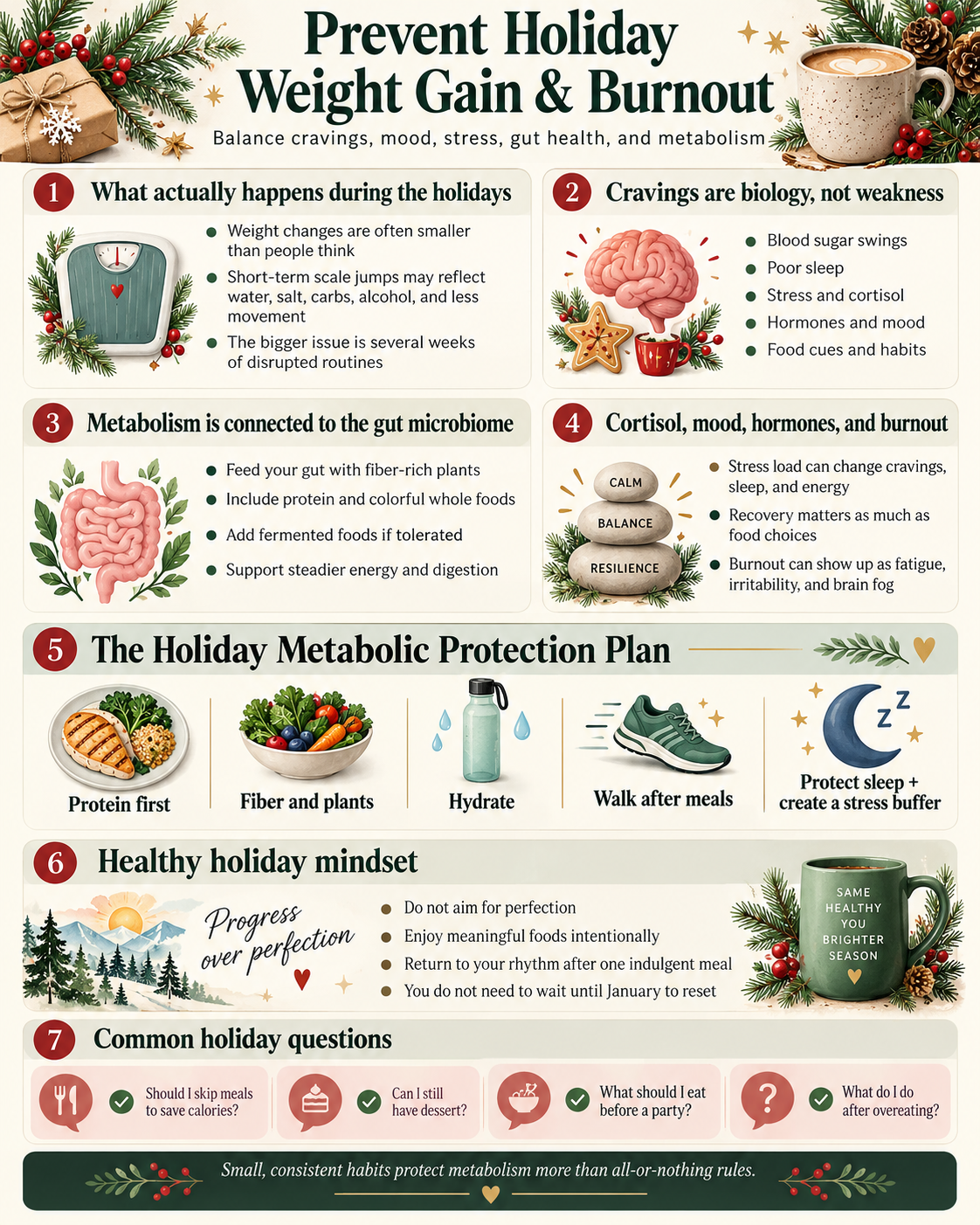
Save this Holiday Metabolic Protection Plan as a quick reminder throughout the season.
Frequently Asked Questions
Why do I crave sugar more during the holidays?
Holiday cravings may be influenced by changes in sleep, stress, food availability, meal timing, blood-sugar patterns, emotional cues, and established habits. Cravings are not simply a measure of willpower.
Can Stress Cause Holiday Weight Gain?
Stress can influence eating behavior, sleep, physical activity, and appetite. Research suggests that stress is associated on average with modest changes in eating behavior, although responses vary substantially from person to person. PubMed
Does Gut Health Affect Metabolism?
The gut microbiome interacts with dietary fiber and produces metabolites that can influence physiologic processes in the gut and elsewhere in the body. Research is actively investigating these relationships in obesity and cardiometabolic health. Nature
What Is the Best Way to Prevent Holiday Weight Gain?
Rather than relying on severe restriction, maintain several basic habits consistently: adequate protein, fiber-rich plant foods, hydration, regular movement, sleep, and stress recovery.
Is Walking After a Holiday Meal Helpful?
Movement after meals can be a practical way to reduce prolonged sedentary time and help working muscles use circulating glucose. A short family walk is a simple option.
Should I Detox After the Holidays?
Most people do not need a restrictive holiday detox.
Your liver, kidneys, gastrointestinal tract, lungs, skin, and other systems are already involved in processing and eliminating metabolic waste and compounds every day.
Returning to whole foods, hydration, adequate protein, fiber, movement, regular bowel habits, and sleep is generally a more sustainable strategy.
Ready to Understand What Your Body Is Telling You?
If you are experiencing persistent fatigue, cravings, weight changes, digestive symptoms, poor sleep, mood changes, or hormone concerns, there may be more going on than holiday stress alone.
At Prolific Well Integrative Medicine, I take an integrative approach to understanding how hormones, metabolism, gut health, nutrition, stress, sleep, and lifestyle patterns may be interacting.
The goal is not to give you another list of health rules.
It is to help you understand your physiology so you can make more informed decisions about your health.
Schedule Your Health Consultation
Take the next step toward understanding the patterns behind your symptoms and building a personalized plan for your health.
References
Yanovski JA, Yanovski SZ, Sovik KN, Nguyen TT, O'Neil PM, Sebring NG. A Prospective Study of Holiday Weight Gain. New England Journal of Medicine. 2000;342:861-867. New England Journal of Medicine
Hill D, Conner M, Clancy F, et al. Stress and eating behaviours in healthy adults: a systematic review and meta-analysis. Health Psychology Review. 2022;16(2):280-304. PubMed
Delzenne NM, Bindels LB, Neyrinck AM, et al. The gut microbiome and dietary fibres: implications in obesity, cardiometabolic diseases and cancer. Nature Reviews Microbiology. 2025;23:225-238. Nature
Mukhopadhya I, Louis P. Gut microbiota-derived short-chain fatty acids and their role in human health and disease. Nature Reviews Microbiology. 2025;23:635-651.


