Herbs to Avoid During Pregnancy: What I Want My Patients to Know
Pregnancy is not the time to assume that because something is natural, it is automatically safe.
Herbal medicine can be incredibly useful when it is chosen intentionally. But herbs contain biologically active compounds, and some can affect uterine activity, hormones, blood pressure, blood clotting, the nervous system, or medication metabolism.
Others simply have not been studied well enough in pregnant humans for me to feel comfortable recommending them.
This is why I tell my patients:
Pregnancy changes the risk-benefit calculation.
An herb you used before becoming pregnant may no longer be appropriate. A product that was perfectly reasonable for sleep, digestion, hormones, anxiety, or immune support before pregnancy may need to be stopped, replaced, or reconsidered once you are pregnant.
And just as importantly, using an herb in food is not necessarily the same as taking that herb medicinally.
Let me explain how I approach this.
What Does “Contraindicated During Pregnancy” Actually Mean?
When patients hear the word contraindicated, it can sound as though one accidental sip of tea or bite of food containing an herb means something terrible will happen.
That is generally not how we should interpret herbal safety.
A contraindication usually means that the potential risk is significant enough that I would not intentionally recommend the herb medicinally during pregnancy unless there were a very specific clinical reason and appropriate medical supervision.
The concern may involve:
stimulation of uterine contractions
promotion of menstrual flow
hormonal activity
possible effects on pregnancy maintenance
fetal toxicity
maternal toxicity
known or suspected teratogenic effects
effects on blood pressure or the cardiovascular system
bleeding risk
interactions with medications
inadequate pregnancy safety data
Some herbal traditions have historically classified plants according to uterine-stimulating, emmenagogue, abortifacient, teratogenic, or poisonous actions.
Modern evidence adds another important category:
We simply do not have enough human pregnancy data for many botanicals.
MotherToBaby notes that most herbal products have not been adequately studied during pregnancy and that some products may cause hormonal changes, contractions, or labor.
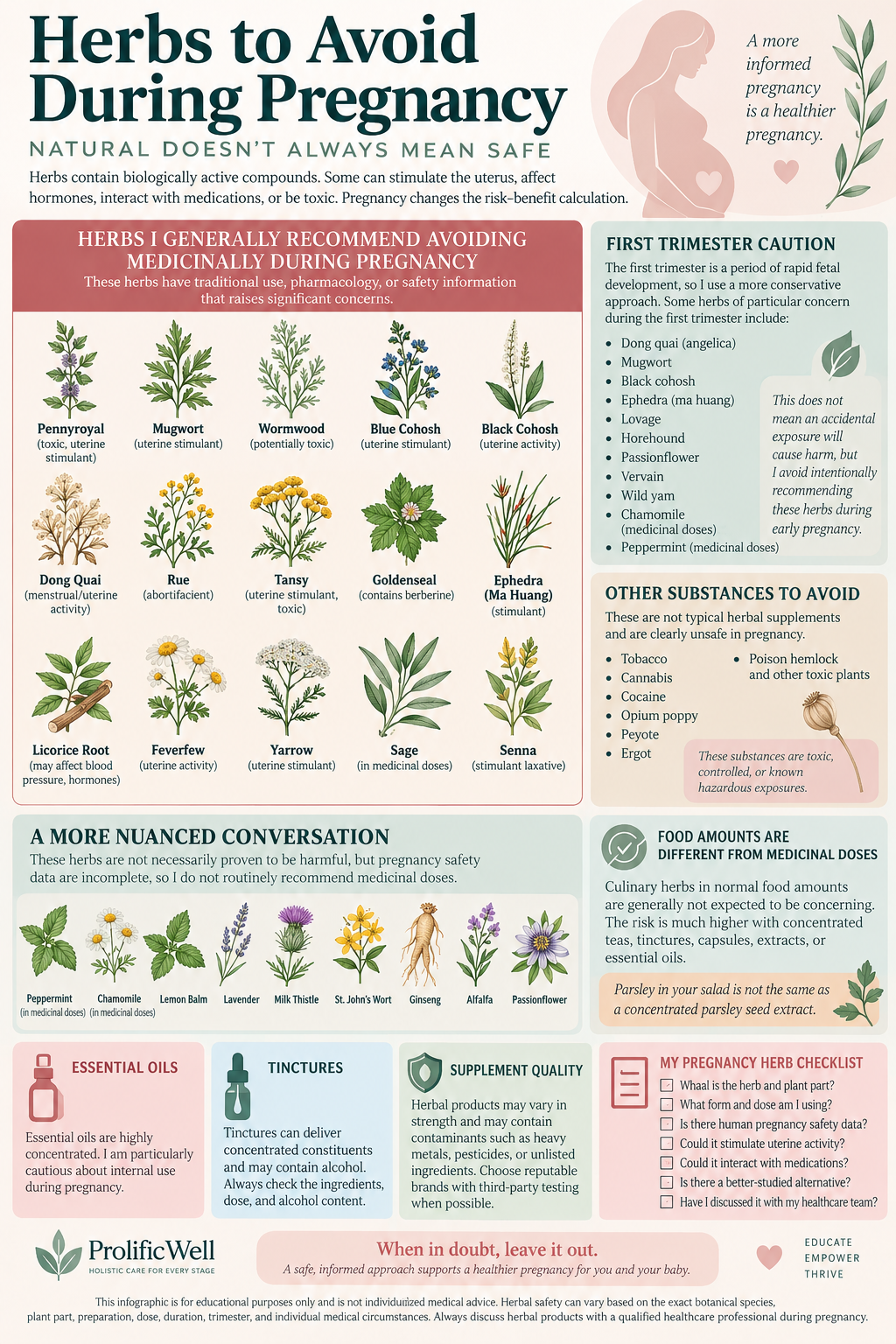
Quick Reference: Herbs to Avoid During Pregnancy
Use this visual as a high-level guide. The details still matter, especially the exact herb, plant part, dose, preparation, trimester, and reason for use.
Why I Am Especially Conservative During the First Trimester
The first trimester is a period of rapid fetal development.
This is when major organs and body systems are developing, so I generally want to minimize unnecessary medicinal exposures.
That does not mean every herbal exposure causes harm.
It means I want a good reason for anything we intentionally introduce.
Before using an herb during the first trimester, I want to know:
Why are you taking it?
Is there evidence that it actually helps the problem?
Is there a better-studied alternative?
What part of the plant is being used?
Is it food, tea, capsule, tincture, extract, or essential oil?
What dose are you taking?
How frequently?
What other medications and supplements are you using?
Several herbs traditionally treated with particular caution during the first trimester include dong quai, mugwort, black cohosh, myrrh, ma huang, lovage, horehound, passionflower, vervain, wild yam, and others.
But I would not treat every plant on an older botanical list as having identical evidence or identical risk.
That distinction matters.
Herbs I Generally Want Pregnant Patients to Avoid Medicinally
There are certain herbs where I would be particularly cautious because their pharmacology, traditional use, toxicity, or available safety information raises meaningful concerns.
1. Pennyroyal
Pennyroyal (Mentha pulegium) is not an herb I recommend during pregnancy.
Historically, pennyroyal has been used to stimulate menstruation and induce abortion. Concentrated preparations, particularly pennyroyal oil, can also be severely toxic.
This is very different from ordinary peppermint.
Pennyroyal appears among herbs traditionally contraindicated throughout pregnancy.
This is also a good example of why common names matter.
Peppermint and pennyroyal are not interchangeable plants.
2. Mugwort
Mugwort (Artemisia vulgaris) has traditionally been associated with stimulating menstrual and uterine activity.
For that reason, I do not recommend medicinal mugwort preparations during pregnancy, particularly during the first trimester. It is specifically included among first-trimester contraindications in traditional botanical safety references.
That includes concentrated teas, tinctures, capsules, and medicinal preparations rather than an accidental trace exposure.
3. Wormwood
Wormwood (Artemisia absinthium) is another herb I would avoid internally during pregnancy.
It belongs to the Artemisia family and has traditionally been treated as inappropriate for pregnancy because of its pharmacologically active constituents and toxicity concerns.
It is included among botanicals contraindicated throughout pregnancy in the botanical reference material.
4. Blue Cohosh
Blue cohosh (Caulophyllum thalictroides) has historically been associated with childbirth and uterine stimulation.
That does not mean it is an herb to self-prescribe during pregnancy.
Because of its physiologic activity and potential maternal and fetal effects, I would only consider anything involving blue cohosh within highly specific professional obstetric or botanical supervision, not as an over-the-counter pregnancy supplement.
It is included in the traditional list of herbs contraindicated throughout pregnancy.
5. Black Cohosh
Black cohosh (Actaea racemosa, formerly Cimicifuga racemosa) is best known today for its use in menopausal symptoms.
Pregnancy is a different physiologic context.
Because black cohosh has historically been associated with uterine activity and labor preparations, I do not recommend patients casually use it during pregnancy.
The botanical reference lists black cohosh among herbs requiring avoidance during pregnancy, while also noting its historical presence in some pregnancy formulations.
This is precisely why traditional use alone should not determine safety.
6. Dong Quai
Dong quai (Angelica species) is frequently found in women's hormone formulas.
That makes it especially important to check labels if you become pregnant while taking a fertility, menstrual, or hormone-support supplement.
I generally discontinue medicinal dong quai during pregnancy because of concerns about uterine and menstrual activity.
The botanical source specifically places angelica/dong quai among herbs contraindicated during the first trimester.
7. Rue
Rue (Ruta graveolens) has historically been associated with stimulating menstruation and pregnancy termination and is not an herb I would use medicinally during pregnancy.
It belongs on the avoid side of the conversation rather than the “we simply don't know enough” category.
Rue is included among botanicals contraindicated throughout pregnancy.
8. Tansy
Tansy (Tanacetum vulgare) is another herb I would not recommend internally during pregnancy.
Traditional botanical references associate it with strong uterine and toxic effects, and it appears among the herbs contraindicated throughout pregnancy.
9. Goldenseal and Berberine-Containing Herbs
Goldenseal (Hydrastis canadensis) appears on the traditional pregnancy contraindication list.
This deserves additional attention because goldenseal contains berberine, an active compound also found in herbs such as barberry and Oregon grape.
MotherToBaby advises discussing berberine-containing supplements with a healthcare professional during pregnancy because pregnancy data are limited and supplements are not generally recommended without a clinical indication.
I would not use berberine as a casual metabolic, antimicrobial, or blood-sugar supplement during pregnancy.
10. Ephedra / Ma Huang
Ephedra, also called ma huang, is a stimulant herb.
It appears among the first-trimester contraindications in the botanical reference.
Given its cardiovascular and stimulant properties, this is not something I would recommend during pregnancy.
11. Licorice Root
Licorice (Glycyrrhiza glabra) appears among herbs traditionally contraindicated throughout pregnancy.
This does not mean that an occasional food containing licorice flavoring is automatically equivalent to taking concentrated licorice-root extract.
Again, dose and preparation matter.
Medicinal licorice may affect blood pressure, electrolyte physiology, and cortisol metabolism, so routine concentrated supplementation during pregnancy deserves considerably more caution.
12. Feverfew
Feverfew (Tanacetum parthenium) is commonly marketed for migraine prevention.
Pregnancy changes that conversation.
Because of concerns regarding uterine effects and insufficient pregnancy safety data, I generally would not recommend medicinal feverfew while pregnant.
It appears on the traditional throughout-pregnancy contraindication list.
13. Yarrow
Yarrow (Achillea millefolium) is another medicinal herb traditionally associated with menstrual and uterine activity.
I would avoid intentional medicinal-dose yarrow during pregnancy.
The source botanical list categorizes it among herbs contraindicated throughout pregnancy.
14. Sage in Medicinal Doses
This one is important because sage used in cooking is not the same thing as taking concentrated sage preparations.
Sage (Salvia officinalis) appears on the traditional throughout-pregnancy contraindication list.
That does not mean I tell patients they cannot have sage seasoning in food.
MotherToBaby similarly notes that herbs used in normal food preparation and moderation are generally not expected to be concerning.
Medicinal extracts, concentrated teas, supplements, and essential oils are a different exposure.
Herbs Where the Answer Is More Nuanced
This is where I want to be careful about using the word contraindicated too broadly.
Some traditional pregnancy lists contain herbs such as:
peppermint
chamomile
lemon balm
lavender
milk thistle
St. John's wort
ginseng
alfalfa
passionflower
The historical document includes several of these botanicals among first-trimester or throughout-pregnancy contraindications.
But current evidence does not support treating every one of them as equally dangerous.
For many, the more accurate statement is:
Pregnancy safety is incomplete, so I would not routinely recommend medicinal doses without a clear indication.
For example, MotherToBaby's current review of St. John's wort reports that available human studies have not demonstrated an increased rate of birth defects, although data remain limited and the herb has substantial potential for medication interactions.
This is why I distinguish:
Known or plausible hazard
from
insufficient evidence to establish safety.
Those are not the same thing.
What About Chamomile and Peppermint?
Patients often become confused when they see familiar herbs appear on pregnancy avoidance lists.
Chamomile and peppermint are good examples.
Both appear in the historical first-trimester contraindication list.
But I would not tell a patient that one accidental cup of peppermint tea is equivalent to taking pennyroyal oil or blue cohosh.
They are entirely different exposures.
With commonly consumed herbs, I look at:
species + plant part + formulation + concentration + dose + frequency + trimester
rather than making a conclusion from the common name alone.
This is also why I recommend reading my companion guide, Herbs During Pregnancy: A Practical Guide to Herbal Safety, where I discuss herbs, teas, tinctures, essential oils, and the importance of preparation in more detail.
Read Herbs During Pregnancy: A Practical Guide to Herbal Safety
What About Aloe During Pregnancy?
This is another case where the part of the plant matters enormously.
Aloe appears among herbs traditionally contraindicated throughout pregnancy.
But topical aloe gel and internally consumed aloe latex are not equivalent.
When reading an herbal safety list, the word “aloe” alone does not give us enough information.
This is exactly why I want patients to bring me the actual product rather than simply telling me, “I'm taking aloe.”
What About Senna During Pregnancy?
Senna also appears on the traditional contraindication list.
This is another example where botanical safety lists and modern medication guidance can differ depending on the dose, duration, and clinical circumstance.
Instead of assuming every constipation herb is interchangeable, I prefer to identify why constipation is happening, address hydration, fiber, movement, magnesium or other appropriate interventions when indicated, and then choose treatments based on individual pregnancy circumstances.
I would not recommend self-prescribing prolonged or aggressive stimulant laxative herbal regimens during pregnancy.
What About St. John's Wort During Pregnancy?
St. John's wort deserves its own conversation because it can have significant medication interactions.
It can alter drug-metabolizing pathways and reduce the effectiveness of numerous medications.
Current MotherToBaby information states that human pregnancy data are limited, but three studies did not report an increased rate of birth defects.
That means I would not describe St. John's wort simply as a proven teratogen.
But I also would not recommend starting it casually during pregnancy, especially when treating depression, anxiety, or another condition for which maternal health also needs to be carefully managed.
Do not abruptly stop psychiatric medication or replace it with an herbal product simply because you become pregnant. That decision should be made with your healthcare team.
What About Ginseng?
Panax ginseng appears among the traditional contraindications for pregnancy.
Because pregnancy safety data are limited and ginseng contains pharmacologically active compounds, I generally do not see a compelling reason to introduce it routinely during pregnancy.
Pregnancy is not the season when I want to add an adaptogen simply because someone feels tired.
Fatigue in pregnancy deserves evaluation.
We should think about:
iron status
thyroid function
sleep
caloric intake
protein intake
hydration
blood pressure
glucose regulation
stress
pregnancy physiology
Treat the reason, not simply the symptom.
Some Substances on Herbal Lists Are Clearly Not Pregnancy Supplements
Traditional botanical references sometimes include substances such as tobacco, cannabis, cocaine, opium poppy, peyote, ergot, poison hemlock, and other toxic plants alongside medicinal herbs. Several of these appear in the document's throughout-pregnancy contraindication section.
These should not be interpreted as ordinary herbal supplements requiring a nuanced “maybe.”
Some are toxic plants, controlled substances, or known hazardous exposures.
They belong in a fundamentally different risk category from an herb such as peppermint, lavender, or lemon balm.
Food Amounts and Medicinal Doses Are Not the Same
This distinction is probably the most important takeaway from both of my pregnancy herb guides.
Consider:
Parsley in your salad
versus
concentrated parsley seed preparation
Sage in stuffing
versus
sage essential oil
Licorice-flavored food
versus
high-dose licorice-root extract
Garlic in dinner
versus
concentrated garlic capsules
These are not pharmacologically equivalent.
Current MotherToBaby guidance specifically notes that herbs used in normal food preparation and in moderation are generally not expected to present the same concern as medicinal herbal products.
So please do not read an avoidance list and start eliminating normal nutritious foods from your diet without context.
Essential Oils Require a Separate Safety Conversation
Essential oils are highly concentrated.
They are not simply “a stronger version of tea.”
Internal ingestion may produce an exposure dramatically different from smelling an herb, drinking tea, or using the herb as seasoning.
I am particularly cautious about internal essential-oil use during pregnancy unless there is a clear indication and an appropriately trained clinician overseeing it.
If you are using essential oils topically or aromatically, tell your healthcare professional the:
specific oil
concentration
carrier oil
frequency
route of use
trimester
“Essential oils” is too broad a category to answer with one universal yes or no.
Tinctures Are Not Just Liquid Herbs
Tinctures can deliver concentrated botanical constituents, and some are alcohol based.
MotherToBaby notes that herbal tinctures and liquid preparations can contain alcohol and that the concentration of active constituents can vary based on the plant, plant part, growing conditions, and manufacturing process.
If you bring me a tincture during pregnancy, I want to see the actual bottle.
I look at:
every ingredient
botanical species
plant part
extraction method
concentration
dose
serving frequency
alcohol content
other medications
why you are taking it
Multi-herb formulas deserve particular attention because one bottle can contain six, ten, or even twenty botanicals.
Why Supplement Quality Matters During Pregnancy
The concern is not limited to the herb itself.
Unlike prescription medications, dietary supplements are regulated differently, and manufacturers do not have to demonstrate safety and effectiveness in the same way before products reach consumers.
NCCIH identifies both drug interactions and product contamination as important supplement safety concerns.
MotherToBaby also notes that herbal products may contain contaminants such as heavy metals, pesticides, microorganisms, or ingredients not listed on the label.
That matters even more during pregnancy.
This is one reason I prefer:
clearly identified ingredients
reputable manufacturers
appropriate third-party testing when available
simple formulations
a specific clinical purpose
More ingredients are not automatically better.
My Pregnancy Herb Checklist
Before you take an herbal product while pregnant, ask these questions:
Why am I taking this herb?
Do I actually need it?
What exact species is it?
What part of the plant is being used?
Is it food, tea, capsule, powder, tincture, extract, or essential oil?
What is the dose?
How frequently will I take it?
What trimester am I in?
Is there human pregnancy safety data?
Could it stimulate uterine activity or influence hormones?
Could it interact with my medications?
Is there a better-studied alternative?
This is the kind of thinking I want my patients to use rather than searching:
“Is ___ safe in pregnancy?”
Pregnancy safety rarely fits neatly into a one-word answer.
Frequently Asked Questions About Herbs to Avoid During Pregnancy
What herbs should I avoid during pregnancy?
Some botanicals I would generally avoid medicinally include pennyroyal, rue, tansy, mugwort, wormwood, blue cohosh, black cohosh, dong quai, feverfew, yarrow, and other herbs with substantial uterine-stimulant or toxicity concerns. Other herbs are avoided primarily because pregnancy data are inadequate.
The appropriate recommendation still depends on the exact herb, plant part, preparation, dose, and clinical circumstance.
Are herbs more dangerous in the first trimester?
The first trimester is the most developmentally sensitive period, so I use a more conservative approach to unnecessary medicinal herbs.
This does not mean an accidental exposure automatically causes harm.
If you discover that you used a product before realizing you were pregnant, do not panic. Stop guessing about the risk and bring the exact product, dose, dates of exposure, and ingredient list to your clinician.
Are culinary herbs safe during pregnancy?
Ordinary amounts used in food are generally a very different exposure from concentrated medicinal products. MotherToBaby states that herbs used in food preparation in moderation are not expected to be concerning.
Is “pregnancy tea” automatically safe?
No.
“Pregnancy tea” is a marketing description, not a safety classification.
Read every ingredient.
A tea may contain raspberry leaf, nettle, peppermint, chamomile, licorice, or several other botanicals in one formula.
Is natural medicine safer than medication during pregnancy?
Not automatically.
“Natural” describes where something came from. It does not tell us its pharmacology, dose, toxicity, interaction profile, or pregnancy safety.
Some prescription medications have considerably more pregnancy safety data than many herbs.
Should I stop every supplement when I find out I'm pregnant?
Do not make sweeping treatment changes without reviewing them.
Instead, make one list containing:
prescription medications
over-the-counter medications
prenatal vitamins
individual nutrients
herbs
teas
tinctures
powders
gummies
essential oils
Then review the whole list with your pregnancy healthcare team.
What if I already took one of these herbs?
An exposure does not automatically mean that harm has occurred.
The next step is to identify:
what product + what dose + how often + how long + what gestational age
Then discuss the specific exposure with your obstetric clinician, midwife, prescribing clinician, pharmacist, or a pregnancy-exposure resource such as MotherToBaby.
What to Read Next
Avoidance is only one side of herbal medicine during pregnancy.
Some herbs have better pregnancy experience or may be reasonable in selected circumstances, but dose, formulation, timing, and indication still matter.
For the companion article, read:
Herbs During Pregnancy: A Practical Guide to Teas, Foods, and Herbal Supplements
I explain how I evaluate ginger, peppermint, chamomile, raspberry leaf, teas, tinctures, essential oils, culinary herbs, and medicinal preparations during pregnancy.
Read Herbs During Pregnancy: A Practical Safety Guide
The Bottom Line
I do not want pregnancy herbal medicine reduced to two lists labeled safe and dangerous.
That is too simplistic.
Instead, I want you to understand the hierarchy:
Some herbs have meaningful evidence or pharmacology suggesting they should be avoided.
Some have inadequate pregnancy data, so the prudent choice is not to use them without a clear clinical reason.
Some are very different when eaten as food versus taken as concentrated medicine.
And some botanicals may have a legitimate role in specific circumstances under professional supervision.
The question I want my patients asking is:
“Does this herb provide enough benefit in my situation to justify exposing myself and my pregnancy to it?”
If we cannot clearly answer that question, there is often no compelling reason to add it.
Pregnancy is not about eliminating everything natural.
It is about becoming much more intentional about what deserves a place in your body during one of the most physiologically important seasons of your life.
Medical Disclaimer
This article is for educational purposes and is not individualized medical advice. Herbal safety can vary according to the exact botanical species, plant part, preparation, dose, duration, trimester, pregnancy history, medical conditions, and medications. Do not use an herbal product to induce menstruation, labor, or pregnancy termination without appropriate medical care. If you are pregnant or think you may be pregnant, discuss medicinal herbs and supplements with a qualified healthcare professional.


