Herbs During Pregnancy: What I Want My Patients to Know Before Using Teas, Supplements, or Tinctures
Pregnancy changes the way we think about everything we put into the body.
A tea that felt completely routine before pregnancy may suddenly raise questions. The same goes for ginger, peppermint, raspberry leaf, chamomile, herbal capsules, tinctures, or essential oils.
One principle I want every patient to remember is simple:
Natural does not automatically mean appropriate during pregnancy.
Herbs contain active compounds. Their effects can vary depending on the plant, dose, preparation, trimester, frequency of use, and your individual medical history. Pregnancy is not the time to assume that something is safe simply because it came from a plant.
The good news is that herbal medicine does not have to be confusing. What matters is using it thoughtfully and understanding the difference between a food, a mild tea, a concentrated supplement, a tincture, and an essential oil.
Are Herbs Safe During Pregnancy?
Some herbs may be appropriate in pregnancy, while others require more caution.
One of the biggest mistakes I see is treating all forms of an herb as if they are interchangeable.
For example, these are not equivalent:
sprinkling cinnamon on oatmeal
drinking a cup of lightly brewed herbal tea
taking several capsules of a concentrated herb
using a tincture multiple times per day
ingesting an essential oil
The plant may have the same name, but the concentration and exposure can be very different.
That is why I do not like giving patients a simplistic “safe” or “unsafe” list without context.
I look at the whole picture: what you are using, why you are using it, how much you are taking, how often you are taking it, and where you are in pregnancy.
Why I Use More Caution in the First Trimester
The first trimester is a period of rapid fetal development, so I generally prefer a more conservative approach with nonessential herbs and supplements.
That does not mean every herb is automatically dangerous during the first trimester. It means there should be a clear reason for using it.
Before adding an herb, I want us to ask:
What symptom or goal are we addressing?
Is there evidence that the herb actually helps?
What form are you taking?
What dose are you taking?
How long do you plan to use it?
Are you taking medications or other supplements that could interact with it?
Do you have any pregnancy complications or medical conditions that change the risk-benefit calculation?
The goal is not to create fear around herbs.
The goal is to remove unnecessary exposures while still using appropriate therapies when they offer meaningful benefit.
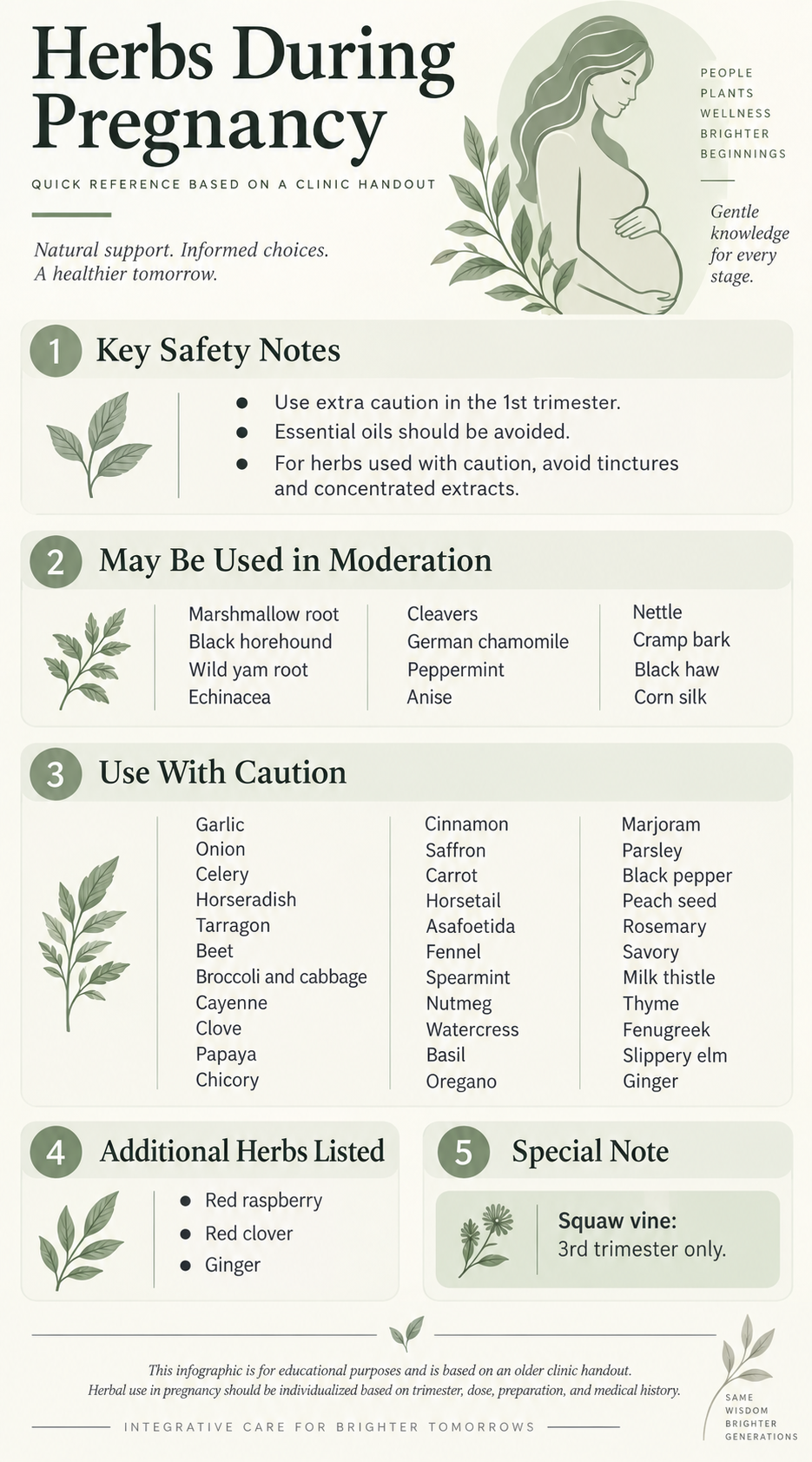
Quick Reference: Herbs During Pregnancy
This visual gives you a practical overview. Keep reading below because dose, preparation, trimester, and individual health history still matter.
Herbs That May Be Used in Moderation During Pregnancy
Depending on the individual situation, herbs traditionally used in moderation during pregnancy include:
Marshmallow root
Black horehound
Wild yam root
Echinacea
Cleavers
German chamomile
Peppermint
Anise
Nettle
Cramp bark
Black haw
Corn silk
The phrase “in moderation” is important.
I would not translate this into “take as much as you want.” Pregnancy changes physiology, and an herb that may be reasonable as an occasional tea may not be appropriate as a high-dose extract.
Evidence quality also varies considerably from herb to herb. For example, available human data on echinacea have been relatively reassuring, including first-trimester exposure, but the overall evidence base for many herbal products in pregnancy remains limited.
Peppermint During Pregnancy
Peppermint is commonly used for digestive discomfort and nausea.
A mild peppermint tea is very different from concentrated peppermint oil. I generally want patients to think about form and dose, rather than simply asking whether “peppermint” is safe.
The broader pregnancy literature on many commonly used herbs remains heterogeneous, which is why I do not assume that frequent or concentrated use is equivalent to occasional culinary or tea use.
Chamomile During Pregnancy
Chamomile is another herb that people often assume is universally safe because it is widely consumed as tea.
The evidence is not that simple.
A 2025 systematic review concluded that the available evidence was not strong enough to establish clear clinical recommendations for chamomile use during pregnancy.
For me, that is a good reminder that common use does not equal proven safety at every dose or duration.
Herbs and Foods I Want You to Use More Thoughtfully
There is another group of plants that may appear frequently in food, seasonings, or teas but deserve more caution when used medicinally or in concentrated preparations.
These include:
Garlic
Onion
Celery
Horseradish
Tarragon
Beet
Broccoli and cabbage
Cayenne
Clove
Papaya
Chicory
Cinnamon
Saffron
Carrot
Horsetail
Asafoetida
Fennel
Spearmint
Nutmeg
Watercress
Basil
Oregano
Marjoram
Parsley
Black pepper
Peach seed
Rosemary
Savory
Milk thistle
Thyme
Fenugreek
Slippery elm
Ginger
This list can look alarming at first because many of these are ordinary foods.
That is exactly why context matters.
Eating garlic in dinner is not the same as taking concentrated garlic extract every day.
Using rosemary to season potatoes is not the same as taking medicinal amounts of rosemary tincture.
Adding cinnamon to oatmeal is not the same as taking concentrated cinnamon capsules.
Pregnancy herbal safety often depends more on how the plant is being used than on the plant name alone.
Food, Tea, Capsule, Tincture, and Essential Oil Are Not the Same Thing
I like to teach patients to think about herbal exposure on a spectrum:
Food → seasoning → mild tea → strong tea → powder/capsule → tincture/extract → essential oil
As you move along that spectrum, the amount of active plant compounds may increase substantially.
That does not mean every concentrated product is automatically harmful.
It means the decision becomes more clinical.
If you ask me:
“Can I eat basil while pregnant?”
that is a very different question from:
“Can I take a concentrated basil extract twice a day while pregnant?”
The answer should reflect the dose and preparation.
What About Ginger During Pregnancy?
Ginger deserves separate attention because it is one of the more extensively studied herbs in pregnancy.
It is commonly used for nausea and vomiting, particularly in early pregnancy.
A 2024 evidence review found that ginger improved pregnancy-related nausea in multiple meta-analyses and did not show significant adverse effects across the studies reviewed, although the quality of the evidence was generally low and the studies varied considerably.
Earlier systematic reviews also found improvement in nausea compared with placebo without a clear increase in major adverse pregnancy outcomes.
The World Health Organization includes ginger among the non-pharmacologic options that may be considered for nausea in early pregnancy.
What I tell my patients about ginger
Ginger can be reasonable for some pregnant patients, particularly for nausea, but I still want to know:
how much you are taking
whether it is tea, food, candy, capsule, or extract
whether you are taking blood-thinning medications or other supplements
whether it causes heartburn or gastrointestinal irritation
how frequently you are using it
Even when an herb has better pregnancy data, more is not necessarily better.
What About Red Raspberry Leaf During Pregnancy?
Red raspberry leaf is probably one of the most recognizable “pregnancy herbs.”
It has traditionally been used later in pregnancy, often with the intention of supporting uterine tone or preparing for labor.
But traditional use and strong clinical evidence are not the same thing.
Reviews of herbal therapies in pregnancy have found relatively limited evidence supporting raspberry leaf for labor-related outcomes, and available studies are not strong enough to justify assuming that it is universally beneficial or appropriate.
If you are considering raspberry leaf, I recommend discussing:
when in pregnancy you plan to start
how much you plan to use
whether you have a history of preterm labor
your obstetric history
whether your midwife or obstetric clinician recommends it for your situation
I do not recommend assuming that every pregnancy tea containing raspberry leaf is automatically appropriate from the beginning of pregnancy.
What About Red Clover During Pregnancy?
Red clover is another herb I would approach individually rather than casually adding to a pregnancy regimen.
There is not enough high-quality pregnancy-specific evidence for me to recommend it broadly based simply on traditional use.
This is one of those situations where lack of evidence of harm is not the same as evidence of safety.
If there is not a clear reason to use an herb during pregnancy, I usually prefer not to introduce unnecessary complexity.
What About Essential Oils During Pregnancy?
Essential oils deserve a separate conversation because they are highly concentrated plant preparations.
A few drops of essential oil can contain a far greater concentration of plant constituents than you would obtain from ordinary culinary use.
That is why I do not consider:
peppermint tea = peppermint essential oil
or
fresh rosemary = rosemary essential oil
They are different exposures.
I generally recommend being particularly cautious with internal essential-oil use during pregnancy unless there is a specific reason and appropriate professional guidance.
Topical or aromatic use is another discussion because the route of exposure is different.
What About Herbal Tinctures During Pregnancy?
Tinctures are also more concentrated than ordinary food or tea preparations.
If a patient brings me a tincture, I want to know the exact:
botanical ingredients
concentration
dose
frequency
alcohol or glycerin base
reason for taking it
trimester
other medications and supplements
Multi-herb tinctures require even more attention because several botanicals may be combined into one product.
I would rather review the exact product than give a blanket answer based on the word “herbal.”
A Simple Pregnancy Herb Checklist
Before taking an herbal product during pregnancy, ask yourself:
Why am I taking this?
Is there a specific symptom or health goal?What form is it?
Food, tea, powder, capsule, tincture, extract, or essential oil?How concentrated is it?
How much am I taking?
How often am I taking it?
What trimester am I in?
Could it interact with my medications or supplements?
Is there meaningful human pregnancy data?
Do I actually need it?
That last question is one of the most useful.
Pregnancy is not necessarily the time to add more supplements simply because they are marketed as supportive.
I want every item in your plan to have a purpose.
Frequently Asked Questions About Herbs During Pregnancy
What herbs are safe during pregnancy?
There is no single list that applies to every pregnant person. Safety depends on the herb, preparation, dose, duration, trimester, medical history, medications, and pregnancy risk factors.
Overall, the scientific literature still has significant gaps for many botanical products used during pregnancy.
Are herbal teas safe during pregnancy?
Some may be appropriate, but I recommend checking the actual ingredients.
This is especially important for blends marketed as:
pregnancy tea
detox tea
sleep tea
hormone tea
immune tea
digestive tea
A product labeled “tea” can contain several medicinal herbs.
Is ginger safe during pregnancy?
Ginger has considerably more pregnancy research than many other herbs and has evidence supporting its use for nausea. Available studies have not shown a clear increase in major adverse outcomes at commonly studied doses, although evidence quality varies.
Is chamomile tea safe during pregnancy?
Occasional use and medicinal or prolonged use should not automatically be treated as equivalent. Current evidence is not strong enough to establish firm pregnancy recommendations across different chamomile products, doses, and durations.
Can I take herbal tinctures while pregnant?
Possibly in selected situations, but I would not recommend starting a tincture without reviewing the ingredients, dose, concentration, indication, trimester, and possible interactions.
Are essential oils safe during pregnancy?
Essential oils are highly concentrated and should not be treated like ordinary culinary herbs or teas. I recommend extra caution, especially with internal use.
Should I stop every herb when I find out I am pregnant?
Not automatically.
Instead, make a complete list of:
medications
prenatal vitamins
individual supplements
herbal capsules
teas
powders
tinctures
essential oils
Then review them with a clinician familiar with pregnancy and botanical medicine.
That gives you a much better answer than stopping or continuing everything indiscriminately.
What to Read Next
Knowing which herbs may have a place during pregnancy is only half of the conversation.
There are also botanicals that I generally do not want patients using during pregnancy because of concerns such as uterine stimulation, hormonal activity, toxicity, bleeding effects, or insufficient safety data.
Coming Next: Herbs Contraindicated in Pregnancy
In the next guide, I will break down which herbs are generally avoided during pregnancy, why they are concerning, and how the risk can differ by dose and preparation.
Once that article is published, I recommend reading the two guides together rather than relying on a single “safe herb” list.
The Bottom Line
The question I want you to ask is not simply:
“Is this herb safe?”
A better question is:
“Is this herb appropriate for me, in this form, at this dose, for this reason, at this stage of pregnancy?”
That is a much more useful clinical question.
Foods and culinary herbs are not automatically equivalent to concentrated supplements.
Tea is not the same as a tincture.
A whole plant is not the same as an essential oil.
And “natural” is not a synonym for “risk-free.”
Pregnancy is a season when I want your treatment plan to become more intentional, not more complicated.
If you are pregnant or preparing for pregnancy, bring your full medication and supplement list to your healthcare visit, including products you may not think of as supplements, such as teas, powders, tinctures, gummies, and essential oils.
We can then decide what belongs in your plan, what deserves a closer look, and what simply does not need to be there.


