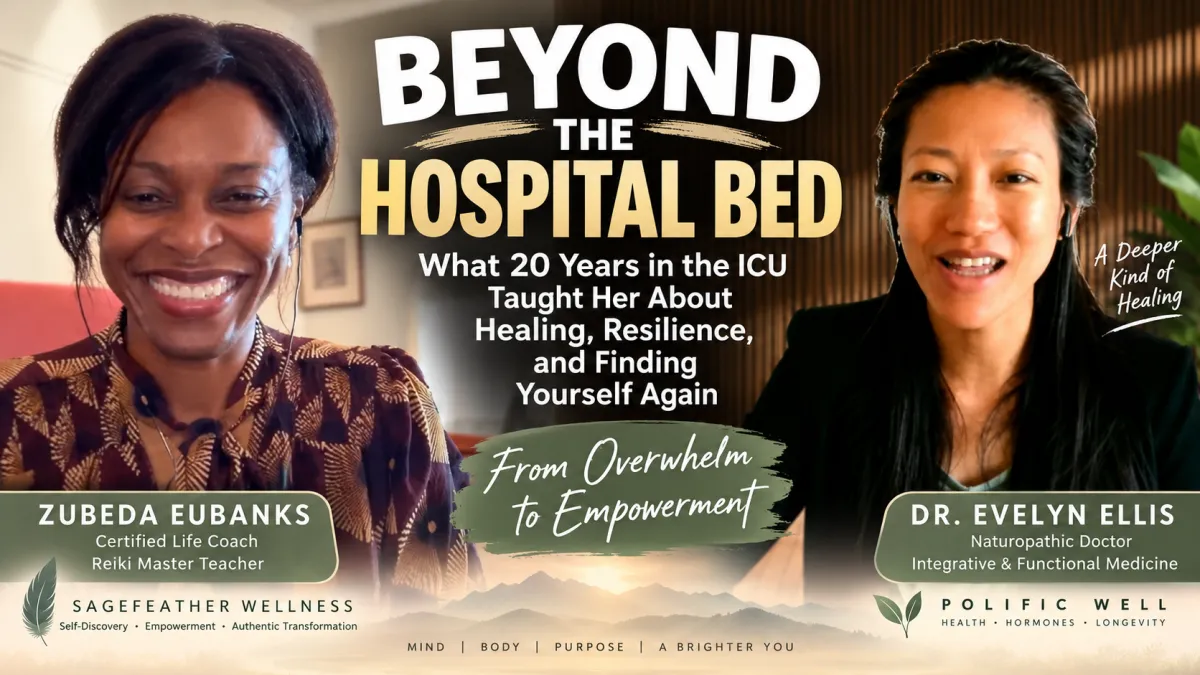
Beyond the Hospital Bed: What 20 Years in the ICU Can Teach Us About Healing, Resilience, and Self-Trust
What does healing actually mean?
For many people, healing means fixing a diagnosis, improving a lab result, recovering from surgery, or getting symptoms under control.
Those things matter.
But after years of working in integrative medicine, I have also seen another side of health: people whose labs look relatively normal, whose acute medical crisis has passed, or who are still functioning on the outside, yet they feel overwhelmed, disconnected, exhausted, or uncertain about who they are becoming.
That is why my recent podcast conversation with Zubeda Eubanks, Certified Life Coach and Reiki Master Teacher, was so interesting.
Zubeda spent more than 20 years working as a Patient Care Technician in the ICU. She witnessed illness, crisis, recovery, grief, family dynamics, resilience, and some of the most vulnerable moments in people's lives.
Today, through Sagefeather Wellness, she helps people explore self-discovery, limiting beliefs, self-worth, overwhelm, relationships, and the transition from simply functioning toward living with greater clarity and purpose.
This conversation raises an important question:
Can you be medically stable and still not feel well?
Yes.
Health is multidimensional.
A person may no longer be in immediate medical danger yet still struggle with:
fatigue
poor sleep
chronic stress
low motivation
anxiety or emotional overwhelm
loss of confidence
disconnection from relationships
uncertainty about purpose
feeling unlike themselves
These experiences can have physical, psychological, social, and lifestyle contributors.
That is one reason I often remind patients that one laboratory value rarely tells the entire story.
My approach to integrative medicine is built around looking at the broader picture, including hormones, metabolism, sleep, stress, digestion, nutrition, brain health, lifestyle, and the person's actual experience of living in their body. You can read more about that approach in my guide to integrative and functional medicine for hormone imbalance and chronic fatigue.
Functioning Is Not the Same as Thriving
One of the strongest themes in my conversation with Zubeda was the difference between functioning and truly feeling well.
Many people become exceptionally good at functioning.
They wake up.
They go to work.
They answer messages.
They take care of children.
They help aging parents.
They maintain the household.
They keep appointments.
They solve other people's problems.
And because they are still completing their responsibilities, they assume everything must be okay.
But internally, they may feel completely depleted.
This can sound like:
"I'm getting everything done, but I don't feel like myself."
Or:
"Nothing is technically wrong, but I don't feel well."
That distinction matters.
Persistent fatigue, brain fog, sleep problems, low motivation, and mood changes should not automatically be dismissed as a lack of willpower or simply being busy. Hormones, blood sugar regulation, sleep quality, nutrient status, thyroid function, stress physiology, and other health factors may contribute.
For a deeper look at this physical side of fatigue, read Why You're Still Tired After Winter: Understanding Energy, Stress, Hormones, and Metabolism.
You may also find my guide to 30 common hormone imbalance symptoms in women and men helpful if fatigue, brain fog, mood changes, sleep problems, or changes in metabolism have become persistent.
What Is Chronic Overwhelm?
Overwhelm is more than having a busy week.
It can develop when the demands placed on you repeatedly exceed the physical, emotional, or cognitive resources you have available.
Sometimes overwhelm is obvious.
Other times it looks highly functional.
You may still be working, parenting, exercising, and caring for other people while feeling internally stretched thin.
Over time, you may notice:
difficulty concentrating
irritability
poor sleep
emotional reactivity
less enjoyment
decision fatigue
reduced motivation
physical fatigue
cravings or irregular eating
feeling constantly "on"
difficulty resting without guilt
Stress physiology can intersect with hormones, metabolism, sleep, and energy regulation.
I discuss this connection further in Prepare Your Body for the Rest of the Year: How to Build Sustainable Energy, Metabolism, and Hormone Balance, where I explore the relationship among stress, gut health, metabolism, hormones, and sustainable energy.
Limiting Beliefs Can Quietly Shape Health Decisions
Zubeda's work also focuses on identifying limiting beliefs.
A limiting belief is a deeply held assumption that influences what you believe is possible or permissible for you.
Examples may include:
"I'm too old to change."
"Everyone else has to come first."
"Rest is lazy."
"I should be able to handle this myself."
"If I set boundaries, people will think I'm selfish."
"My needs aren't as important."
"This is just what aging feels like."
The problem is not simply having a negative thought.
The problem is when that thought becomes an unquestioned rule.
If you believe that taking care of yourself is selfish, you may repeatedly postpone medical appointments, sleep, movement, recovery, nutrition, or restorative activities.
If you believe that fatigue is simply inevitable with age, you may overlook a treatable contributor.
If you believe that asking for help means weakness, you may wait until burnout becomes severe.
Awareness creates an opportunity to challenge those assumptions.
Midlife Can Magnify the Question: "Who Am I Now?"
This conversation is particularly relevant in midlife.
People in their 40s, 50s, and 60s often find themselves managing several transitions simultaneously:
children becoming more independent
aging parents needing more help
career changes
relationship transitions
menopause or andropause
changes in body composition
changes in energy
grief or loss
reevaluation of priorities
questions about the next chapter of life
I explored this idea in another podcast-based article, Midlife Isn't a Crisis: How Women 45+ Can Reclaim Purpose, Confidence, and Their Heart's Calling.
Aging does not automatically mean declining into passivity.
Sometimes midlife is when people finally begin asking:
What do I actually want my life to look like?
That question can be uncomfortable, but it can also be useful.
The Relationship You Have With Yourself Matters
One of Zubeda's central themes is strengthening the relationship you have with yourself.
That can sound abstract until we translate it into behavior.
A healthier relationship with yourself may mean:
noticing exhaustion rather than automatically overriding it
taking symptoms seriously without catastrophizing them
asking for help
keeping reasonable commitments to yourself
saying no when necessary
identifying your needs before resentment develops
making health decisions based on your values rather than fear
speaking to yourself with the same fairness you would offer someone else
Self-awareness does not mean ignoring medical problems.
It means becoming a better observer of yourself.
That includes recognizing when something deserves medical evaluation.
For example, persistent fatigue can reflect many different contributors, including iron deficiency, digestive problems, thyroid dysfunction, hormone changes, inadequate nutrition, sleep disruption, and inflammation. My article on why ferritin may remain low despite iron supplementation illustrates why symptoms often require a broader investigation rather than a single assumption.
Being Heard Is Part of Whole-Person Care
One of the most important lessons from clinical medicine is that people want to be heard.
They may come into an appointment asking about fatigue, weight gain, sleep, digestion, hormones, or brain fog.
But underneath the symptom is often a larger story.
Maybe they have been caring for an ill parent.
Maybe their marriage is under stress.
Maybe they have spent years sleeping five hours a night.
Maybe they are approaching menopause.
Maybe they are grieving.
Maybe they have quietly stopped doing nearly everything that once gave them energy.
None of this means symptoms are "all in your head."
It means context matters.
Whole-person medicine asks both:
What is happening physiologically?
and
What is happening in this person's life?
That is one of the reasons I built Prolific Well around a personalized, root-cause model rather than focusing on a single symptom in isolation. You can read more about my clinical philosophy in Meet Dr. Evelyn Ellis: Integrative Medicine, Hormone & Longevity Physician.
Can Stress Affect Hormones and Metabolism?
Yes, although the relationship is more nuanced than saying "stress causes everything."
Stress responses interact with:
sleep
appetite
blood glucose regulation
cortisol rhythms
physical activity
food choices
recovery
cardiovascular physiology
reproductive hormone signaling
This is why someone experiencing prolonged stress may notice changes in energy, cravings, sleep, mood, and weight.
In Why Cravings, Weight Gain, and Mood Swings Happen, I discuss the interaction among stress, cortisol, blood sugar, hormones, metabolism, energy, and emotional balance.
The goal is not to eliminate all stress.
That is unrealistic.
The goal is to improve how well your body can recover from stress.
What Does Resilience Actually Mean?
Resilience is often misunderstood as the ability to tolerate more.
Work harder.
Push longer.
Need less.
Keep going.
But resilience can also mean recognizing when your current strategy is no longer sustainable.
Sometimes resilience means resting.
Sometimes it means asking for help.
Sometimes it means changing a boundary.
Sometimes it means seeking medical evaluation.
Sometimes it means admitting:
"The way I have been doing this is no longer working."
True resilience is not endless endurance.
It is the ability to adapt.
Where Does Reiki Fit Into This Conversation?
Zubeda is also a Reiki Master Teacher.
Reiki is generally described as a complementary wellness practice involving light touch or hands placed near the body, with the intention of supporting relaxation and well-being.
It is important to distinguish complementary wellness practices from medical treatment.
Reiki should not be used as a substitute for appropriate medical evaluation, diagnosis, emergency care, medication, surgery, or other indicated treatment.
However, some people use Reiki alongside conventional care as a relaxation or reflective practice.
This is similar to how people may incorporate meditation, breathwork, massage, yoga, mindfulness, or other complementary approaches into a broader wellness plan.
The key is understanding the scope of the intervention.
What Does Whole-Person Health Actually Mean?
Whole-person health does not mean rejecting conventional medicine.
It means recognizing that biology does not occur in isolation.
Health may be influenced by:
hormones
sleep
nutrition
gut health
movement
metabolic health
relationships
stress
environment
purpose
behaviors
social connection
access to appropriate medical care
My work at Prolific Well Integrative Medicine focuses on integrating these pieces rather than treating every symptom as an isolated event.
Gut health is another good example of this interconnected model. Diet, microbiome diversity, stress, hormones, and energy regulation can overlap. You can explore this further in Heal Your Gut, Boost Your Hormones, and Regain Energy Through Food Diversity.
You Do Not Have to Reinvent Your Entire Life
When people feel stuck, they often assume they need an enormous transformation.
Quit the job.
Move somewhere new.
Completely change their diet.
Start an intense exercise program.
Reinvent their identity.
That can make change feel even more overwhelming.
A more useful approach is often to ask:
What is the next reasonable step?
It might be:
going to bed 30 minutes earlier
scheduling overdue lab work
taking a 10-minute walk after dinner
eating a protein-rich breakfast
calling a friend
asking for help
setting one boundary
returning to an activity you used to enjoy
writing down what currently drains your energy
speaking with a healthcare professional about persistent symptoms
Small changes generate information.
Information creates clarity.
Clarity helps us make better decisions.
If you are trying to define a clearer direction for your health without adding another overwhelming plan, you may also enjoy Build a Clear Health Vision That Fuels Your Hormones and Longevity Without Restrictive Rules or Overwhelm.
Three Questions to Ask Yourself This Week
You do not need to have your entire future figured out.
Start with three questions:
1. What am I tolerating that is consistently draining me?
Not everything can be changed immediately.
But identifying the drain is different from unconsciously living with it.
2. What does my body keep asking me to pay attention to?
Fatigue?
Sleep disruption?
Digestive problems?
Mood changes?
Pain?
Brain fog?
Changes in weight?
Reduced exercise tolerance?
Do not automatically assume these symptoms are "just stress" or "just aging."
Persistent symptoms deserve appropriate evaluation.
3. What is one realistic action I can take next?
Not twenty actions.
One.
Frequently Asked Questions
What is the difference between functioning and thriving?
Functioning means you are able to complete daily responsibilities. Thriving generally refers to having enough physical, emotional, and cognitive capacity to engage meaningfully with your life rather than simply getting through it.
Someone may appear highly functional while experiencing chronic fatigue, poor sleep, emotional overwhelm, or loss of motivation.
Can chronic stress cause physical symptoms?
Chronic stress can influence sleep, appetite, blood glucose regulation, cardiovascular physiology, muscle tension, recovery, and other systems. However, persistent symptoms should not automatically be attributed to stress without considering other medical causes.
Can hormone imbalance cause fatigue and mood changes?
Hormonal changes can contribute to symptoms such as fatigue, sleep disruption, brain fog, mood changes, changes in body composition, and sexual symptoms. These symptoms are not specific to hormones, so a broader evaluation may be appropriate. Read more in my guide to hormone imbalance symptoms in women and men.
What is whole-person medicine?
Whole-person medicine considers biological factors alongside sleep, nutrition, stress, lifestyle, environment, relationships, and other influences on health while still using appropriate medical evaluation and treatment.
Does Reiki treat medical conditions?
Reiki should not be presented as a replacement for medical diagnosis or treatment. Some people use it as a complementary wellness practice for relaxation, reflection, or subjective well-being.
How do I know when I should seek medical evaluation?
Seek appropriate medical care when symptoms are new, persistent, worsening, severe, unexplained, or interfering with normal activities. Acute symptoms such as chest pain, severe shortness of breath, neurological changes, severe bleeding, or other emergencies require prompt medical attention.
Watch the Full Conversation With Zubeda Eubanks
In the full podcast episode, Zubeda and I discuss:
what 20+ years in the ICU taught her about life
resilience during difficult seasons
chronic overwhelm
limiting beliefs
self-worth
self-judgment
boundaries
self-trust
life coaching
Reiki
complementary wellness practices
finding greater clarity and purpose
Watch the full podcast here:
[INSERT YOUR YOUTUBE VIDEO LINK]
About Zubeda Eubanks
Zubeda Eubanks is a Certified Life Coach and Reiki Master Teacher with more than 20 years of experience working in healthcare as a Patient Care Technician in the ICU.
Her work through Sagefeather Wellness focuses on self-discovery, empowerment, limiting beliefs, relationships, self-worth, personal growth, and helping people create greater clarity, meaning, joy, and peace.
Sagefeather Wellness:
https://www.sagefeatherwellness.com/
Instagram:
https://www.instagram.com/zubeda_zee/
Facebook:
https://www.facebook.com/profile.php?id=61575027335706&mibextid=wwXIfr
About Dr. Evelyn Ellis
I am Dr. Evelyn Ellis, ND, MPH, FAIHM, founder of Prolific Well Integrative Medicine in Olympia, Washington.
My clinical work focuses on integrative and functional medicine, hormone health, metabolic health, gastrointestinal health, brain health, fatigue, healthy aging, and longevity.
My goal is to help women and men better understand why symptoms are happening and build practical, personalized strategies for improving long-term health.
Learn more about my approach:
Meet Dr. Evelyn Ellis
Explore the Prolific Well Wellness Journal:
https://prolificwell.com/blogs
Prolific Well Integrative Medicine:
https://prolificwell.com/
The Bottom Line
Healing does not always begin with doing more.
Sometimes it begins with paying closer attention.
To your symptoms.
To your energy.
To your beliefs.
To your relationships.
To what your body has been signaling.
And to whether the life you are maintaining is still supporting the person you are becoming.
You do not have to solve everything today.
But you can become curious about what needs your attention next.


