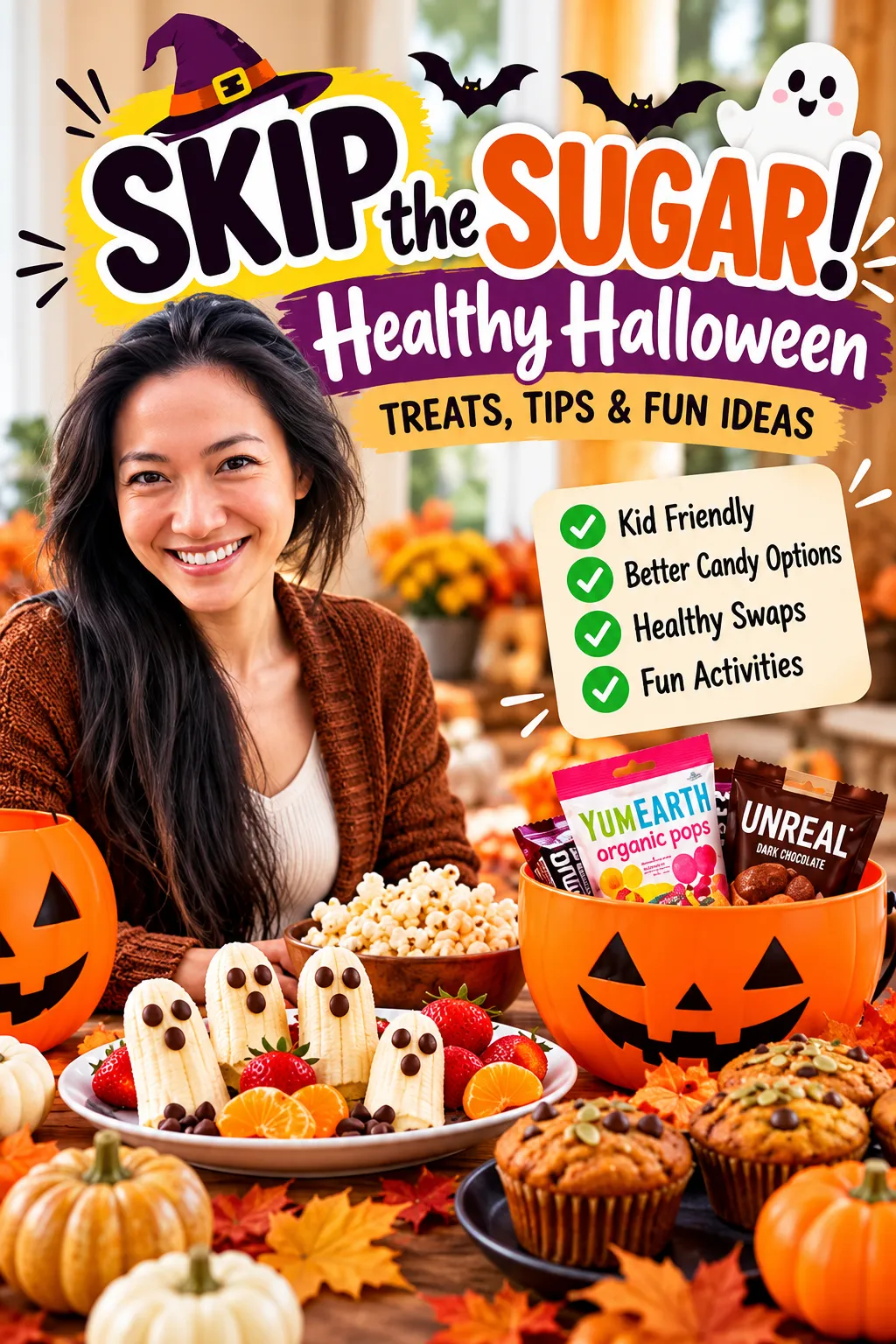
Healthy Halloween: 15 Candy Swaps, Snacks & Fun Ideas for Kids
Halloween is a wonderful time for costumes, pumpkin carving, trick-or-treating, and creating memories with family. But it's also a time when children can consume considerably more added sugar than usual.
As a naturopathic physician and a parent, I believe we can celebrate Halloween while teaching children how to make healthier food choices.
A healthy Halloween doesn't mean eliminating candy. It means balancing nutrition, making informed choices, and creating traditions that extend beyond sweets.
In this guide, I'll share healthier Halloween candy alternatives, easy homemade Halloween snacks, strategies to support balanced blood sugar, and family-friendly activities that make the holiday enjoyable for everyone.
Quick Answer: How Can You Make Halloween Healthier for Kids?
To enjoy a healthier Halloween, offer a balanced meal before trick-or-treating, choose candy thoughtfully, include nutritious homemade snacks, maintain good dental hygiene, and encourage fun activities beyond candy. Most importantly, teach moderation without creating fear or guilt around food.
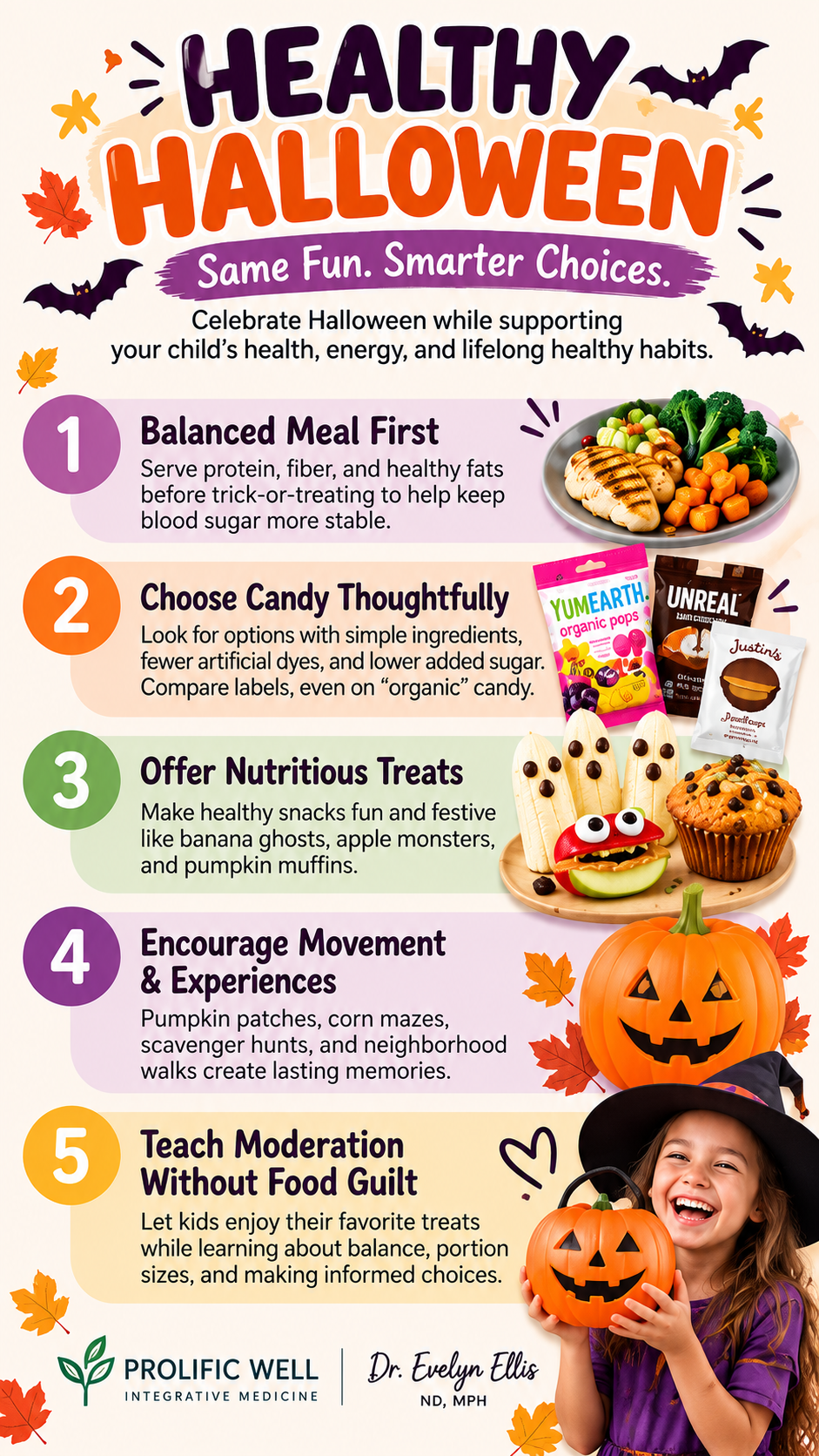
Here are 15 practical ideas to get started.
1. Understand How Much Added Sugar Children Consume
Halloween candy often contains added sugars, refined carbohydrates, artificial colors, and flavorings.
Although these ingredients do not all carry the same health risks, understanding what children consume can help parents make informed decisions.
According to the American Heart Association, children ages 2–18 should consume no more than approximately 25 grams, or 6 teaspoons, of added sugar per day.
For children younger than 2, the recommendation is to avoid added sugars.
Why does this matter?
Regularly consuming excessive amounts of added sugar may contribute to:
Increased risk of dental cavities
Excess calorie intake
Displacement of nutrient-dense foods
Unhealthy dietary patterns
Greater long-term cardiometabolic risk
However, I want to emphasize something important.
One Halloween celebration does not cause diabetes, obesity, or metabolic dysfunction. Long-term dietary patterns are much more important than a single day of eating candy.
For more information on nutrition and metabolism, explore the Prolific Well Health and Wellness Journal.
2. Choose Healthier Halloween Candy Alternatives
Parents frequently ask me which Halloween candies are better options.
Some candy brands offer products without certain artificial dyes, flavors, or common allergens.
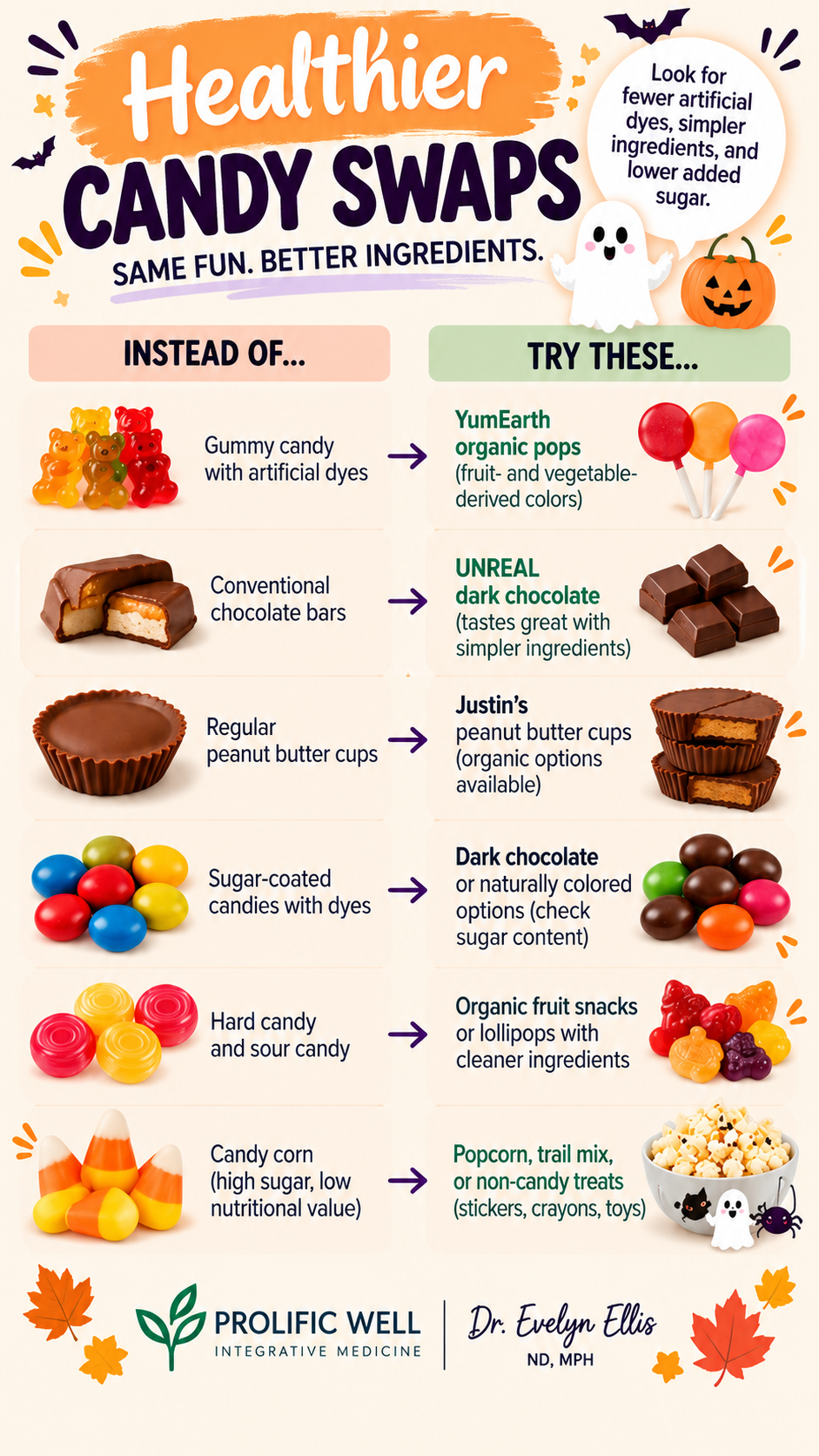
Here are several options mentioned in my Halloween educational video.
Candy or snack | What to consider |
|---|---|
YumEarth lollipops | Some products use fruit- or vegetable-derived colors and avoid high-fructose corn syrup |
UNREAL chocolate treats | Some varieties offer different ingredient profiles than conventional chocolate candies |
Justin's chocolate nut-butter cups | An alternative to conventional peanut-butter cups, with nut-allergy precautions |
Organic popcorn | A savory alternative that may provide whole grains and fiber |
Dark chocolate | Some varieties contain less added sugar than milk chocolate, depending on serving size |
Important: These products are not necessarily sugar-free or nutritionally superior in every respect. Ingredients, allergens, and sugar content vary by product and can change over time.
I recommend checking the Nutrition Facts label rather than relying exclusively on packaging claims such as "organic," "natural," or "better-for-you."
For children with food allergies, always verify the current allergen statement and manufacturing information.
3. Feed Your Kids a Blood-Sugar-Friendly Dinner Before Trick-or-Treating
One of the simplest strategies I recommend is feeding children a satisfying dinner before heading out for Halloween activities.
A balanced meal containing protein, fiber-rich carbohydrates, vegetables, and healthy fats can promote fullness and support steadier post-meal blood glucose responses.
Here are four dinner ideas:
Chicken and sweet potato bowls: Grilled or roasted chicken, sweet potatoes, and colorful vegetables.
Korean-inspired beef bowls: Lean beef, rice, sautéed vegetables, and sesame seeds when appropriate.
Healthy taco salad: Ground turkey or beans, lettuce, tomatoes, avocado, and whole-grain tortillas.
Salmon and quinoa: Baked salmon, quinoa, and roasted vegetables.
I encourage families to think about meal composition rather than simply cutting carbohydrates.
Protein, fiber, and healthy fats help make meals more satisfying. Carbohydrates can absolutely be part of a healthy eating pattern.
For a broader discussion of nutrition, metabolism, and individualized preventive medicine, read How Integrative and Functional Medicine Uncover the Root Cause of Hormone Imbalance and Chronic Fatigue.
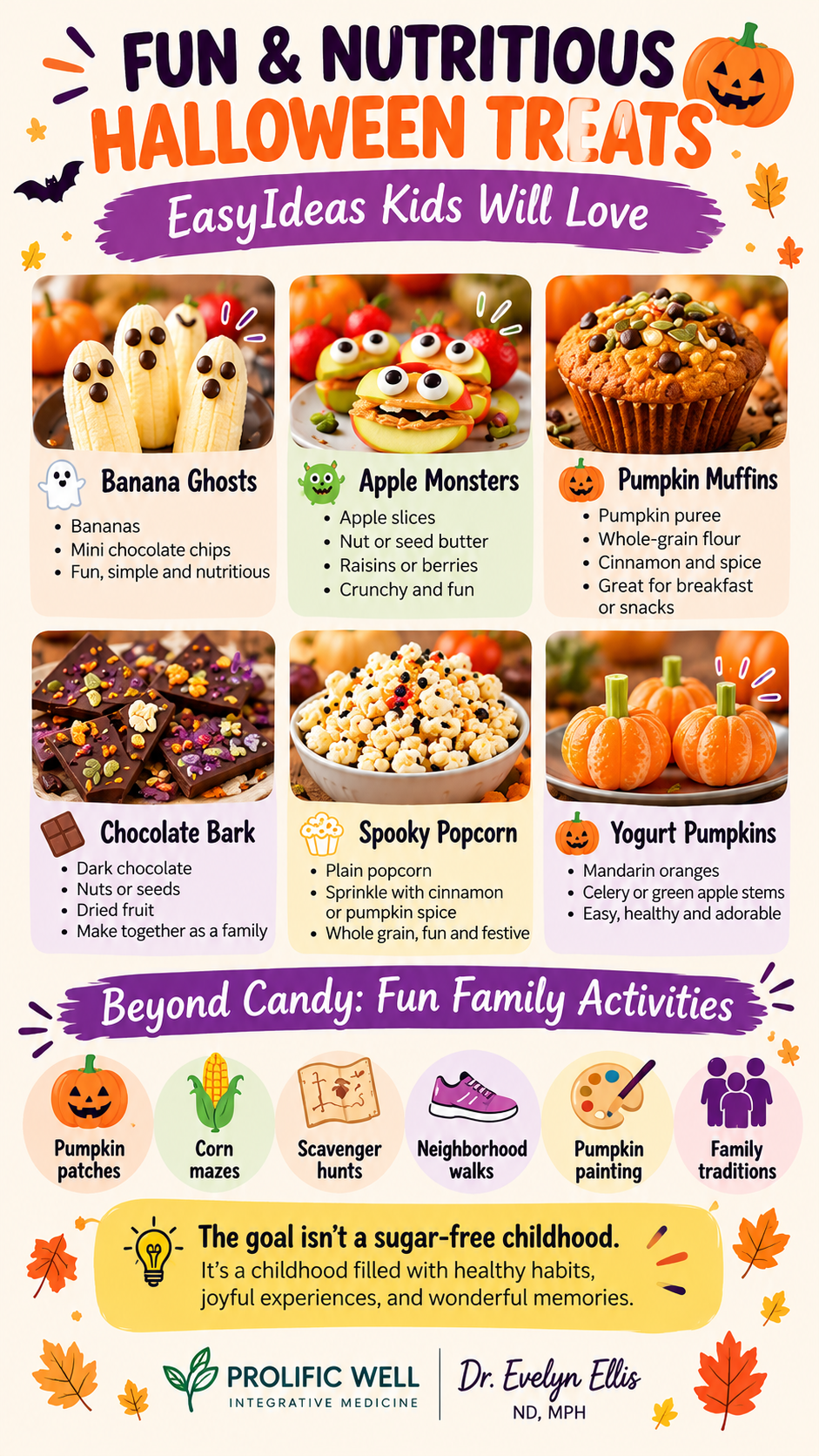
4. Make Banana Ghosts
These are among the easiest healthy Halloween treats to prepare with children.
Ingredients:
Bananas
Mini chocolate chips
Optional strawberries or blueberries
Instructions:
Peel and cut bananas in half.
Place two mini chocolate chips on each banana for eyes.
Add another chocolate chip for the mouth.
Serve immediately or refrigerate briefly.
Bananas provide carbohydrates, potassium, and some fiber. They make a fun alternative to traditional Halloween desserts.
For young children, adapt the size and texture to reduce choking risk.
5. Create Apple Monster Snacks
Apple slices can become fun Halloween treats with a little creativity.
Use sliced apples, unsweetened nut or seed butter, and small decorations such as finely chopped fruit.
Apple skins contain dietary fiber, and nut or seed butter adds fat and some protein.
Avoid whole nuts and large, sticky spoonfuls of nut butter for young children because of choking risk.
6. Bake Healthier Pumpkin Muffins
Pumpkin is one of my favorite seasonal ingredients.
Pumpkin puree provides beta-carotene, which the body can convert into vitamin A, along with fiber and other nutrients.
Try making pumpkin muffins with:
Unsweetened pumpkin puree
Whole-wheat or oat flour
Eggs
Cinnamon and pumpkin spice
A modest amount of maple syrup or another sweetener
Olive oil or another suitable baking fat
Keep in mind that honey and maple syrup still contribute added sugars. Honey should never be given to infants younger than 12 months.
Baking together is also an opportunity to teach children about ingredients, cooking skills, and the joy of preparing food.
7. Try Homemade Chocolate Treats
Homemade chocolate allows families to experiment with ingredients and sweetness levels.
Try melting dark chocolate and adding toppings such as crushed freeze-dried berries, pumpkin seeds, or shredded coconut.
Refrigerate until firm and break into small pieces.
Remember that chocolate remains an occasional treat, even when homemade.
For young children, ensure all toppings and pieces are age-appropriate.
8. Offer Savory Halloween Snacks
Not every Halloween snack needs to be sweet.
Try:
Pumpkin-spiced popcorn for older children
Roasted chickpeas
Whole-grain crackers with cheese
Vegetable sticks with hummus
Mini turkey and cheese roll-ups
Popcorn, whole nuts, and some crunchy foods pose choking hazards for young children, particularly those younger than 4.
Savory snacks can help provide variety alongside traditional Halloween treats.
9. Teach Children Moderation Without Food Guilt
Parents sometimes ask whether they should throw away Halloween candy, hide it, or exchange it for toys.
There is no single approach that works for every family.
I encourage parents to avoid making candy a source of fear, shame, or conflict.
Instead, establish reasonable expectations before trick-or-treating.
Children can help choose their favorite candies, decide when to enjoy them, and learn to recognize hunger and fullness.
Some families enjoy a voluntary candy exchange for toys or activities. Others prefer to save favorite treats and enjoy them over several days.
The important distinction is that children should not feel punished for wanting sweets.
Food education is more effective when it builds understanding, confidence, and flexibility rather than guilt.
10. Protect Children's Teeth During Halloween
From a preventive medicine perspective, oral health deserves special attention.
Sugar-containing foods can contribute to tooth decay because oral bacteria metabolize fermentable carbohydrates and produce acids that damage tooth enamel.
Sticky candies may remain on teeth, while sour candies can introduce additional acidity.
To protect dental health:
Encourage water after eating candy.
Brush twice daily using age-appropriate fluoride toothpaste.
Floss as recommended.
Avoid frequent candy grazing throughout the day.
Maintain regular dental visits.
Eating candy with or shortly after a meal may be preferable to repeatedly snacking on sweets throughout the day.
11. Give Out Non-Candy Halloween Treats
For families interested in alternatives to traditional candy, non-food treats are an excellent option.
Consider stickers, crayons, bubbles, glow bracelets, washable markers, small coloring books, or age-appropriate fidget toys.
These choices can also help make Halloween more inclusive for children with food allergies.
Avoid small toys that pose choking hazards for younger children.
12. Turn Trick-or-Treating Into Family Movement
Walking from house to house is a simple way to incorporate physical activity into Halloween.
Movement supports cardiovascular health, muscular development, coordination, and overall well-being.
You can also organize a Halloween scavenger hunt, neighborhood pumpkin walk, or family costume parade.
I often remind patients that physical activity doesn't always have to look like a structured workout.
Movement can be playful, social, and enjoyable.
13. Create Halloween Memories Beyond Candy
One of my favorite Halloween memories is exploring a corn maze and getting lost as the evening grew darker.
What stayed with me wasn't the candy. It was the excitement, adventure, and experience.
Some of the best family traditions are built around shared activities:
Visit a pumpkin patch.
Paint or carve pumpkins.
Take a hayride.
Explore a corn maze.
Roast pumpkin seeds.
Create homemade decorations.
Organize a neighborhood scavenger hunt.
These experiences encourage creativity, connection, and movement.
And they remind children that celebrations are about much more than food.
14. Use Halloween to Teach Children About Nutrition Labels
Halloween can become a practical nutrition education opportunity.
With older children, compare two candy labels together.
Look at the serving size, added sugars, ingredients, and allergen statements.
Explain that a product labeled "organic" may still contain considerable amounts of sugar.
Similarly, candy made with fruit juice concentrates or natural sweeteners can still contribute sugars.
I encourage parents to focus on understanding rather than judgment.
Children who learn to interpret nutrition labels gain useful skills they can carry into adulthood.
15. Focus on Long-Term Healthy Habits, Not One Perfect Holiday
As an integrative medicine physician, I view nutrition as one part of a much larger picture.
Metabolic health is influenced by dietary patterns, physical activity, sleep, genetics, stress, and other factors.
The goal is not to micromanage every food decision.
Instead, we want to establish consistent habits that support healthy growth, energy, and well-being.
These include eating nutrient-dense meals, staying active, maintaining adequate sleep, and developing a positive relationship with food.
For additional information about the relationship between metabolic health and the body's regulatory systems, read Hormone Imbalance Symptoms in Women and Men: 30 Warning Signs You Shouldn't Ignore.
Watch the Video: Healthy Halloween Treats, Candy Swaps & Family Activities
In my Halloween video, I walk through healthier candy options, simple homemade snacks, family traditions, and strategies for enjoying the holiday without making sugar the center of every celebration.
Watch Healthy Halloween Treats & Candy Swaps for Kids on YouTube
You can also explore more evidence-informed educational videos on my YouTube channel, Dr. Evelyn Ellis.
Frequently Asked Questions About Healthy Halloween
What are the healthiest Halloween candies for kids?
No candy is universally the healthiest. Parents can compare added sugar, portion size, ingredients, and allergens. Some families prefer products without synthetic food dyes or certain additives, but these products can still contain substantial sugar.
Is organic Halloween candy better than regular candy?
Organic certification addresses certain production standards. It does not necessarily mean a candy contains less sugar or provides greater nutritional value. Compare the Nutrition Facts labels.
How much Halloween candy should children eat?
There is no universally recommended number of pieces for Halloween. Appropriate amounts depend on age, dietary needs, candy size, and overall eating patterns. Parents can establish flexible boundaries without encouraging guilt or excessive restriction.
Can eating too much Halloween candy cause diabetes?
A single episode of eating Halloween candy does not cause diabetes. Type 1 diabetes is an autoimmune condition, while type 2 diabetes develops through multiple interacting factors, including genetics and metabolic health.
Long-term dietary habits are more relevant than one holiday.
What should kids eat before trick-or-treating?
A balanced dinner containing protein, fiber-rich carbohydrates, vegetables, and healthy fats can help children feel satisfied before Halloween activities.
What are some Halloween treats without candy?
Try banana ghosts, pumpkin muffins, fruit snacks, age-appropriate popcorn, stickers, crayons, bubbles, and other non-food alternatives.
How can parents reduce Halloween sugar without restricting children?
Offer balanced meals, provide water, discuss nutrition in age-appropriate language, and establish reasonable family routines. Avoid using food as punishment or creating guilt around sweets.
Are artificial food dyes dangerous for children?
Some studies suggest certain synthetic food dyes may affect behavior in susceptible children. However, evidence varies by dye, exposure, and individual response. Parents concerned about behavioral sensitivity can review ingredient labels and discuss concerns with their child's clinician.
What Halloween candies are better for dental health?
Candies that dissolve or clear from the mouth relatively quickly may be preferable to sticky or highly acidic candies. Frequency of sugar exposure, oral hygiene, and fluoride use are also important.
What are healthy Halloween activities for families?
Pumpkin carving, corn mazes, scavenger hunts, neighborhood walks, costume contests, and seasonal cooking are enjoyable alternatives to activities centered entirely on candy.
Final Thoughts From Dr. Evelyn
Halloween is an opportunity to celebrate childhood, creativity, and family traditions.
It can also be a meaningful time to teach children about nutrition, food choices, and moderation.
I don't believe families need to eliminate every sweet treat to live healthfully.
Instead, I encourage small, sustainable habits that help children understand how to nourish their bodies while enjoying life's celebrations.
Healthy living is about rhythm, not perfection.
Wishing you and your family a joyful, safe, and healthy Halloween.
About Dr. Evelyn Ellis, ND, MPH
Dr. Evelyn Ellis is a licensed naturopathic physician and founder of Prolific Well Integrative Medicine in Olympia, Washington.
She holds a Doctor of Naturopathic Medicine degree from Bastyr University and a Master of Public Health from the University of Washington.
Her work focuses on preventive medicine, clinical nutrition, metabolic health, hormone health, and healthy aging through individualized, evidence-informed care.
Explore more educational resources at Prolific Well.
References
Vos MB, et al. Added Sugars and Cardiovascular Disease Risk in Children: A Scientific Statement From the American Heart Association. Circulation. 2017;135–e1034. https://doi.org/10.1161/CIR.0000000000000439
World Health Organization. Guideline: Sugars Intake for Adults and Children. 2015. WHO guideline
Centers for Disease Control and Prevention. Get the Facts: Added Sugars.CDC nutrition resources
American Academy of Pediatric Dentistry. Policy on Dietary Recommendations for Infants, Children, and Adolescents.AAPD oral health recommendations
American Academy of Pediatrics. HealthyChildren.org: Healthy Eating and Nutrition.HealthyChildren.org
U.S. Department of Agriculture. MyPlate.https://www.myplate.gov
Medical disclaimer: This article is for educational purposes and does not replace individualized medical advice. Children with diabetes, food allergies, swallowing difficulties, or specific nutritional needs may require individualized guidance.


