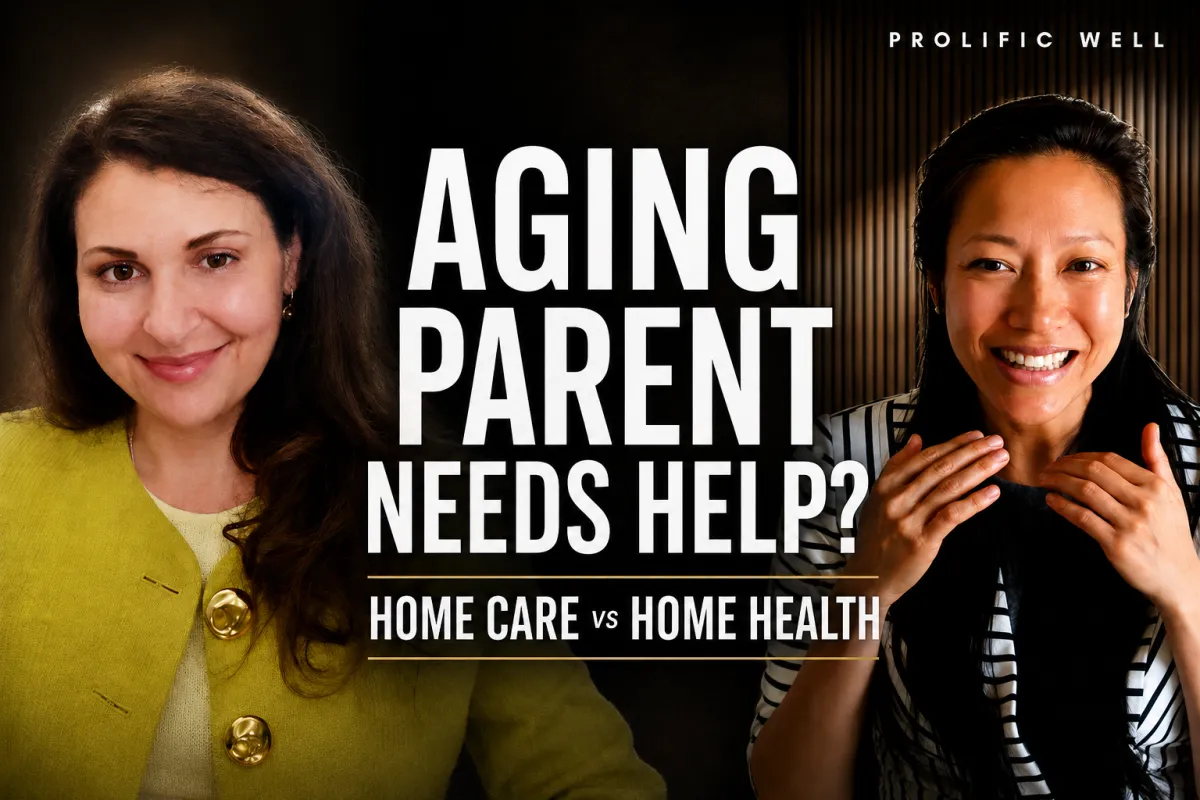
Aging Parent Needs Help? How to Choose the Right Care Before a Crisis Happens
Watching a parent, grandparent, or other loved one need more help is rarely a simple transition.
I have experienced this personally in my own family. My grandparents and extended relatives have faced decisions around nursing homes, hospice, increasing care needs, and whether someone could safely remain at home.
Those decisions are never just medical.
They involve independence, safety, finances, culture, caregiver capacity, family dynamics, and the wishes of the person you love.
That is why I wanted to have this conversation with Natalya Rubel, founder and CEO of ABOVE Home Health, who has spent more than 30 years working in senior care.
In our podcast conversation, we discussed a question many families eventually face:
How do you know when an aging parent needs help, and what type of help is actually appropriate?
This conversation also connects closely with something I talk about often in my own work: healthy aging is not simply about adding more years to life. It is about preserving function, cognition, independence, energy, and quality of life for as long as possible.
If you are thinking more broadly about healthy aging and long-term vitality, you may also want to explore my articles on brain health and healthy aging and how to build sustainable energy, metabolism, and hormone balance.
Home Care vs. Home Health: What Is the Difference?
One of the first areas families get confused about is the difference between home care and home health.
They sound similar, but they are not interchangeable.
Home care generally focuses on practical, non-medical support at home. That may include:
Personal care
Meal preparation
Companionship
Mobility assistance
Transportation
Support with daily routines
Home health generally refers to healthcare services provided in the home when medically appropriate.
The important question is not simply:
“Is someone coming to the house?”
The better question is:
“What does this person actually need during the hours when no professional is there?”
A medical professional may visit for a specific service, but that does not automatically solve problems with bathing, meals, medication organization, nighttime safety, mobility, or caregiver exhaustion.
Families need to look at the whole picture.
That same whole-person perspective is central to how I approach health in my own practice. Symptoms rarely exist in isolation. Energy, cognition, hormones, stress, mobility, nutrition, sleep, and social support all influence function over time. You can read more about that approach in my article on how integrative and functional medicine look for root causes instead of isolated symptoms.
Warning Signs an Aging Parent May Need More Help
Loss of independence usually does not happen all at once.
It often happens gradually.
That is why the early signs can be easy to dismiss.
Some warning signs we discussed include:
Unopened mail piling up
Bills becoming disorganized
Missed or mixed-up medications
Difficulty preparing meals
Changes in hygiene
Falls or near-falls
Increasing confusion
Social withdrawal
Difficulty with bathing or dressing
Repeated emergency-room visits
A spouse or adult child becoming exhausted from caregiving
Sometimes the clearest warning sign is not the older adult.
Sometimes it is the caregiver.
A spouse or adult child may quietly absorb more and more responsibility until the entire household is structured around keeping one person functioning.
That is not sustainable indefinitely.
One question families may need to ask is:
Are we preserving independence, or are we asking someone to manage more than they can safely manage?
Those are not the same thing.
The First 24 to 72 Hours After Hospital Discharge Matter
A hospital discharge can sound like the problem is over.
Often, it is simply the beginning of the next phase.
An older adult may be medically stable enough to leave the hospital but still be weaker, more confused, less mobile, or more dependent than they were before hospitalization.
Their medications may also have changed.
Their ability to prepare food may have changed.
Their ability to get to the bathroom safely may have changed.
Their cognition may have changed.
This is why I think every family should ask one practical question before discharge:
What will the first 24 to 72 hours at home actually look like?
Not theoretically.
Practically.
Who will be there?
Who understands the medication changes?
Can this person safely get out of bed?
Can they prepare meals?
Can they use the bathroom at night?
Can they manage stairs?
Who will take them to follow-up appointments?
What happens if they are discharged on a Friday evening or holiday weekend?
A discharge plan on paper is only useful if someone can realistically carry it out at home.
Healthy Aging Is About Function, Not Just Longevity
We talk a lot about longevity now.
But longevity without function is not the goal.
What most people really want is to be able to think clearly, move independently, make decisions, participate in relationships, and remain engaged in life.
That is why brain health becomes so important as we age.
I have written extensively about the relationship between cognition, hormones, stress, energy, and aging. If this is an area you are thinking about for yourself or your family, explore my brain health articles.
You may also find my article Midlife Isn’t a Crisis: How Women 45+ Can Reclaim Purpose, Confidence, and Their Heart’s Calling helpful because healthy aging is not only biological. Identity, purpose, emotional resilience, and connection matter too.
Accepting Help Does Not Mean Losing Independence
One of the most important ideas from my conversation with Natalya was this:
Getting help does not automatically mean losing independence.
Many older adults understandably resist support.
They may say:
“I’m fine.”
“I don’t need anyone.”
“I’ve always taken care of myself.”
“I want to stay in my home.”
That resistance makes sense.
For many people, accepting help feels like admitting decline.
But there is another way to look at it.
The right amount of support may actually allow someone to remain independent longer.
Natalya discussed flexible options such as NoMi short visits, where someone may receive specific assistance without committing to a traditional multi-hour caregiving shift.
That is an important reminder:
Senior care is not always all-or-nothing.
There may be many options between complete independence and moving into a facility.
Dementia Care Is Also Caregiver Care
Dementia changes the entire family dynamic.
The person experiencing cognitive decline may not fully recognize how much their abilities have changed.
At the same time, a spouse or adult child may slowly become a full-time caregiver.
Medication management.
Meals.
Transportation.
Appointments.
Bathing.
Supervision.
Nighttime awakenings.
Household responsibilities.
Emotional support.
Each individual task may sound manageable.
Together, they can become overwhelming.
Natalya and I also discussed GUIDE dementia respite support through eligible partnerships.
The larger lesson is that caregiver support is not optional.
Caregivers need opportunities to rest, attend to their own health, maintain employment, spend time with other family members, and step temporarily out of the caregiver role.
Supporting the caregiver is part of supporting the person with dementia.
This topic is particularly meaningful to me because my own interest in brain health and longevity was deeply influenced by watching dementia affect my family. That experience continues to shape the way I think about prevention, cognition, and healthy aging.
Stress, Fatigue, and Caregiving Can Affect the Whole Body
Caregiving is not only emotionally demanding.
It can affect sleep, energy, eating patterns, stress regulation, mood, and overall health.
I often teach that chronic stress does not stay neatly inside the mind. It affects the nervous system, metabolism, hormones, energy, and behavior.
If you are a caregiver who feels exhausted, wired, depleted, or unable to recover, I recommend reading my article on why fatigue can persist and how stress, the nervous system, metabolism, and blood sugar influence energy.
For additional mind-body support, you may also find my conversation on Qi Gong, Reiki, nervous-system regulation, and coming back to your body useful. That episode explores gentle approaches to stress recovery and whole-person health.
When Should Assisted Living or Memory Care Be Considered?
Most older adults want to remain at home for as long as possible.
That is understandable.
But eventually, there may be a point when home is no longer the safest environment.
Some factors families may need to consider include:
Falls
Wandering
Increasing confusion
Nighttime supervision needs
Medication errors
Inability to perform basic activities of daily living
Caregiver burnout
Social isolation
Increasing medical complexity
These decisions can be painful.
I have experienced versions of them in my own extended family.
There may be guilt.
There may be disagreement among siblings.
There may be cultural expectations about who should provide care.
There may be financial concerns.
And there may be a deep fear that choosing assisted living, memory care, nursing care, or hospice means giving up.
A better question may be:
Where can this person receive the level of support they now need while preserving as much dignity, safety, connection, and quality of life as possible?
That is very different from simply asking:
“Should they stay home?”
Do Not Wait for a Crisis to Learn Your Options
Perhaps the most important takeaway from this conversation is that families should understand senior-care options before they desperately need them.
Know the difference between home care and home health.
Ask your parents what matters to them as they age.
Talk about finances.
Know who has medical and financial decision-making authority.
Pay attention to changes in cognition and function.
Understand what staying at home would realistically require.
Learn about caregiver respite.
Know when assisted living, memory care, nursing care, or hospice may need to enter the conversation.
And know who you would call if circumstances changed tomorrow.
These conversations can feel premature when everyone is healthy.
They feel very different when you are standing in a hospital hallway and someone tells you your parent is being discharged in three hours.
Preparation does not eliminate difficult decisions.
It gives families more room to make those decisions thoughtfully.
My Takeaway: Add Life to the Years
For me, healthy aging has never been simply about chasing a number.
It is about adding more life to the years.
That means protecting cognition.
Maintaining strength.
Preserving mobility.
Supporting relationships.
Managing chronic disease.
Maintaining purpose.
And getting the right level of support when circumstances change.
Sometimes asking for help is not a loss of independence.
Sometimes it is exactly what protects independence.
Watch the Full Podcast Conversation
In the full episode, Natalya Rubel and I discuss:
Home care vs. home health
Warning signs an aging parent needs help
Hospital-to-home transitions
The critical first 24 to 72 hours after discharge
Private-duty nursing
NoMi short visits
Dementia respite support
Caregiver stress
Assisted living and memory care
What families can do when they simply do not know where to start
Watch the full episode:
You can also explore more conversations on healthy aging, brain health, hormones, longevity, and integrative medicine on my YouTube channel.
About Natalya Rubel
Natalya Rubel is the founder and CEO of ABOVE Home Health, a Washington-licensed home health and home care agency. She helps older adults and families understand care options and put appropriate support in place before a manageable situation becomes a crisis.
Learn more at abovehh.com.


